Six months ago I would have told anyone building a new L1 in 2025 that they were wasting time.
Every serious developer I know either builds on Ethereum or picks an established L2. The infrastructure is there. The liquidity is there. Starting fresh feels like choosing to swim upstream when there is a perfectly good current available.
Then I read through Dusk's whitepaper properly and that confidence started cracking.
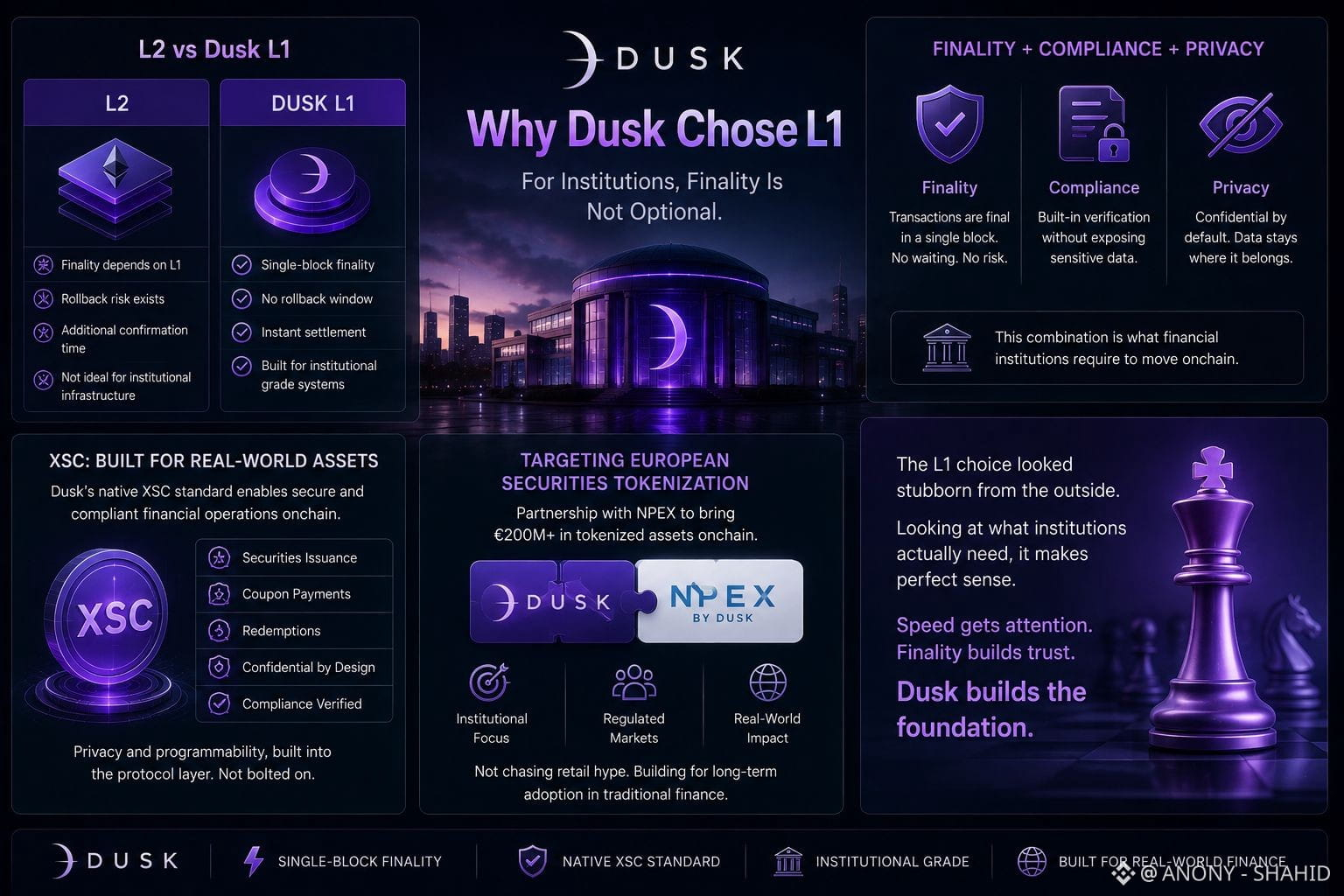
Layer 2 solves throughput. It does not solve finality dependence. Every L2 transaction ultimately settles on L1, which means rollback risk exists until that L1 confirmation lands. For retail traders that risk is acceptable. For a brokerage back office running risk control systems, a transaction that might get rolled back is a compliance problem that cannot be coded around cleanly.
Single-block finality on @Dusk means settlement is final the moment it confirms. No waiting for additional confirmations. No rollback window. For institutional financial infrastructure that distinction is not a nice-to-have.
The native XSC contract standard is the other piece that L2 cannot replicate easily. Securities issuance, coupon payments, and redemptions running with built-in confidentiality while keeping compliance verification intact requires privacy and programmability working together at the protocol level. Bolting that onto an L2 forces tradeoffs that break either the privacy or the compliance layer.
Dusk is targeting European securities tokenization specifically. The NPEX partnership for 200 million euro plus in tokenized assets reflects that institutional focus. This is not a project chasing retail volume or TPS rankings.
The L1 decision looked stubborn from the outside. Looking at what financial institutions actually need, it reads differently now.
Speed alone does not close institutional deals. Finality, compliance, and privacy together do.
#dusk $DUSK #Binance
Every serious developer I know either builds on Ethereum or picks an established L2. The infrastructure is there. The liquidity is there. Starting fresh feels like choosing to swim upstream when there is a perfectly good current available.
Then I read through Dusk's whitepaper properly and that confidence started cracking.
Layer 2 solves throughput. It does not solve finality dependence. Every L2 transaction ultimately settles on L1, which means rollback risk exists until that L1 confirmation lands. For retail traders that risk is acceptable. For a brokerage back office running risk control systems, a transaction that might get rolled back is a compliance problem that cannot be coded around cleanly.
Single-block finality on @Dusk means settlement is final the moment it confirms. No waiting for additional confirmations. No rollback window. For institutional financial infrastructure that distinction is not a nice-to-have.
The native XSC contract standard is the other piece that L2 cannot replicate easily. Securities issuance, coupon payments, and redemptions running with built-in confidentiality while keeping compliance verification intact requires privacy and programmability working together at the protocol level. Bolting that onto an L2 forces tradeoffs that break either the privacy or the compliance layer.
Dusk is targeting European securities tokenization specifically. The NPEX partnership for 200 million euro plus in tokenized assets reflects that institutional focus. This is not a project chasing retail volume or TPS rankings.
The L1 decision looked stubborn from the outside. Looking at what financial institutions actually need, it reads differently now.
Speed alone does not close institutional deals. Finality, compliance, and privacy together do.
#dusk $DUSK #Binance