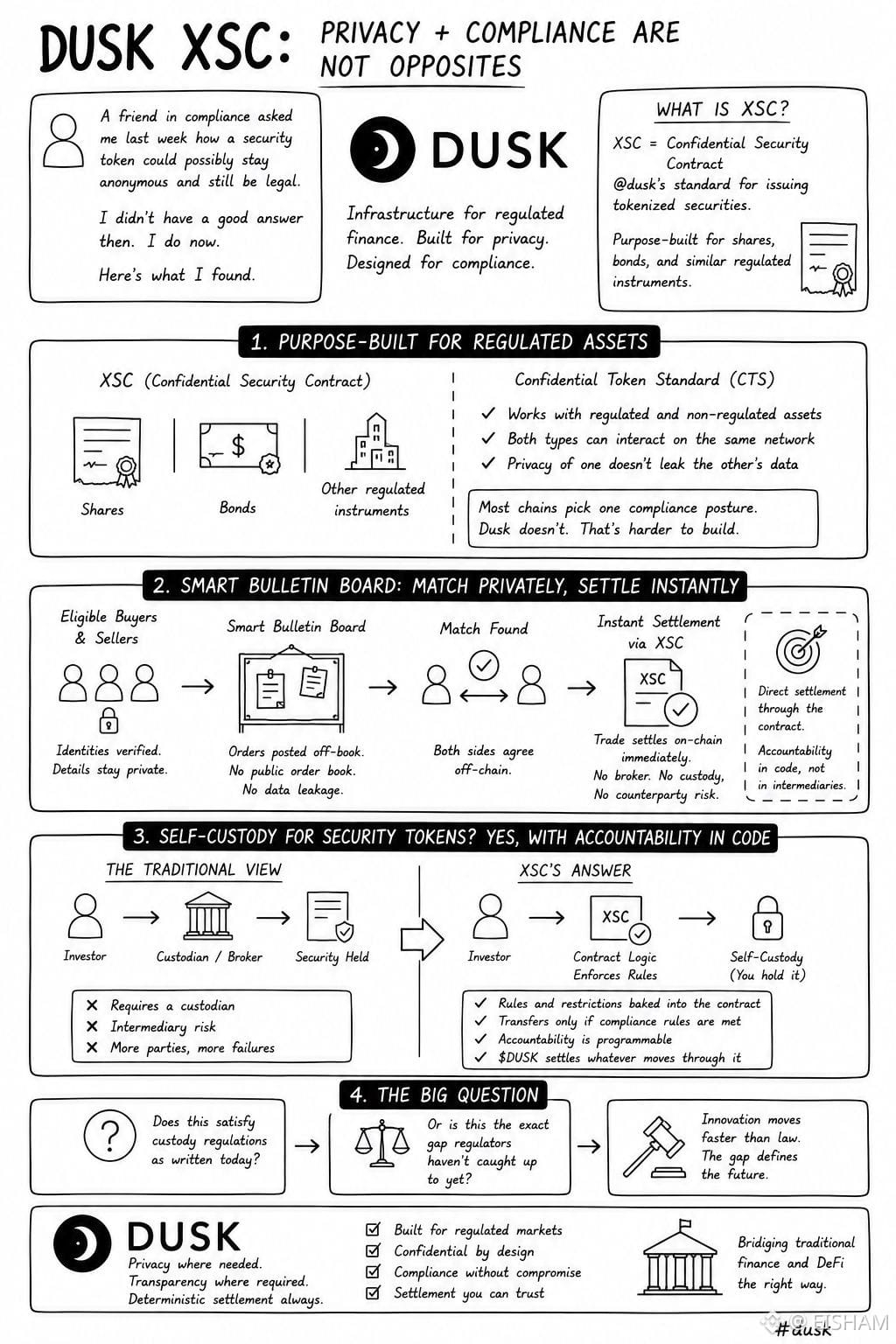
a friend in compliance asked me last week how a security token could possibly stay anonymous and still be legal. I didn't have a good answer then. I do now, after reading into how Dusk's XSC standard actually works.
XSC, Confidential Security Contract, is the standard @Dusk designed specifically for issuing tokenized securities — not a generic token template, a purpose-built structure for shares, bonds, and similar regulated instruments.
One piece I hadn't seen mentioned much:
Dusk pairs it with a separate Confidential Token Standard, built so regulated and non-regulated assets can interact on the same network without either side leaking the other's privacy. That's a harder problem than it sounds — most chains just pick one compliance posture for everything.
the mechanism I found genuinely clever is the Smart Bulletin Board. Instead of a public order book broadcasting every bid, eligible buyers and sellers get matched indirectly, and once both sides agree, the trade settles instantly through the XSC contract itself — no broker holding custody in between, no counterparty risk sitting in some intermediary's ledger.
self-custody for a security token sounds almost contradictory on paper, since securities usually require someone accountable for custody. XSC's answer is putting that accountability into the contract logic instead of a person.
$DUSK settles whatever moves through it. Does that actually satisfy custody regulations as written today, or is that the exact gap regulators haven't caught up to yet?
#dusk $DUSK @Dusk
XSC, Confidential Security Contract, is the standard @Dusk designed specifically for issuing tokenized securities — not a generic token template, a purpose-built structure for shares, bonds, and similar regulated instruments.
One piece I hadn't seen mentioned much:
Dusk pairs it with a separate Confidential Token Standard, built so regulated and non-regulated assets can interact on the same network without either side leaking the other's privacy. That's a harder problem than it sounds — most chains just pick one compliance posture for everything.
the mechanism I found genuinely clever is the Smart Bulletin Board. Instead of a public order book broadcasting every bid, eligible buyers and sellers get matched indirectly, and once both sides agree, the trade settles instantly through the XSC contract itself — no broker holding custody in between, no counterparty risk sitting in some intermediary's ledger.
self-custody for a security token sounds almost contradictory on paper, since securities usually require someone accountable for custody. XSC's answer is putting that accountability into the contract logic instead of a person.
$DUSK settles whatever moves through it. Does that actually satisfy custody regulations as written today, or is that the exact gap regulators haven't caught up to yet?
#dusk $DUSK @Dusk