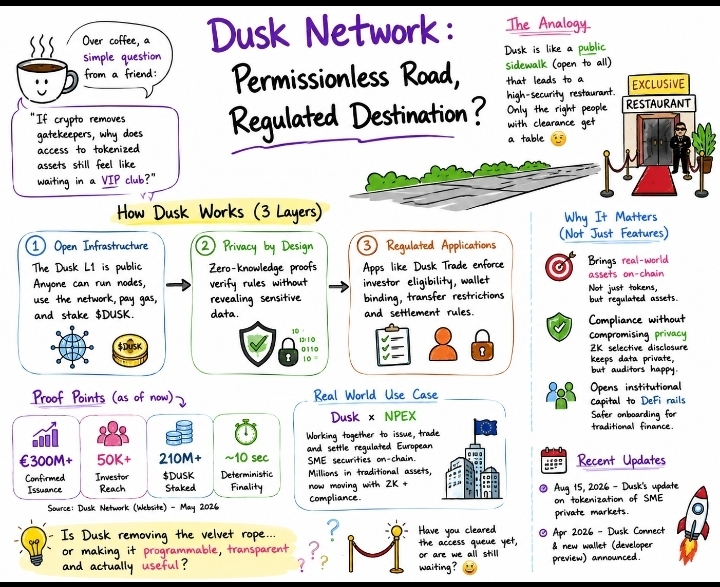
A friend asked me over coffee: “If crypto is supposed to remove financial gatekeepers, why does getting access to tokenized assets still feel like waiting outside a VIP club?” ☕
That question sent me back into @Dusk , and I realized I’d made a basic mistake: permissionless infrastructure doesn’t mean permissionless access to every asset.
Think of Dusk like a public road leading to a regulated financial district.
Step 1: anyone can use the underlying network infrastructure.
Step 2: zero-knowledge proofs can verify that transactions follow the rules without exposing every sensitive detail.
Step 3: the application layer can enforce investor eligibility, transfer restrictions and compliance around regulated securities.
That last part is where things get interesting.
Dusk currently reports €300M+ in confirmed issuance, 50K+ investor reach, 210M+ DUSK staked and roughly 10-second deterministic finality.
$DUSK itself is used for gas and staking, but holding it obviously doesn’t automatically give someone access to regulated securities.
The NPEX connection makes this more tangible.
NPEX is a regulated Dutch SME exchange, and Dusk is working with it on DLT-based issuance, trading and settlement.
Their partnership has already explored moving regulated European securities on-chain, alongside Chainlink infrastructure for interoperability and data.
And Dusk’s latest August update made me rethink the thesis again: tokenization doesn’t magically create liquidity.
It has to connect issuers, eligible investors, pricing, payments and settlement.
So maybe the real breakthrough isn’t removing the velvet rope.
It’s making the rope programmable enough that regulated finance can finally operate on shared infrastructure.
But can Dusk turn that infrastructure into a market people actually use? 🤔
#dusk
That question sent me back into @Dusk , and I realized I’d made a basic mistake: permissionless infrastructure doesn’t mean permissionless access to every asset.
Think of Dusk like a public road leading to a regulated financial district.
Step 1: anyone can use the underlying network infrastructure.
Step 2: zero-knowledge proofs can verify that transactions follow the rules without exposing every sensitive detail.
Step 3: the application layer can enforce investor eligibility, transfer restrictions and compliance around regulated securities.
That last part is where things get interesting.
Dusk currently reports €300M+ in confirmed issuance, 50K+ investor reach, 210M+ DUSK staked and roughly 10-second deterministic finality.
$DUSK itself is used for gas and staking, but holding it obviously doesn’t automatically give someone access to regulated securities.
The NPEX connection makes this more tangible.
NPEX is a regulated Dutch SME exchange, and Dusk is working with it on DLT-based issuance, trading and settlement.
Their partnership has already explored moving regulated European securities on-chain, alongside Chainlink infrastructure for interoperability and data.
And Dusk’s latest August update made me rethink the thesis again: tokenization doesn’t magically create liquidity.
It has to connect issuers, eligible investors, pricing, payments and settlement.
So maybe the real breakthrough isn’t removing the velvet rope.
It’s making the rope programmable enough that regulated finance can finally operate on shared infrastructure.
But can Dusk turn that infrastructure into a market people actually use? 🤔
#dusk