
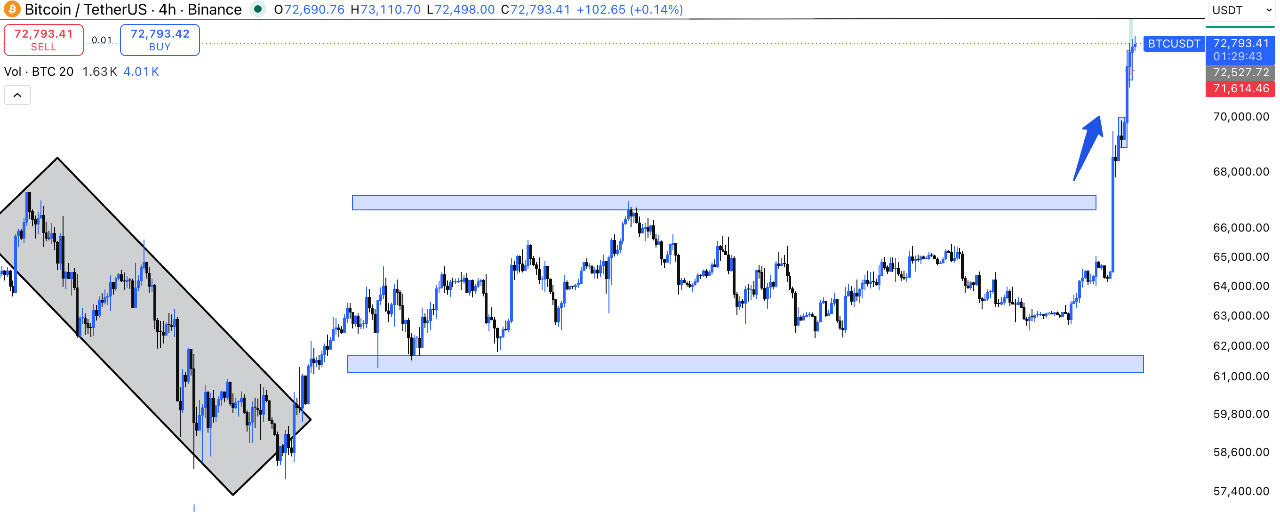

Bitcoin is sitting just over $71K as I write this. Up double digits on the day. First time above $70K since June, and the timeline has already made up its mind about why.
"Stealth QE." "Printer's back." "Treasury just green lit the bull run."
Cool. Now go read the actual document.
Because the press release everyone screenshotted on Wednesday is not the story. The story is in a set of meeting minutes published two weeks earlier that got almost zero engagement, and once you read it, the $70K candle stops looking like a rally and starts looking like a receipt.
Let me walk you through it.
What actually got announced
August 19. Treasury puts out a release saying it's increasing the size of its long-end liquidity support buybacks. The maximum per operation goes from $2 billion to at least $4 billion, covering the 10 year to 20 year and 20 year to 30 year sectors. Effective September 9. Runs through November 4.
That's it. That's the whole thing. A few paragraphs on a government website.
The bond market moved inside minutes. The 30 year yield had touched 5.337% the day before, which is the highest it's been since 2007, and it dropped roughly 9 basis points on the news. The 10 year came down to about 4.647%.
Then crypto did what crypto does when somebody yanks the long end down. BTC ripped 8.2% from around $64,100. ETH reclaimed $2,000 and change. SOL and XRP both put in 6% plus days.
And the liquidation engine did the rest. Around $1.44 billion in shorts got wiped in 24 hours. About $1.29 billion of that closed inside sixty minutes. Roughly 110,000 positions gone. Biggest short wipeout in the data going back to 2021.
So yeah. Big candle. Everyone saw it.
Almost nobody read the minutes.
The number nobody clipped
On August 4, the Treasury Borrowing Advisory Committee met. TBAC is the group of dealers and asset managers that advises Treasury on how America actually funds itself. Their minutes get published. They're free. They're boring. Nobody reads them.
Buried in the fiscal section of the August 4 minutes is this: based on median primary dealer forecasts, Treasury is looking at a $1.45 trillion funding shortfall across FY2027 and FY2028 if coupon auction sizes and bill supply stay where they are.
One point four five trillion. That's the gap.
Now here's the part that should make you sit up. Later in that same meeting, the Committee turned to its financing recommendation and unanimously told Treasury to keep nominal coupon, floating rate note and TIPS auction sizes exactly where they are.
Read those two things back to back.
There's a $1.45T hole. And the recommendation is do not issue more long paper.
So where does the money come from?
The minutes answer that too. Dealer consensus is that current coupon sizes cover Treasury through the rest of FY2026, with changes in Treasury bill supply likely being adequate to handle whatever comes up. Bills. Short dated paper. That's the plan, written down, in a public document, signed and certified.
Now the buyback makes sense
Put the two documents next to each other and the picture changes completely.
Treasury is buying back long bonds. Treasury is not increasing long bond issuance. Treasury is funding the gap with bills.
That is not money printing. Nothing gets created. The debt doesn't shrink by a single dollar. What changes is duration. The government is quietly rolling its own liability structure from the long end to the short end.
Which, if you strip the suits off it, is the same expression as being long BTC against a debasing currency. Except it's being run by the issuer of the currency.
The people who print the dollar do not want to own thirty year dollar risk. Sit with that one for a second, fam.
And it gets better. Same minutes, different section. Dealers were asked about the long run composition of the Fed's portfolio, the SOMA book. Consensus expectation: over the long run, SOMA moves toward holding only Treasury securities with substantially shorter duration and a higher allocation to T-bills than it holds today.
So Treasury is shortening. And the Fed's book is expected to shorten. Both sides of the world's most important balance sheet drifting toward the front end at the same time.
Nobody wants the long end. Not even the two institutions that manufacture it.
The part where they told themselves not to do this
Here's my favorite detail, and it's the one that turns this from analysis into something with teeth.
TBAC has been on record about buybacks before. Their position was that buybacks are useful when they're fixing genuine market liquidity problems, and not useful if they're being used to change the debt profile. The Committee said plainly that issuance is the primary tool for managing the debt profile. They also cautioned against buybacks becoming a political instrument.
Now look at the August 19 press release again. Treasury doubles long-end buybacks. One day after the 30 year hits a nineteen year high. The stated reason is "liquidity support" in sectors with "consistent strong sponsorship."
Strong sponsorship. Meaning: plenty of people want to sell us these bonds.
I'm not saying anyone lied. I'm saying when you do the thing your own advisory committee told you not to do, and you use the exact vocabulary that makes it sound like the other thing, that's worth noticing. The market noticed within nine basis points.
The constraint underneath all of it
Why does any of this exist? Interest.
Through the first ten months of FY2026, net interest payments came in around $963 billion. CBO has the full year landing near a trillion. Roughly 15% of all federal spending.
That's the same order of magnitude as the base defense appropriation. On debt service. That's the whole game.
The August 4 minutes show it in the raw data too. Outlays at the Department of Treasury itself rose $120 billion, about 10%, and the reason given is higher gross interest from higher levels of debt. The biggest single outlay increase in the report is the cost of the debt.
Once interest expense is that large a share of spending, the long end of the curve stops being a market price and starts being a budget line. And budget lines get managed.
That's the environment we're all trading in now, whether you follow bonds or not. Bitcoin isn't rallying because a committee likes it. Bitcoin is rallying because the entity on the other side of the world's reserve asset is visibly managing its own duration risk, and some people would rather hold something with no counterparty on the other side.
Gold's noticed. Central banks bought 288.9 tonnes in Q2 2026, up 62% year over year, strongest second quarter on record. And they bought it into a falling price. That's not momentum chasing. That's positioning.
The line I keep coming back to
Second charge in those same minutes was intraday repo. Dry stuff. Plumbing.
And in the middle of it, the Committee discussed how blockchain technology and tokenization could improve intraday liquidity in the Treasury market.
Not a startup deck. Not a conference panel. Not a founder on a podcast. The committee that advises the United States on how it finances itself, discussing tokenized collateral as infrastructure, in certified minutes.
If you've been building the RWA thesis, that's your citation. Everything else is commentary.
Members did add that the effects on reserve demand, funding rates and Treasury trading need more work before anyone moves. Fine. That's how these things always read right before they happen.
Okay so what's real and what's mechanical
I'm not going to sell you a bull case I don't fully hold. Here's the honest split.
What's real: spot BTC ETFs took in roughly $1 billion in net inflows across the first two weeks of August. August 19 alone did about $517 million, strongest single day since May. Those flows were building before the Treasury headline. That's allocation, not reaction.
What's mechanical: most of the size in that candle was short covering. $1.29 billion in one hour is not conviction buying, that's forced buying. And you cannot liquidate the same 110,000 positions twice. That fuel is spent.
What's fragile: the buyback expansion runs through November 4 and then Treasury reassesses at the next Quarterly Refunding. If long end yields have calmed down by then, there is zero guarantee the bigger operation size continues. This is a window, not a regime.
What's telling: the Fear and Greed index sat at 52 during the whole move. Dead neutral. Retail is not in this. Which is either bullish because there's fuel left, or a warning that nobody believes it yet. Depends on your read.
And BTC is still roughly 43% below the $126K all time high from October 2025. We are not in a bull market. We are in a range that got its ceiling raised.
Levels and the calendar
The consolidation that had held for weeks was roughly $62K to $66K. That broke through the $66.5K to $67K supply zone and hasn't looked back yet. $70K to $70.5K was psychological resistance and it's now underneath us, which makes it the first real test on any pullback.
If we lose $67K and close below it, the whole thing was a squeeze and nothing more. If $70K holds as support on a retest with actual spot volume behind it, then organic demand took the baton from short covering, and that's a different market.
Above here, the next Fibonacci cluster analysts are watching sits around $72.1K.
Dates that actually matter:
August 27 to 29: Jackson Hole. Theme this year is literally "Financial Innovation: Implications for Payments and Policy."
August 28: Kevin Warsh's first keynote as Fed Chair. This is the one.
September 9: buybacks go live at the new $4B size.
September 15: CLARITY Act cloture vote.
September 16: FOMC.
November 4: Quarterly Refunding. Buyback size gets reassessed.
That Warsh speech is the risk nobody's pricing properly. He came in on a "monetary barbell" framework, pragmatic on short rates and aggressive on quantitative tightening to shrink a $6.6 trillion balance sheet. At the July 29 meeting the vote was 9 to 3, and all three dissenters wanted a hike, not a cut.
So you've got Treasury easing the long end while the Fed leans on the short end. Those two things do not point the same direction. September hike odds are hovering around one in three.
If Warsh stands up on the 28th and pushes back on the idea that fiscal policy is doing the easing for him, this move gets tested fast.
Where I actually stand
Constructive, not euphoric.
The structural read is genuinely bullish and it's bullish for boring reasons. A sovereign shortening its own duration, a central bank portfolio expected to do the same, a trillion dollar interest bill, and a debt load headed for $40 trillion. That's the backdrop scarce assets were built for. Grayscale's research head is out saying the summer low near $58K may have been the bottom, and I don't think that's a crazy position.
The tactical read says most of Wednesday was liquidation mechanics with a real but smaller bid underneath, in a window that closes November 4, three days before a Fed chair who dislikes easy money speaks for the first time.
Both can be true. They are true.
Size accordingly. Don't chase green candles into resistance. And go read the minutes yourself, they're public and they're free, which is the funniest part of this whole thing ♥️
DYOR.