#dusk $DUSK @Dusk
I've spent the first few days looking at the infrastructure behind @Dusk, but today I wanted to focus on what happens when tokenized assets actually need a market.
Because creating a regulated token is one thing.
Giving that token somewhere useful to trade is another.
This is where Dusk Trade caught my attention.
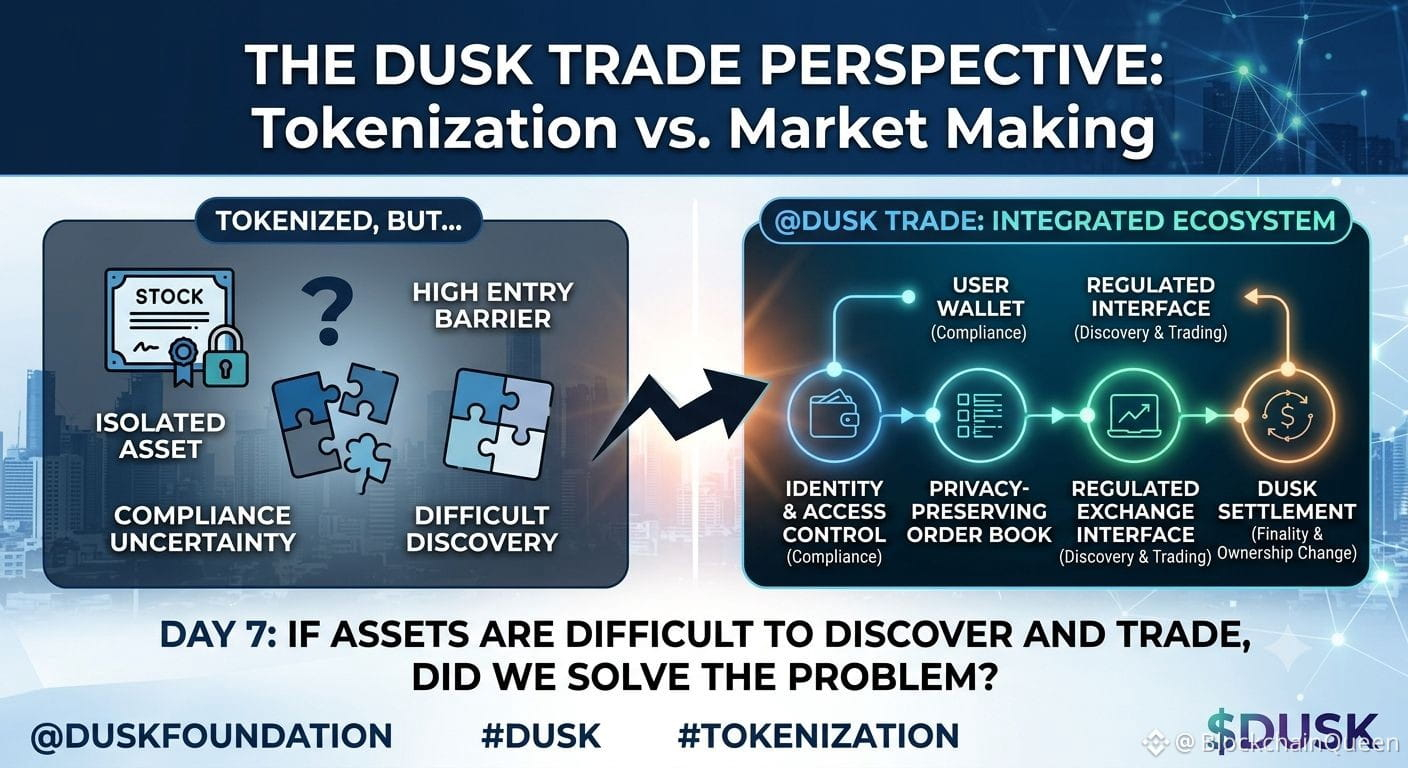
The tokenization narrative often stops at "this asset is now on-chain." But an asset doesn't become useful simply because it has a blockchain representation.
Investors need to discover it.
Eligible participants need to access it.
Orders need to interact with each other.
Ownership needs to change correctly.
Payments need to settle.
And the whole process still needs to operate within whatever regulatory framework applies to the asset.
That's a much bigger problem than issuing a token.
Dusk Trade is interesting because it moves the conversation toward the actual market infrastructure surrounding tokenized financial assets.
And that distinction matters.
Imagine a regulated security represented on-chain.
The issuer creates it.
An eligible investor wants exposure.
The investor connects a wallet.
The system checks whether the participant can access the asset.
A trade happens.
Then the resulting asset ownership and payment need to settle reliably.
Every step depends on infrastructure underneath the application.
If even one part of that workflow is disconnected, you end up recreating the same fragmentation that blockchain was supposed to improve.
That's why I think the combination of Dusk's components is more interesting than looking at any single feature in isolation.
Privacy addresses sensitive information.
Identity and access controls address eligibility.
Dusk's settlement infrastructure addresses finality.
And applications such as Dusk Trade provide a place where these primitives can actually become useful to market participants.
The important thing is that this creates a different way to think about $DUSK .
@duskfoundation $DUSK #dusk
I've spent the first few days looking at the infrastructure behind @Dusk, but today I wanted to focus on what happens when tokenized assets actually need a market.
Because creating a regulated token is one thing.
Giving that token somewhere useful to trade is another.
This is where Dusk Trade caught my attention.
The tokenization narrative often stops at "this asset is now on-chain." But an asset doesn't become useful simply because it has a blockchain representation.
Investors need to discover it.
Eligible participants need to access it.
Orders need to interact with each other.
Ownership needs to change correctly.
Payments need to settle.
And the whole process still needs to operate within whatever regulatory framework applies to the asset.
That's a much bigger problem than issuing a token.
Dusk Trade is interesting because it moves the conversation toward the actual market infrastructure surrounding tokenized financial assets.
And that distinction matters.
Imagine a regulated security represented on-chain.
The issuer creates it.
An eligible investor wants exposure.
The investor connects a wallet.
The system checks whether the participant can access the asset.
A trade happens.
Then the resulting asset ownership and payment need to settle reliably.
Every step depends on infrastructure underneath the application.
If even one part of that workflow is disconnected, you end up recreating the same fragmentation that blockchain was supposed to improve.
That's why I think the combination of Dusk's components is more interesting than looking at any single feature in isolation.
Privacy addresses sensitive information.
Identity and access controls address eligibility.
Dusk's settlement infrastructure addresses finality.
And applications such as Dusk Trade provide a place where these primitives can actually become useful to market participants.
The important thing is that this creates a different way to think about $DUSK .
@duskfoundation $DUSK #dusk