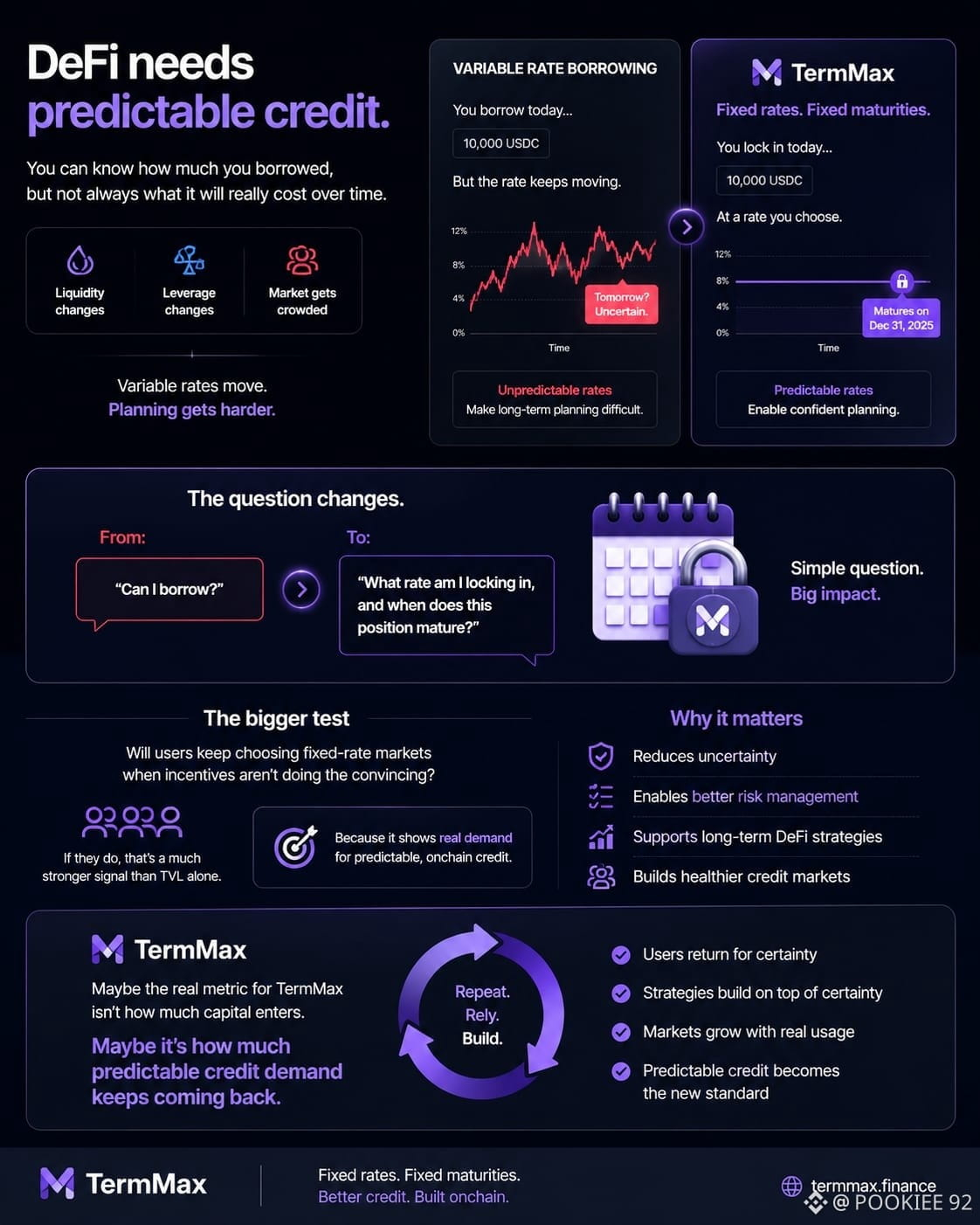
DeFi has a weird problem.
You can know exactly how much you borrowed, but not always what that borrowing will really cost over time.
Variable rates can move because liquidity changes, leverage changes, or the market suddenly gets crowded.
That makes planning harder.
This is where TermMax gets interesting to me.
Instead of treating the interest rate as something that constantly floats around, it builds markets around fixed rates and fixed maturities.
That changes the question.
You’re not just asking:
“Can I borrow?”
You’re asking:
“What rate am I locking in, and when does this position mature?”
That sounds simple, but it matters a lot when the goal is to build more predictable onchain credit markets.
The bigger test, though, is whether users actually keep choosing fixed-rate markets when incentives aren't doing the convincing.
If they do, that’s a much stronger signal than TVL alone.
Maybe the real metric for TermMax isn't how much capital enters.
Maybe it's how much predictable credit demand keeps coming back.
#termmax @TermMax#termmax @TermMax