#termmax @TermMax Assumed "liquidation" on TermMax happened the moment a position crossed its threshold, the same instant-trigger model most lending markets use. Reading the actual mechanism changed that assumption. 🧩
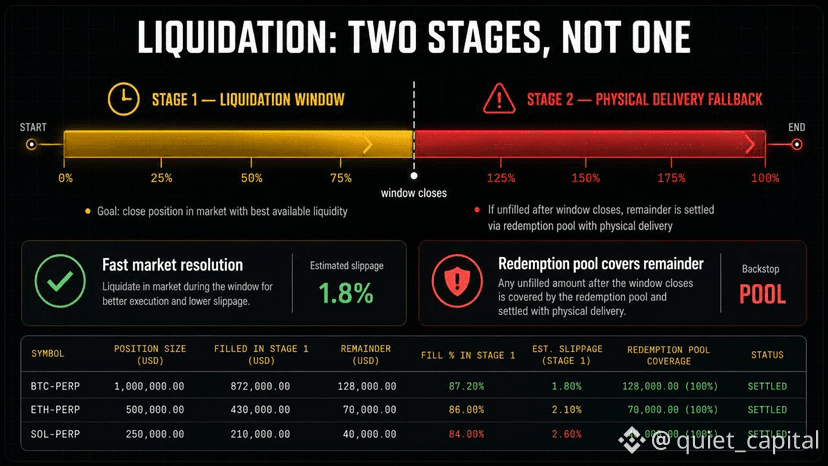
TermMax's liquidation isn't a single instant event — there's a defined liquidation window, a period during which the position can still be liquidated through normal means before the more drastic physical delivery fallback kicks in. ⏳ Only if a loan remains unpaid or only partially liquidated after that window closes does physical delivery begin, with the redemption pool covering the remainder from underlying tokens and borrower collateral together.
Quick numbers to make the trade-off concrete: say a position needs to unwind $500K of collateral. In a thin market, dumping that in one instant block can realize 8-12% slippage easily. Spread across a window where the engine can work in smaller tranches as liquidity refills, realized slippage on the same $500K can land closer to 2-4% — the window isn't just a grace period, it's a mechanism for capturing better average execution. 📐
That's a meaningfully different design than "one liquidation attempt and you're done" — it's an acknowledgment that liquidations don't always resolve cleanly on the first try, especially exactly when they matter most, and that a few extra minutes of patience can be worth several percentage points of value saved for both sides. 🚨
Does knowing there's a defined window before the fallback triggers change how you'd size a position on a less liquid TermMax market? 👇 Has anyone actually watched a position go through both stages — how long did the window run before delivery kicked in?
@TermMax #TermMax
TermMax's liquidation isn't a single instant event — there's a defined liquidation window, a period during which the position can still be liquidated through normal means before the more drastic physical delivery fallback kicks in. ⏳ Only if a loan remains unpaid or only partially liquidated after that window closes does physical delivery begin, with the redemption pool covering the remainder from underlying tokens and borrower collateral together.
Quick numbers to make the trade-off concrete: say a position needs to unwind $500K of collateral. In a thin market, dumping that in one instant block can realize 8-12% slippage easily. Spread across a window where the engine can work in smaller tranches as liquidity refills, realized slippage on the same $500K can land closer to 2-4% — the window isn't just a grace period, it's a mechanism for capturing better average execution. 📐
That's a meaningfully different design than "one liquidation attempt and you're done" — it's an acknowledgment that liquidations don't always resolve cleanly on the first try, especially exactly when they matter most, and that a few extra minutes of patience can be worth several percentage points of value saved for both sides. 🚨
Does knowing there's a defined window before the fallback triggers change how you'd size a position on a less liquid TermMax market? 👇 Has anyone actually watched a position go through both stages — how long did the window run before delivery kicked in?
@TermMax #TermMax