#termmax @TermMax TermMax: When Time Becomes Part of Pricing
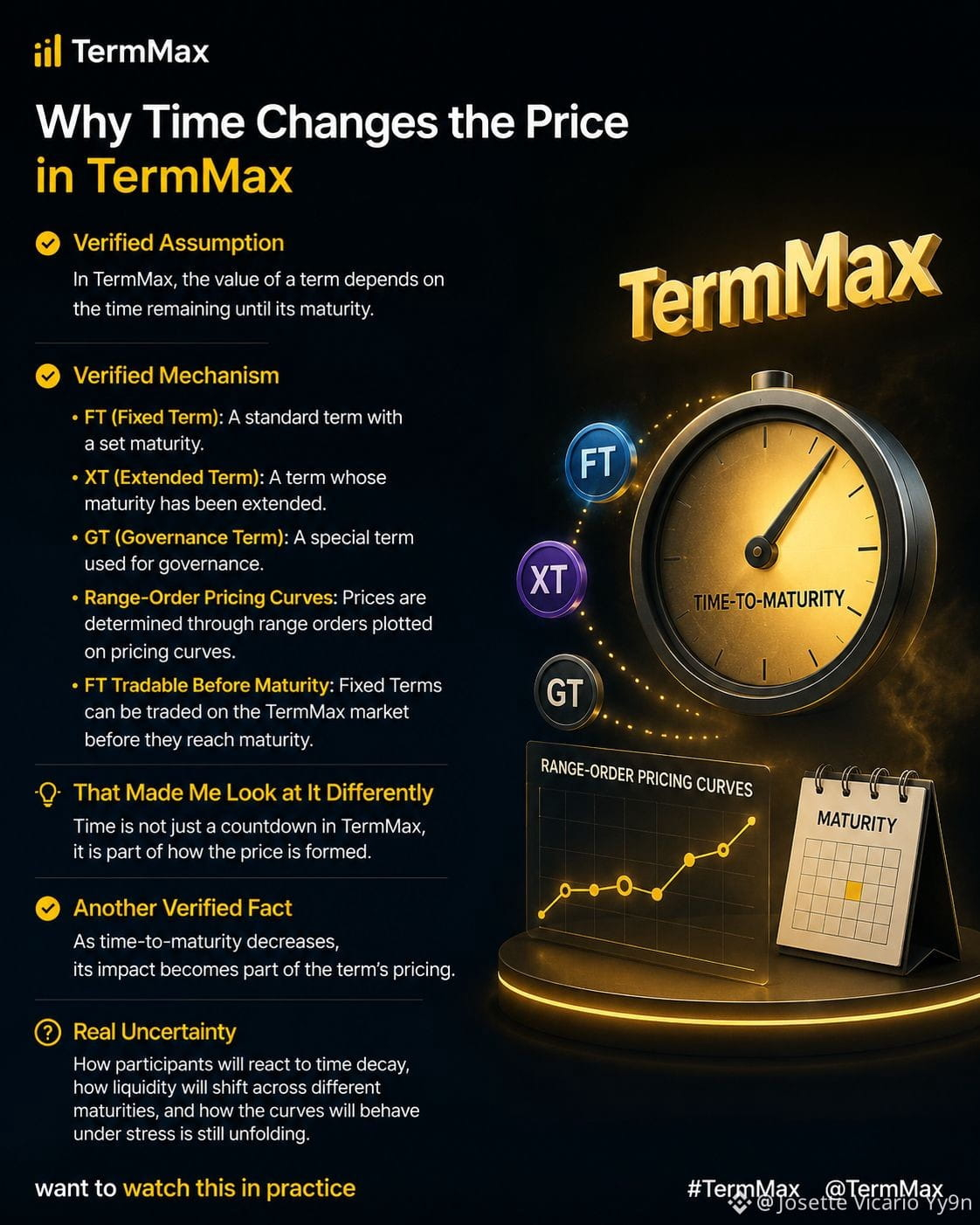
A common assumption is that a fixed-term position is mainly defined by its maturity and rate. TermMax makes the mechanism more specific: markets use FT (Fixed Term) and XT (Variable Term) tokens, while GT (Gearing Token) represents a leveraged position. TermMax also uses range-order pricing curves, where different price/rate levels can apply across specified ranges. FT can be traded before maturity.
That made me look at it differently: maturity is not simply an endpoint—it is part of the pricing structure.
The TermMax range-order model defines pricing using the time-to-maturity ratio, so the remaining term is incorporated into the relationship between FT, XT, and the pricing curve.
What remains genuinely interesting is how participants will behave as maturity approaches: how liquidity moves between different ranges, how pricing curves respond to changing conditions, and how actively FT trades before maturity.
want to watch this in practice
#TermMax @TermMax
A common assumption is that a fixed-term position is mainly defined by its maturity and rate. TermMax makes the mechanism more specific: markets use FT (Fixed Term) and XT (Variable Term) tokens, while GT (Gearing Token) represents a leveraged position. TermMax also uses range-order pricing curves, where different price/rate levels can apply across specified ranges. FT can be traded before maturity.
That made me look at it differently: maturity is not simply an endpoint—it is part of the pricing structure.
The TermMax range-order model defines pricing using the time-to-maturity ratio, so the remaining term is incorporated into the relationship between FT, XT, and the pricing curve.
What remains genuinely interesting is how participants will behave as maturity approaches: how liquidity moves between different ranges, how pricing curves respond to changing conditions, and how actively FT trades before maturity.
want to watch this in practice
#TermMax @TermMax