#dusk $DUSK @Dusk I dug into Citadel last night — Dusk's identity and licensing layer — assuming it'd work like most KYC modules bolted onto DeFi: verify once, store a "verified" flag, done. That's not really it.
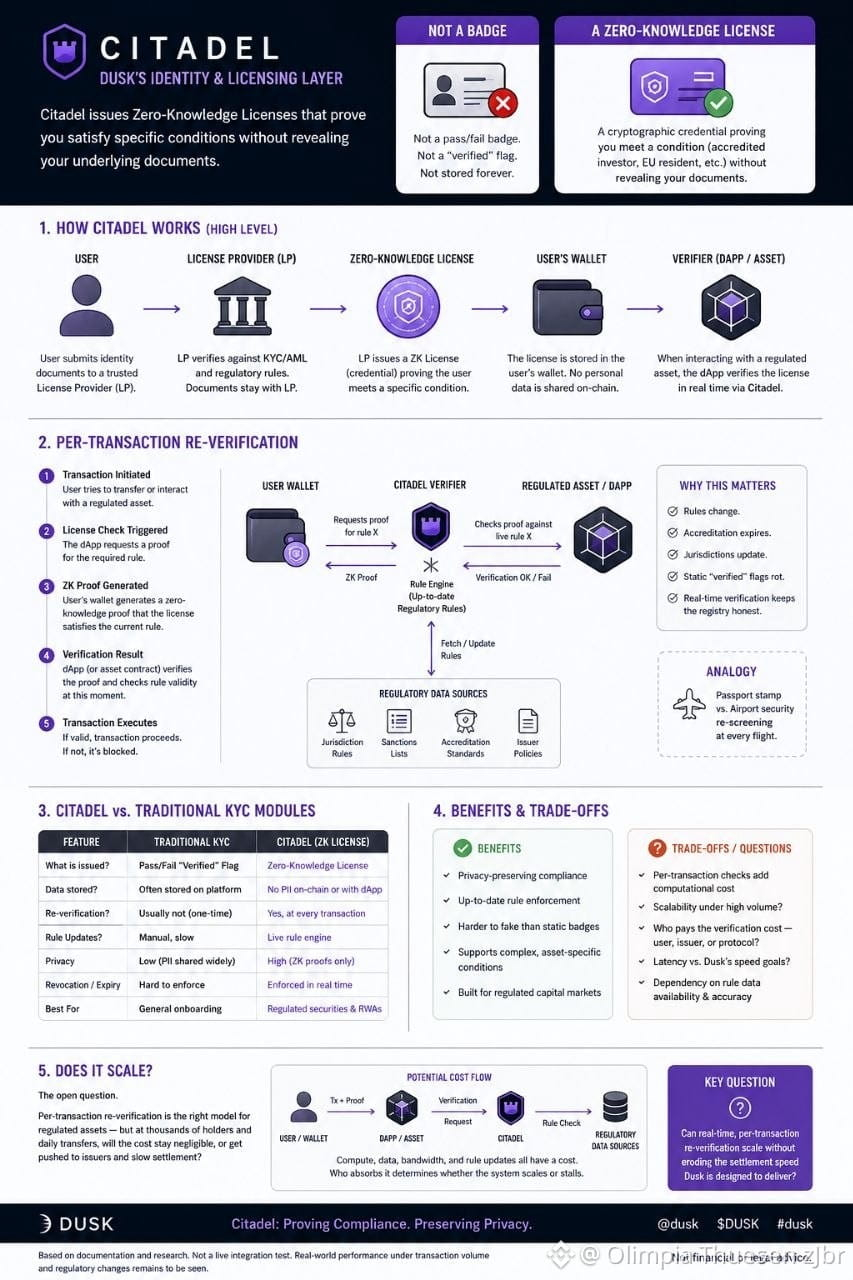
What Citadel issues isn't a pass/fail badge. It's a zero-knowledge license — a credential proving you satisfy a specific condition (accredited investor, EU resident, whatever the asset requires) without revealing the underlying documents that prove it. The verifier learns "this holder qualifies," not your passport number or bank statement.
I expected that to be the whole story. It isn't. A license still has to be checked against a live rule every time an asset moves, not just once at onboarding. Static "verified" flags rot — jurisdictions change, accreditation expires, rules get updated. Citadel's model is built around proving compliance at the moment of the transaction, not renting out a badge earned months earlier.
Reminded me of the difference between a passport stamp and airport security re-screening you every time you board a new flight. One's a record of a past check. The other confirms you still qualify, right now, for this specific gate.
Makes sense for a chain settling regulated securities. A registry that says "this wallet was compliant in March" is useless to an issuer in September if the rule moved and nobody re-checked. Baking re-verification into the transaction itself, instead of trusting a stale credential, is the part that's actually hard to fake.
Worth being clear: I'm going off documentation, not a live integration I tested myself — how this behaves under real transaction volume with actual regulatory rule changes isn't something I've seen in practice yet.
Still turning it over — does per-transaction re-verification scale once thousands of holders are moving assets daily, or does that checking cost end up pushed onto issuers in a way that slows the exact settlement speed Dusk is selling?
@dusk $DUSK #dusk