Was going through the capital efficiency framing inside TermMax —, #TermMax , @TermMax . The pitch is layered: fixed-rate lending keeps costs predictable, and idle capital auto-routes to Aave or Morpho while it waits to be matched. Options on top. All of it supposed to mean your capital never sleeps.
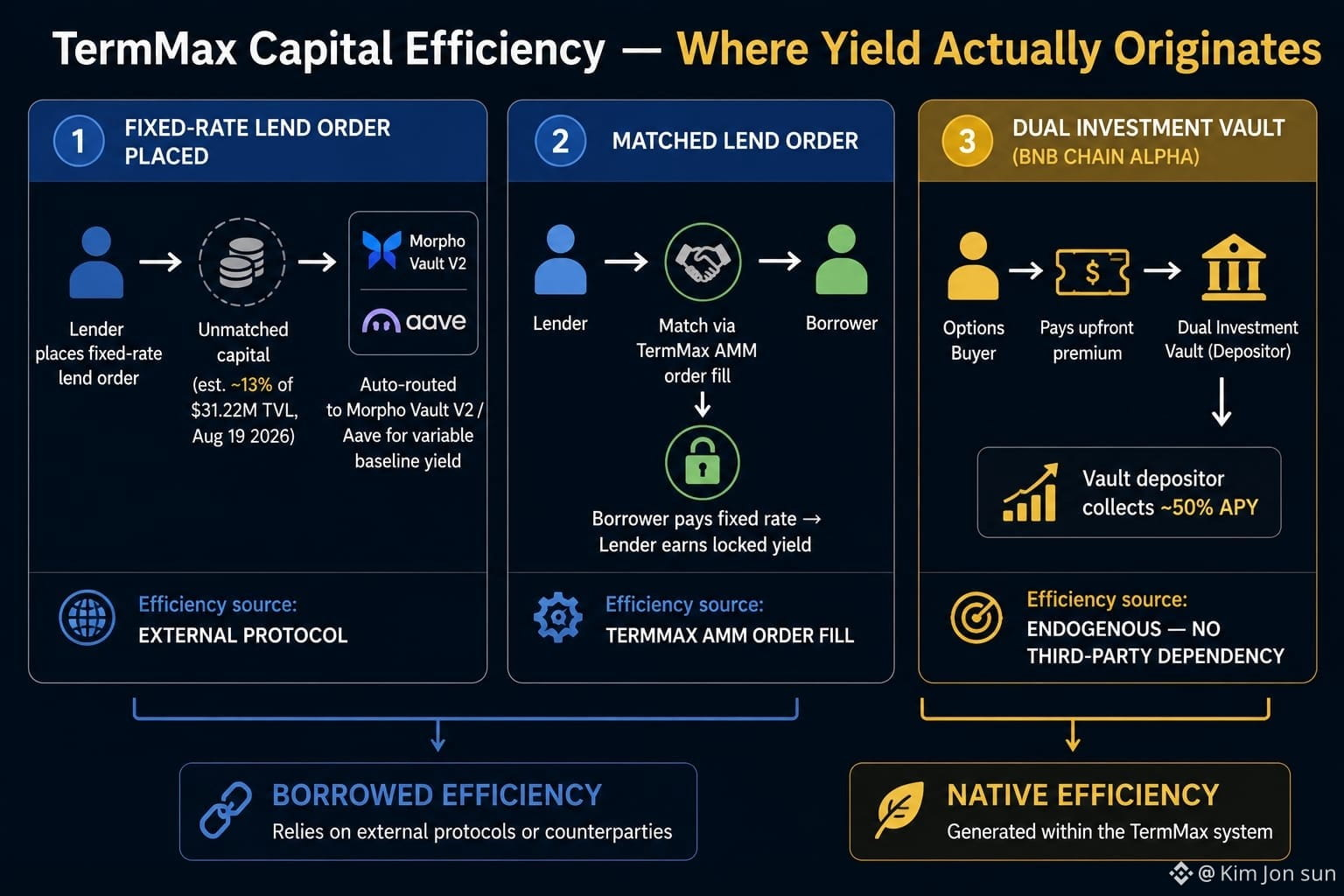
Hold up. DefiLlama is showing $31.22M TVL against $27.28M in active loans right now. That's roughly 87% utilisation across 77 markets on 8 chains. So the "earn while you wait" routing to Morpho Vault V2 — the baseline variable rate that supposedly keeps unmatched lender capital working — is only touching maybe 13% of deposited funds at this point. That mechanic is real, but it's doing less lifting than the framing implies.
The part that actually generates efficiency independently — without outsourcing to Aave or Morpho — is the options layer. Dual Investment Vault premium income on BNB Chain doesn't need a third-party baseline rate. The yield is endogenous: traders pay premiums to take leveraged positions, vault depositors collect it. That's a closed loop. The fixed-rate side's idle routing borrows its efficiency from protocols TermMax doesn't control. The options side builds it internally.
I kept thinking about which of the two actually expands capital efficiency versus just routing it somewhere else...
Still not sure the pitch separates those clearly enough for most users walking in.
Hold up. DefiLlama is showing $31.22M TVL against $27.28M in active loans right now. That's roughly 87% utilisation across 77 markets on 8 chains. So the "earn while you wait" routing to Morpho Vault V2 — the baseline variable rate that supposedly keeps unmatched lender capital working — is only touching maybe 13% of deposited funds at this point. That mechanic is real, but it's doing less lifting than the framing implies.
The part that actually generates efficiency independently — without outsourcing to Aave or Morpho — is the options layer. Dual Investment Vault premium income on BNB Chain doesn't need a third-party baseline rate. The yield is endogenous: traders pay premiums to take leveraged positions, vault depositors collect it. That's a closed loop. The fixed-rate side's idle routing borrows its efficiency from protocols TermMax doesn't control. The options side builds it internally.
I kept thinking about which of the two actually expands capital efficiency versus just routing it somewhere else...
Still not sure the pitch separates those clearly enough for most users walking in.