#termmax @TermMax
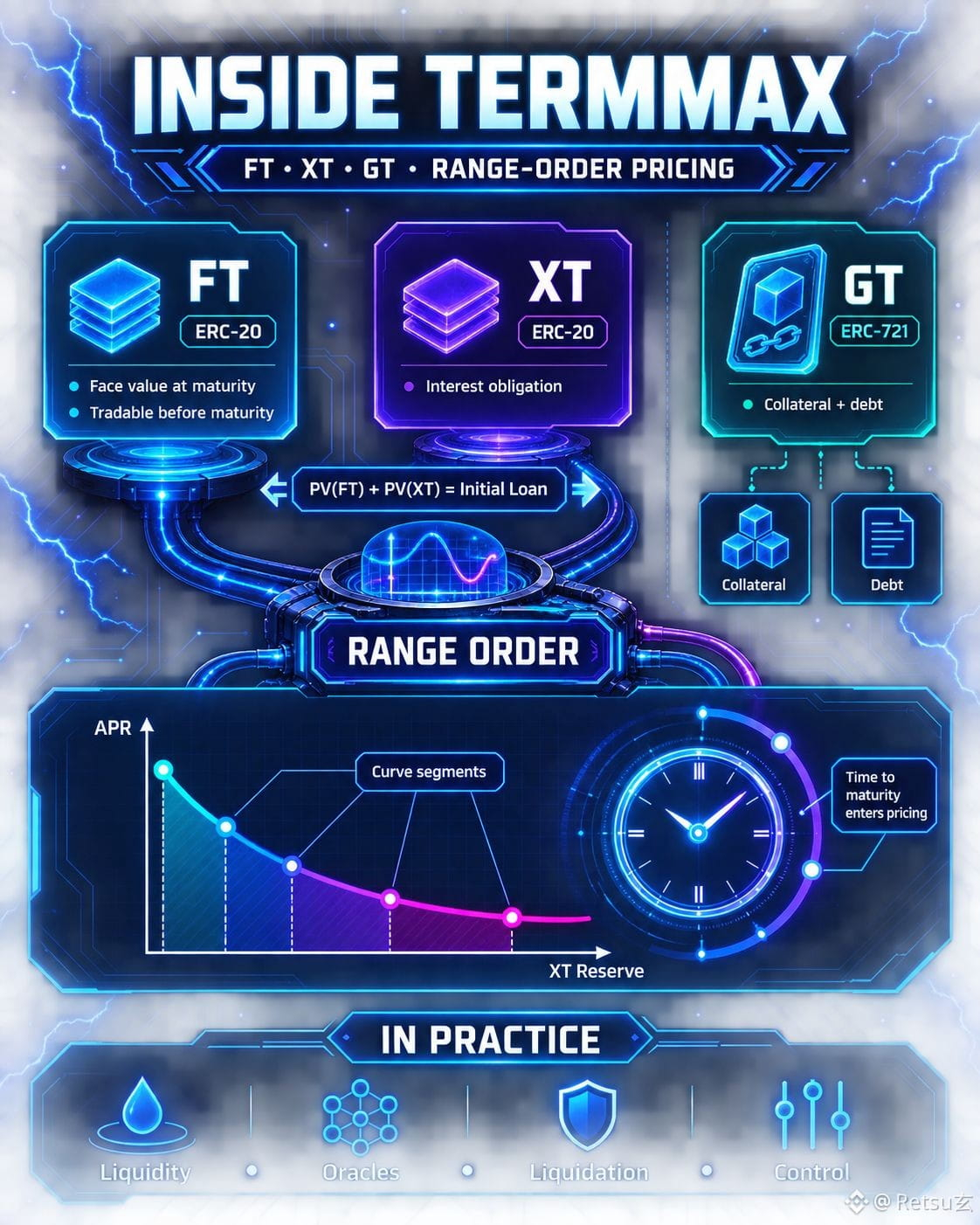
I spent part of last night tracing a TermMax market from the documentation into the contract code. My initial interpretation was that FT, XT, and GT were three labels for one loan. FT is an ERC-20 bought below face value, redeemable at face value in the debt token at maturity, and tradable before then. XT is an ERC-20 representing the interest obligation; the combined present value of FT and XT equals the initial loan amount. GT is an ERC-721 representing a borrowing position and recording its collateral and debt.
A range order is a series of continuous orders configured by a setter or curator. Its pricing curve is built from segments with an APR upper bound and an XT lower bound, and one market can contain multiple range orders.
That made me look at it differently.
The whitepaper defines its time ratio as days to maturity divided by 365. The V2 contracts calculate days remaining and pass that value into the curve and FT/XT swap logic.
My interpretation is that the rate a user sees reflects curve placement, XT reserve movement, and time. What happens to an FT exit when liquidity sits in only a few segments? During market stress, how do oracle fallback, DEX slippage, and liquidation capacity interact? How should control be divided among curators, guardians, admins, and token governance?
I want to watch this in practice.
I spent part of last night tracing a TermMax market from the documentation into the contract code. My initial interpretation was that FT, XT, and GT were three labels for one loan. FT is an ERC-20 bought below face value, redeemable at face value in the debt token at maturity, and tradable before then. XT is an ERC-20 representing the interest obligation; the combined present value of FT and XT equals the initial loan amount. GT is an ERC-721 representing a borrowing position and recording its collateral and debt.
A range order is a series of continuous orders configured by a setter or curator. Its pricing curve is built from segments with an APR upper bound and an XT lower bound, and one market can contain multiple range orders.
That made me look at it differently.
The whitepaper defines its time ratio as days to maturity divided by 365. The V2 contracts calculate days remaining and pass that value into the curve and FT/XT swap logic.
My interpretation is that the rate a user sees reflects curve placement, XT reserve movement, and time. What happens to an FT exit when liquidity sits in only a few segments? During market stress, how do oracle fallback, DEX slippage, and liquidation capacity interact? How should control be divided among curators, guardians, admins, and token governance?
I want to watch this in practice.