Privacy onchain is easy to describe. Making it usable inside an actual application is the harder part.
That’s why Dusk’s recent Dusk Connect release caught my attention.
@Dusk
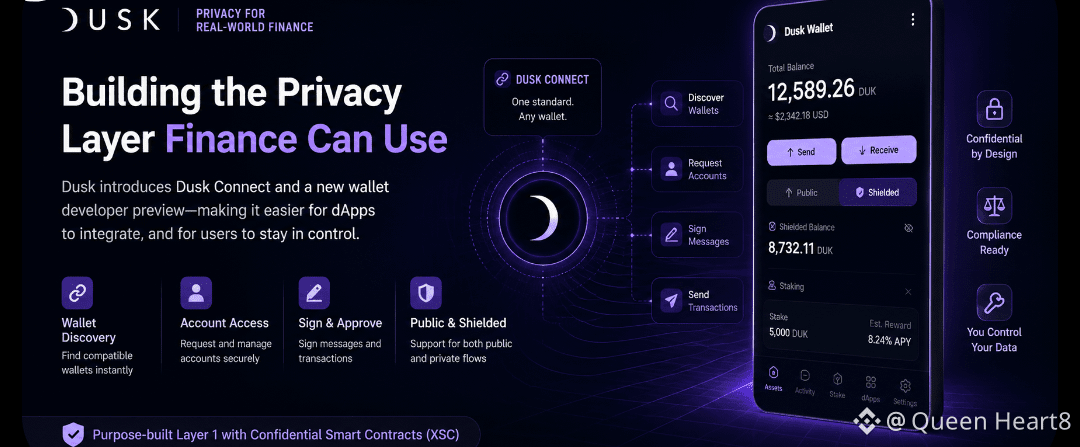
The project introduced a wallet integration SDK alongside a new first-party wallet, giving Dusk dApps a standard way to discover wallets, request account access, sign messages, and handle transactions. It also supports public and shielded account flows.
At first glance, this sounds like basic developer infrastructure. But that’s exactly the point.
For a network targeting regulated finance, privacy cannot live only in the protocol layer. Developers need a practical path from a smart contract to a user’s wallet without rebuilding the entire interaction stack themselves.
Dusk is gradually filling that gap while building around confidential assets, selective disclosure and compliance-oriented workflows.
My takeaway: the interesting test for privacy chains isn’t whether they can hide data. It’s whether they can make privacy feel normal while still giving applications the control regulators and institutions require.
If private financial infrastructure becomes easy to use, does privacy eventually become a default expectation rather than a specialized feature?
$DUSK
#dusk
That’s why Dusk’s recent Dusk Connect release caught my attention.
@Dusk
The project introduced a wallet integration SDK alongside a new first-party wallet, giving Dusk dApps a standard way to discover wallets, request account access, sign messages, and handle transactions. It also supports public and shielded account flows.
At first glance, this sounds like basic developer infrastructure. But that’s exactly the point.
For a network targeting regulated finance, privacy cannot live only in the protocol layer. Developers need a practical path from a smart contract to a user’s wallet without rebuilding the entire interaction stack themselves.
Dusk is gradually filling that gap while building around confidential assets, selective disclosure and compliance-oriented workflows.
My takeaway: the interesting test for privacy chains isn’t whether they can hide data. It’s whether they can make privacy feel normal while still giving applications the control regulators and institutions require.
If private financial infrastructure becomes easy to use, does privacy eventually become a default expectation rather than a specialized feature?
$DUSK
#dusk