Went to the bank last week to update a phone number on file, only to find out they don't handle personal banking on Saturday afternoons. Lights on, doors locked, glass separating me from a counter that wasn't open. The world outside kept moving. Banking didn't.
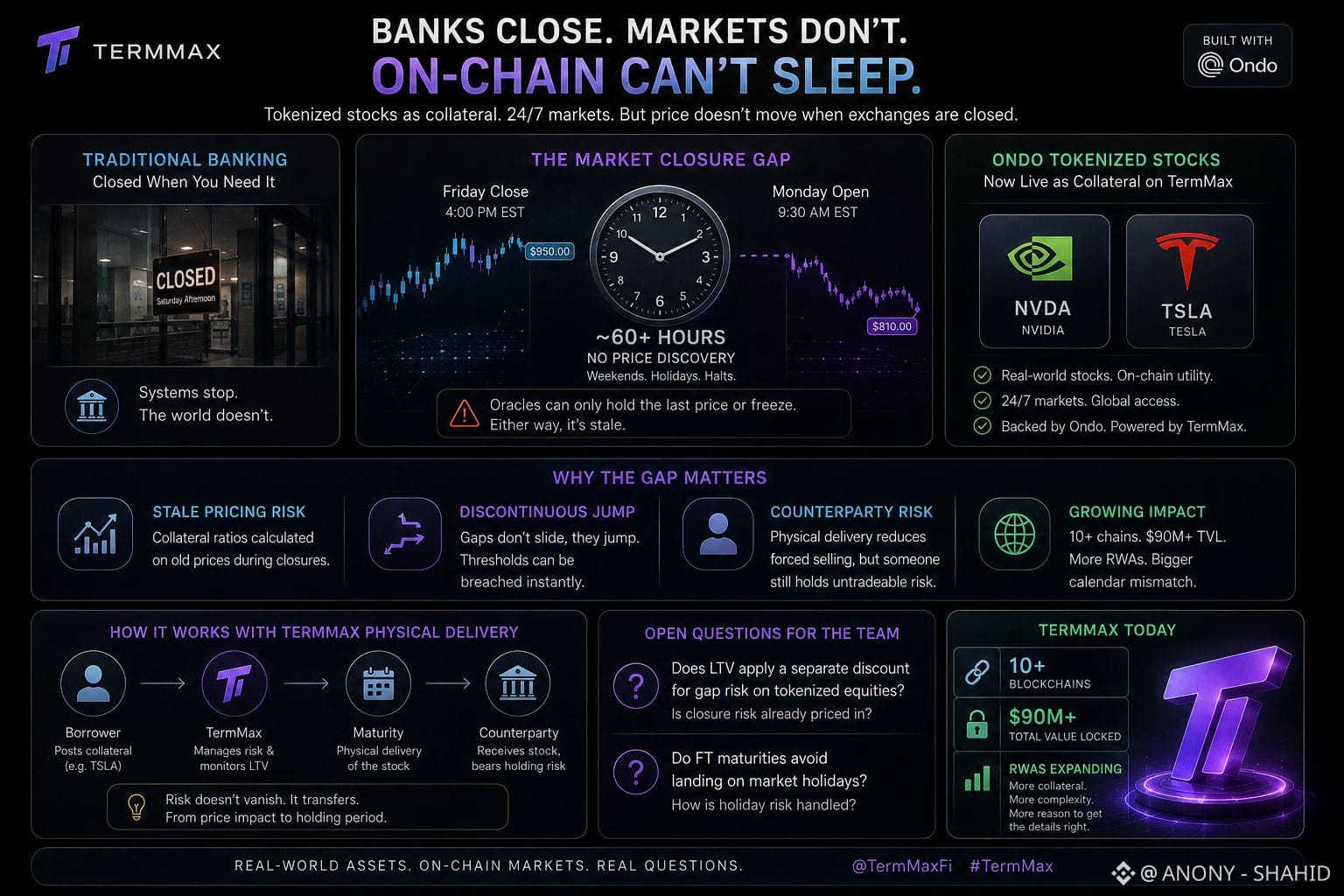
That same closed-door problem is what's been on my mind since @TermMax added Ondo's tokenized stocks as collateral. Names like NVDA and TSLA can now back positions on-chain, and on-chain markets run continuously. The underlying stock doesn't. Friday close to Monday open leaves over sixty hours with no real trade happening, before you even count holidays or single-stock halts.
That gap matters more than it sounds. On-chain settlement needs a live price to work. During market close, there isn't one, an oracle can only hold the last printed price or stop updating. Either way, collateral ratios end up calculated off a number that's already stale.
This isn't just a crypto quirk either. It's the same discontinuous-jump problem that shows up in classic options pricing theory, hedging that depends on continuous price movement breaks down the moment price gaps instead of sliding. If a stock opens Monday down sharply on bad earnings, that's not a gradual slide through a liquidation threshold, it's a jump straight past it.
TermMax's physical delivery model softens the forced-selling side of this. But the counterparty who ends up holding that collateral still can't trade it during the closure window either. The risk doesn't disappear, it moves from price impact to a holding-period problem.
With TermMax now running across ten chains and TVL past ninety million, this calendar mismatch only gets harder to route around as more RWA collateral types get added.
Genuine question for anyone closer to the product: does LTV get a separate discount for gap risk on tokenized equities, and do FT maturities avoid landing on market holidays?
#termmax #Binance
That same closed-door problem is what's been on my mind since @TermMax added Ondo's tokenized stocks as collateral. Names like NVDA and TSLA can now back positions on-chain, and on-chain markets run continuously. The underlying stock doesn't. Friday close to Monday open leaves over sixty hours with no real trade happening, before you even count holidays or single-stock halts.
That gap matters more than it sounds. On-chain settlement needs a live price to work. During market close, there isn't one, an oracle can only hold the last printed price or stop updating. Either way, collateral ratios end up calculated off a number that's already stale.
This isn't just a crypto quirk either. It's the same discontinuous-jump problem that shows up in classic options pricing theory, hedging that depends on continuous price movement breaks down the moment price gaps instead of sliding. If a stock opens Monday down sharply on bad earnings, that's not a gradual slide through a liquidation threshold, it's a jump straight past it.
TermMax's physical delivery model softens the forced-selling side of this. But the counterparty who ends up holding that collateral still can't trade it during the closure window either. The risk doesn't disappear, it moves from price impact to a holding-period problem.
With TermMax now running across ten chains and TVL past ninety million, this calendar mismatch only gets harder to route around as more RWA collateral types get added.
Genuine question for anyone closer to the product: does LTV get a separate discount for gap risk on tokenized equities, and do FT maturities avoid landing on market holidays?
#termmax #Binance