#termmax @TermMax
I opened the TermMax TGE update expecting to look at the usual launch numbers. Somehow, an hour later, I was still reading the docs instead of finishing my snack.
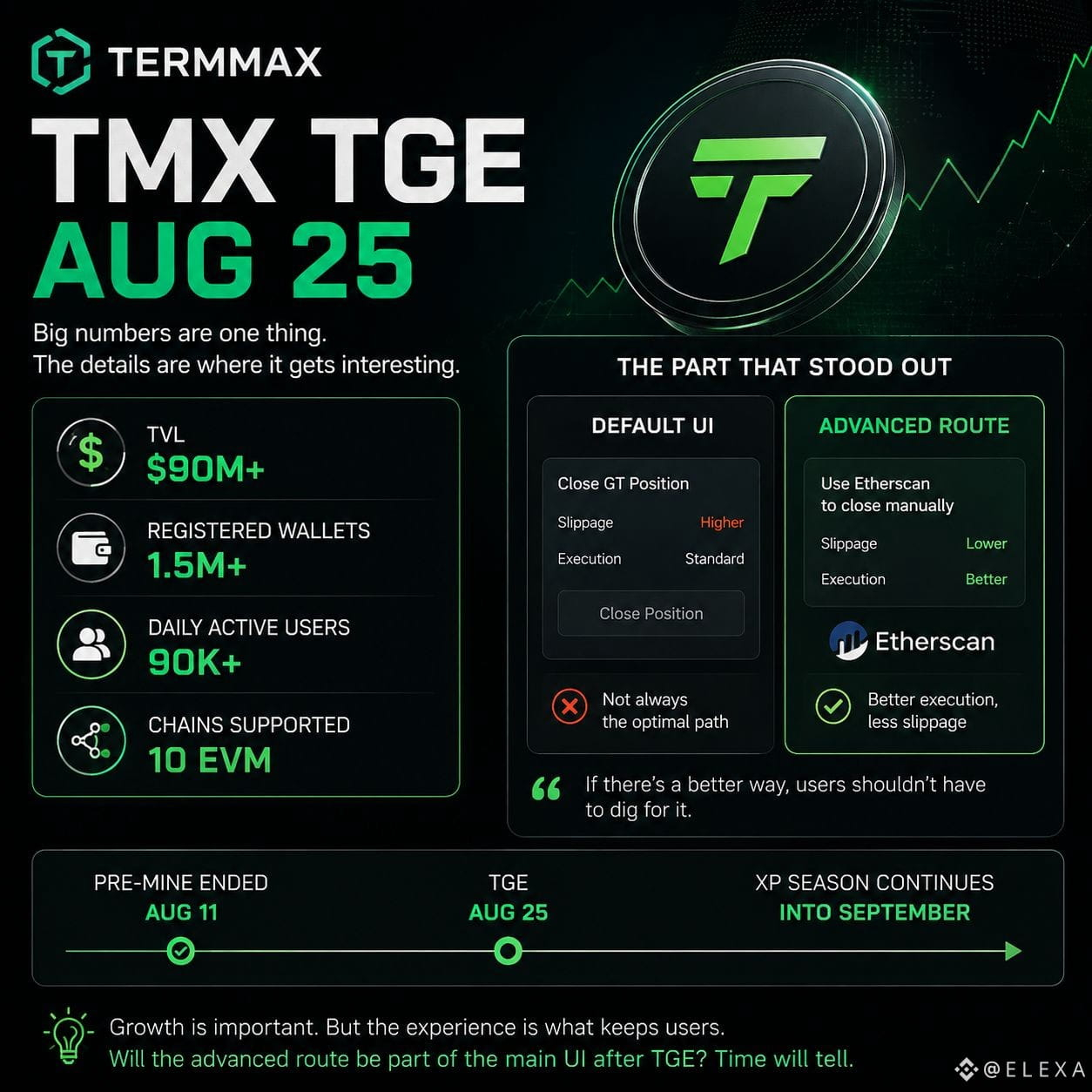
TMX is set for August 25, and the numbers are getting attention: TermMax says TVL is above $90M, registered wallets have passed 1.5M, and daily active users are above 90K across ten EVM chains.
Impressive, sure. But honestly, that wasn’t the part that stayed in my head.
What caught me was the way leveraged GT positions are closed.
TermMax’s docs explain that the default UI isn’t always the best route for unwinding these positions. Advanced users can go directly through Etherscan and manually close them, potentially getting better execution and reducing slippage.
That made me stop.
If there’s already a better execution path, why does a regular user have to know about it first?
It’s a small UX issue, but these small things matter in DeFi. A protocol can have strong liquidity and impressive growth, but if the best execution requires digging through documentation and using Etherscan manually, the experience still has room to improve.
The timing is interesting too. The pre-mine ended August 11, while the XP season continues into September, with the TGE arriving on August 25.
I’m curious whether this advanced closing route eventually gets pulled into the main interface or stays as a power-user option.
For me, that’s one of the more useful things to watch after TGE: not just how many users TermMax has, but how easily those users can actually use the product.
What do you think matters more after launch growth or better execution
I opened the TermMax TGE update expecting to look at the usual launch numbers. Somehow, an hour later, I was still reading the docs instead of finishing my snack.
TMX is set for August 25, and the numbers are getting attention: TermMax says TVL is above $90M, registered wallets have passed 1.5M, and daily active users are above 90K across ten EVM chains.
Impressive, sure. But honestly, that wasn’t the part that stayed in my head.
What caught me was the way leveraged GT positions are closed.
TermMax’s docs explain that the default UI isn’t always the best route for unwinding these positions. Advanced users can go directly through Etherscan and manually close them, potentially getting better execution and reducing slippage.
That made me stop.
If there’s already a better execution path, why does a regular user have to know about it first?
It’s a small UX issue, but these small things matter in DeFi. A protocol can have strong liquidity and impressive growth, but if the best execution requires digging through documentation and using Etherscan manually, the experience still has room to improve.
The timing is interesting too. The pre-mine ended August 11, while the XP season continues into September, with the TGE arriving on August 25.
I’m curious whether this advanced closing route eventually gets pulled into the main interface or stays as a power-user option.
For me, that’s one of the more useful things to watch after TGE: not just how many users TermMax has, but how easily those users can actually use the product.
What do you think matters more after launch growth or better execution