
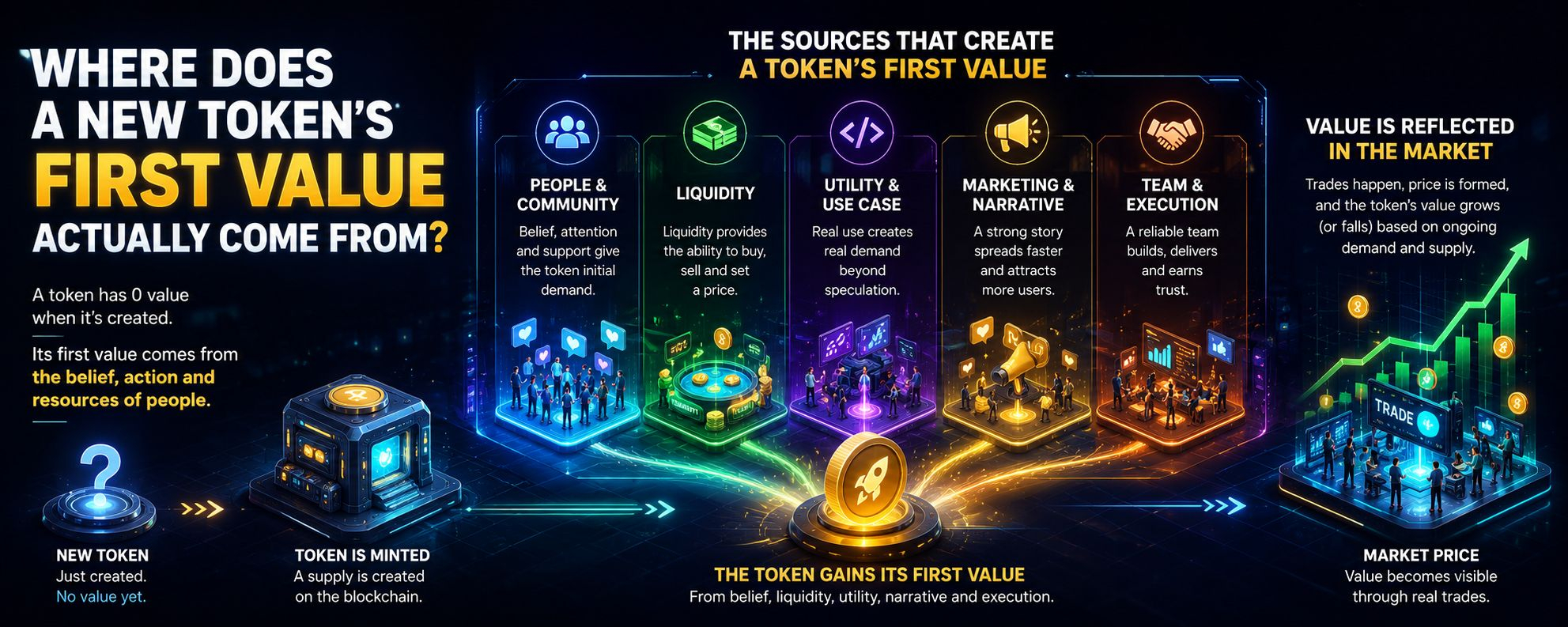

When a brand-new token appears at $0.00000…, many people immediately think:
“Wow, it's extremely cheap.”
But here's the twist:
The token didn't necessarily start with that value.
On an AMM-based DEX, a new token needs liquidity before normal swapping can happen. The initial liquidity provider deposits both the new token and another asset—for example BNB, ETH, SOL, or a stablecoin. The initial ratio between those assets establishes the starting exchange price. �
Uniswap Developers +1
Imagine:
1,000,000 ABC + 1 BNB
That ratio creates the initial ABC/BNB price.
If someone buys ABC using BNB, the pool's balances change. The AMM then adjusts the price according to its pricing mechanism. In the classic constant-product model:
x × y = k
So the price isn't coming from some central authority saying:
“ABC is worth $0.000001.”
It's emerging from the assets placed into the market and subsequent trading activity. �
Uniswap Developers +1
🤯 And this is where it gets interesting.
A token can have:
1,000,000,000 tokens
and trade at:
$0.000001
while another token has:
1,000,000 tokens
and trades at:
$1
The first token isn't automatically cheaper.
Supply matters.
That's why looking only at the number after the dollar sign can be extremely misleading.
🌐 The same basic idea appears across ecosystems.
BNB Chain can have $BNB /token pools.
Ethereum can have $ETH /token pools.
Solana can have $SOL /token pools.
The native asset isn't being “broken into” the new token.
Instead, it becomes one side of the economic trading pair.
And here's the question I think is much more interesting:
Who provides the first BNB, ETH, SOL or stablecoins that gives a brand-new token its first market price?
Because that first liquidity isn't just a number.
It's the moment a token moves from being a smart-contract balance to becoming a tradable market.
And that leads to an even bigger question:
If the initial liquidity is tiny, how meaningful is the token's displayed market price?
That's where things get really interesting.
Educational discussion only. Crypto markets are highly volatile and this is not financial advice.
#Crypto #Tokenomics #DeFi #LiquidityPool #Blockchain #Web3 #BNBChain #Ethereum #Solana #BinanceSquare