
The battle for $65,000 is officially underway. Bitcoin (BTC) pushed aggressively against this psychological resistance line on Tuesday, injecting a massive dose of bullish momentum into the digital asset markets.
Crucially, this latest price breakout isn't happening in a vacuum. At the exact moment BTC tested macro highs, two of Wall Street's most influential financial institutions deeply reinforced their long-term commitments to the digital asset class.
For the Binance Square community, this represents a major convergence of spot price action and long-term institutional infrastructure. Here is what is happening.
🚀 1. The Powerhouse Mandate: BlackRock’s 1-2% Portfolio Call
BlackRock, the world’s largest asset manager, is no longer just offering a Bitcoin product—they are actively rewriting the rules of traditional portfolio management.
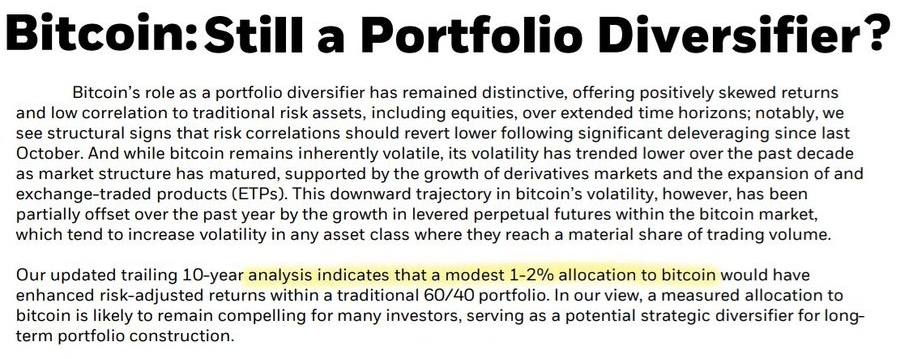
The firm recently reiterated its strategic stance that modern diversified institutional portfolios should feature a structural 1% to 2% allocation to Bitcoin.
The Math: If even a fraction of global pension funds, sovereign wealth funds, and traditional 60/40 portfolios adopt BlackRock’s 2% baseline recommendation, it will trigger an unprecedented, multi-billion dollar demand loop.
The Vehicle: This structural push directly feeds into BlackRock’s own iShares Bitcoin Trust (IBIT), which has already solidified its status as the fastest-growing ETF in financial history.
🏦 2. Citi’s "Custody+" Arrival: The Institutional Bridge
While BlackRock drives institutional allocation demand, banking giant Citi is building the high-security bridge to house it. Citi confirmed that its highly anticipated institutional-grade Bitcoin custody service will officially go live this year.
Why Custody Matters: Large-scale hedge funds, corporate treasuries, and endowment funds are legally barred from holding digital assets on retail platforms or unverified wallets. They require tier-one banking custody to enter the space.
The Capital Inflow: By providing ironclad, regulatory-compliant custody solutions, Citi is effectively opening the floodgates for conservative, heavy-capital players who have spent years sitting on the crypto sidelines.
⚖️ The Invisible Catalyst: Regulatory Pressure Forcing Structural Shifts
Interestingly, this massive institutional onslaught comes at a time when global regulatory pressures are peaking. With the U.S. Clarity Act currently stalled in the Senate due to congressional recess delays, enforcement oversight remains heavily active.
Furthermore, macro analysts and DeFi founders—including Curve Finance creator Michael Egorov—note that tightening Financial Action Task Force (FATF) anti-money laundering rules are acting as an unintended catalyst. While regulators are aggressively targeting and centralizing retail entry points, they are simultaneously forcing the industry to adapt.
The result? Institutions like Citi and BlackRock are capturing the regulated, compliant fiat inflows, while decentralized applications are being forced to build deeper, more un-censorable structural architectures.
💡 The Big Picture for Traders: The Floor is Rising
When Bitcoin tests $65,000 driven by retail momentum, it is often a highly volatile, fragile spike. But when $65,000 is tested while BlackRock demands portfolio allocation and Citi deploys custody infrastructure, the underlying market structure changes completely.
The Bottom Line: Wall Street is no longer debating whether Bitcoin is a viable asset class. They are actively competing to build the infrastructure that will run it. As the supply on exchanges continues to compress against this massive institutional adoption curve, the floor beneath Bitcoin's macro price action is structurally rising. Secure your positions, track the inflows, and always look at the macro horizon.
Disclaimer: This post is for informational and educational purposes only. It does not constitute financial advice. Always Do Your Own Research (DYOR).