Why do we think a blockchain must reveal everything it knows just to prove something is true?
I found @Dusk while exploring blockchain infrastructure, and its privacy approach caught my attention more than the usual token talk.
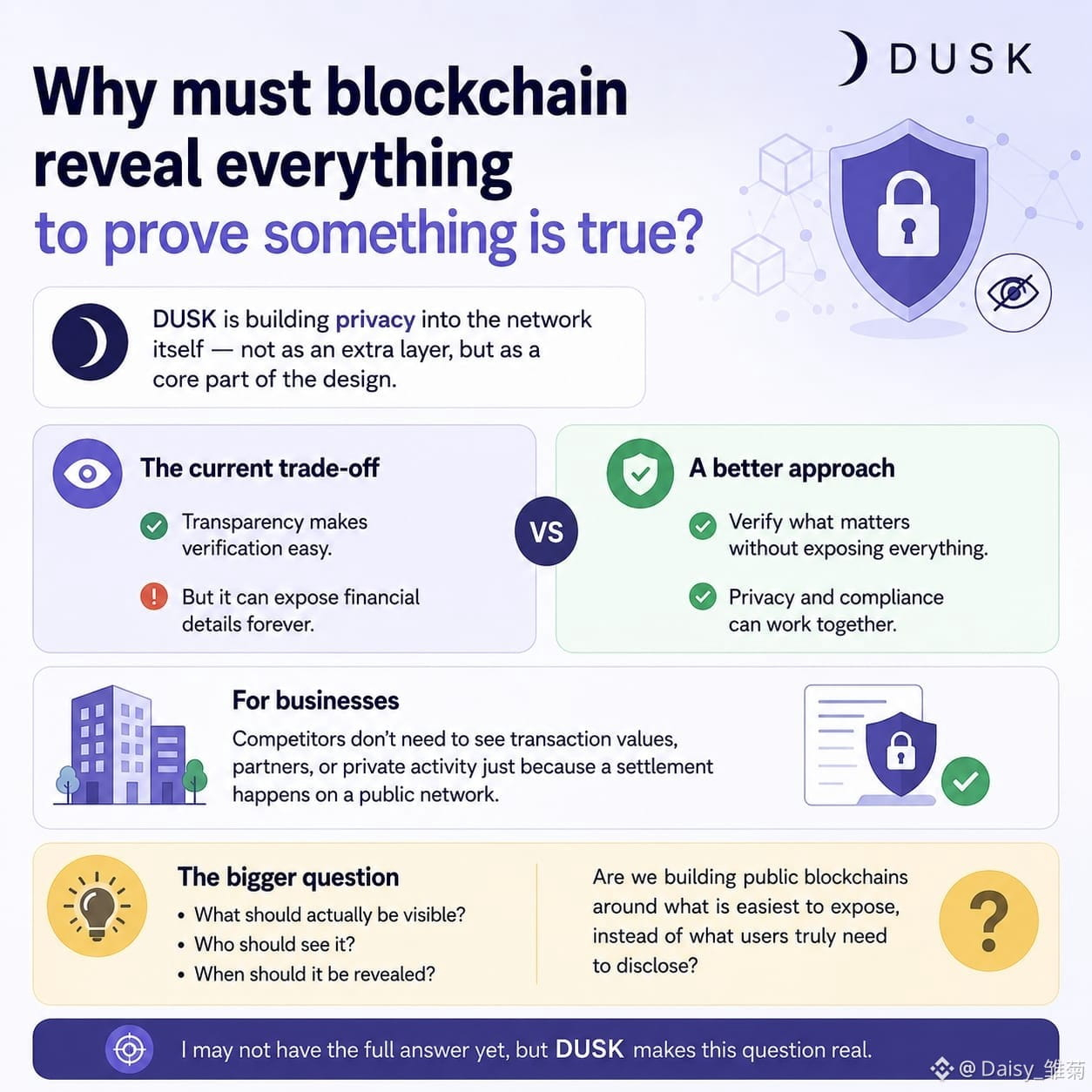
What stands out is that DUSK is trying to build privacy into the network itself, instead of adding it later as an extra feature.
That matters because blockchain often comes with a difficult trade-off: transparency makes verification simple, but it can also leave financial details visible forever.
For businesses, that may not always be useful. Competitors do not need to see transaction values, business partners, or private activity just because a settlement happens on a public network.
What really caught my interest is the idea that privacy and compliance can work together. DUSK explores ways to verify important information without exposing every detail to everyone.
While learning about it, I kept thinking about how early blockchain systems often treated full visibility as something naturally positive.
But maybe the bigger question is:
What should actually be visible, who should see it, and when should it be revealed?
Are we creating public blockchains around what is easiest to expose, instead of what users truly need to disclose?
I still do not have a simple answer, but DUSK makes that question feel much more real.
$DUSK #dusk $DUSK
I found @Dusk while exploring blockchain infrastructure, and its privacy approach caught my attention more than the usual token talk.
What stands out is that DUSK is trying to build privacy into the network itself, instead of adding it later as an extra feature.
That matters because blockchain often comes with a difficult trade-off: transparency makes verification simple, but it can also leave financial details visible forever.
For businesses, that may not always be useful. Competitors do not need to see transaction values, business partners, or private activity just because a settlement happens on a public network.
What really caught my interest is the idea that privacy and compliance can work together. DUSK explores ways to verify important information without exposing every detail to everyone.
While learning about it, I kept thinking about how early blockchain systems often treated full visibility as something naturally positive.
But maybe the bigger question is:
What should actually be visible, who should see it, and when should it be revealed?
Are we creating public blockchains around what is easiest to expose, instead of what users truly need to disclose?
I still do not have a simple answer, but DUSK makes that question feel much more real.
$DUSK #dusk $DUSK