#termmax @TermMax
The more I studied TermMax, the more one thing kept pulling me back.
It wasn't the yield numbers or the marketing. It was how calmly the whole system treats a loan as something that can be taken apart.
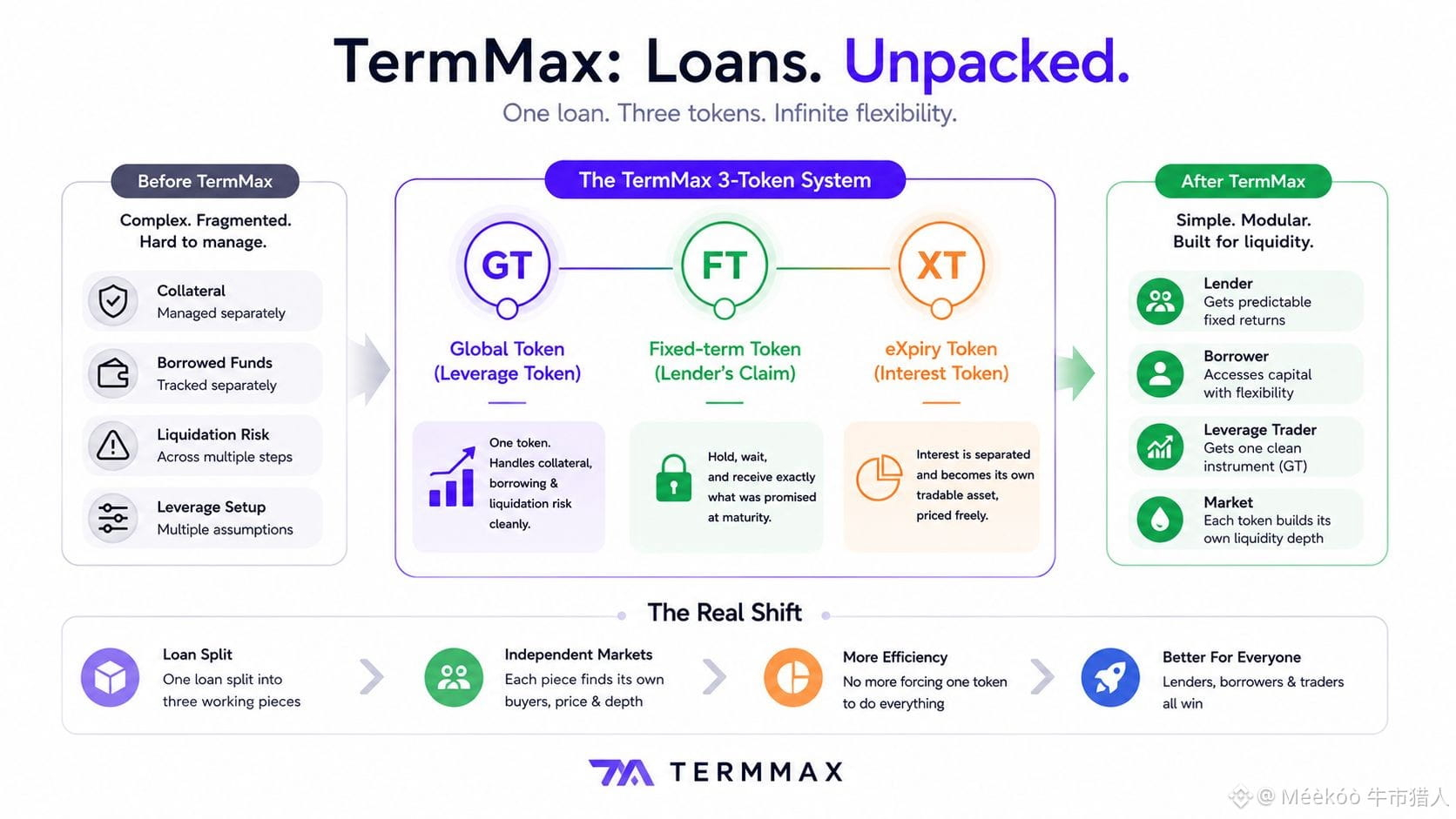
Take GT first. Leverage on most protocols means juggling collateral, borrowed funds, and liquidation risk across separate steps. Here it's one token doing that job cleanly.
Then FT shows up as the quiet one. A lender holds it, waits, and gets exactly what was promised at maturity. Nothing floating, nothing to monitor daily. #TermMax
XT is the part that actually made me stop and think. Interest gets separated from the loan itself and becomes its own tradable object, priced on its own terms.
Most people scroll past this because it doesn't look exciting on a chart.
They'll check volume, listings, maybe a TVL number, and decide the story ends there.
It doesn't, and that's the part being missed.
The real shift is in how liquidity behaves once you split a loan into three working pieces. Each piece finds its own buyers, its own price, its own depth, instead of being locked inside one rigid contract.
Fixed income on-chain kept failing before this because one token was forced to act as lender's claim, borrower's obligation, and leverage wrapper all at once.
TermMax simply stopped forcing that.
A lender stops babysitting rates. A borrower stops stacking synthetic products just to get flexibility. A leverage trader gets one clean instrument instead of five assumptions glued together.
I keep thinking the market will notice this eventually, just later than it should have.
$RED
$METAB
The more I studied TermMax, the more one thing kept pulling me back.
It wasn't the yield numbers or the marketing. It was how calmly the whole system treats a loan as something that can be taken apart.
Take GT first. Leverage on most protocols means juggling collateral, borrowed funds, and liquidation risk across separate steps. Here it's one token doing that job cleanly.
Then FT shows up as the quiet one. A lender holds it, waits, and gets exactly what was promised at maturity. Nothing floating, nothing to monitor daily. #TermMax
XT is the part that actually made me stop and think. Interest gets separated from the loan itself and becomes its own tradable object, priced on its own terms.
Most people scroll past this because it doesn't look exciting on a chart.
They'll check volume, listings, maybe a TVL number, and decide the story ends there.
It doesn't, and that's the part being missed.
The real shift is in how liquidity behaves once you split a loan into three working pieces. Each piece finds its own buyers, its own price, its own depth, instead of being locked inside one rigid contract.
Fixed income on-chain kept failing before this because one token was forced to act as lender's claim, borrower's obligation, and leverage wrapper all at once.
TermMax simply stopped forcing that.
A lender stops babysitting rates. A borrower stops stacking synthetic products just to get flexibility. A leverage trader gets one clean instrument instead of five assumptions glued together.
I keep thinking the market will notice this eventually, just later than it should have.
$RED
$METAB