
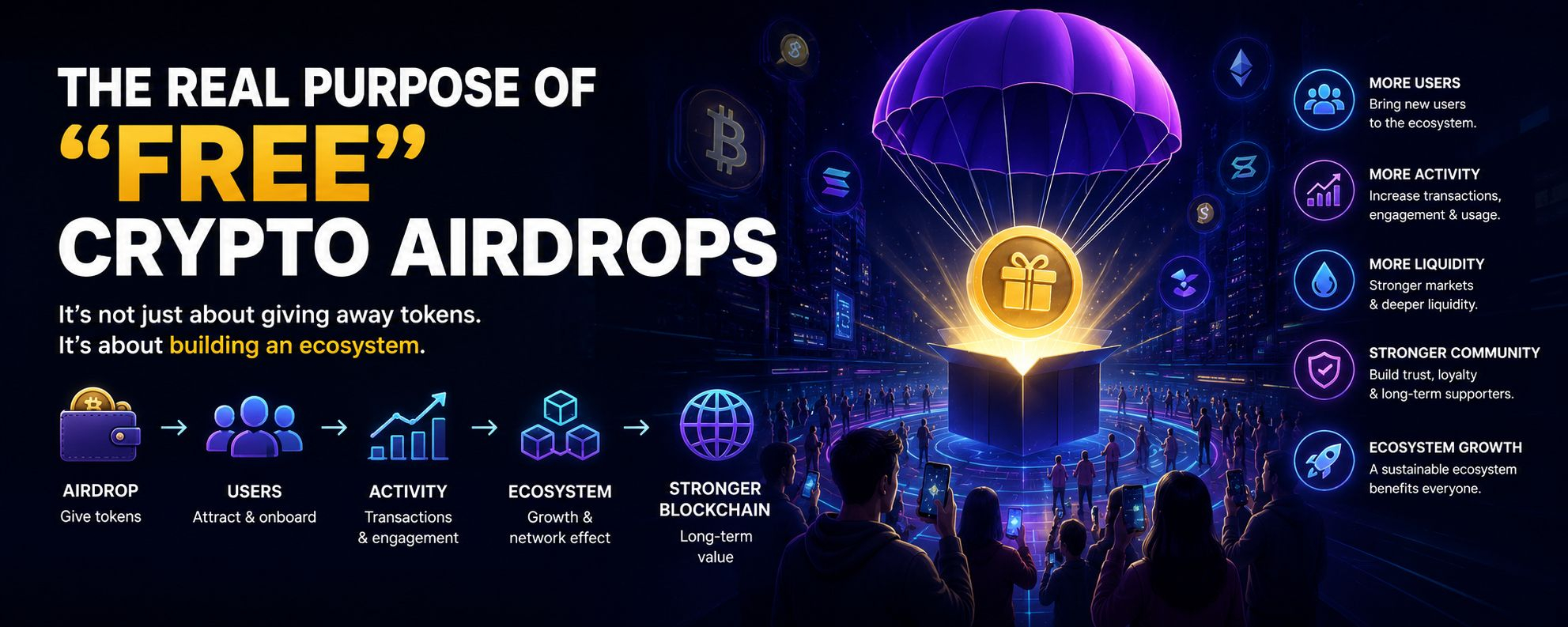

We usually see an airdrop and think:
“Free tokens. Nice.”
But what if we're looking at the wrong side of the equation?
A blockchain ecosystem doesn't only need tokens.
🛑 It needs users.
And users create activity.
A small project can distribute tokens to thousands of wallets and suddenly create:
👛 New active wallets
🔄 More transactions
🌐 More dApp interaction
💧 More liquidity
👥 A larger community
The token may be tiny.
The network effect isn't.
Think about the cycle:
Blockchain → Projects → Airdrops → Users → Activity → Ecosystem Growth
This isn't unique to one chain.
We've seen different versions of this strategy across Ethereum, BNB Chain, Solana, Layer-2 networks and other ecosystems.
And there's an interesting economic question hiding underneath:
> Are some “free” tokens actually an ecosystem's customer-acquisition cost?
Instead of paying for traditional advertising, a project gives users something they can potentially value.
The project gets:
attention + wallets + activity + community
The user gets:
tokens + an opportunity to participate
Of course, not every airdrop succeeds.
Some tokens disappear.
Some projects lose activity after incentives end.
And some distributions are simply marketing campaigns.
But when you zoom out, airdrops start looking less like free money...
…and more like infrastructure for bootstrapping an economy.
The real question isn't:
“How much is this airdrop worth?”
It's:
“How much activity can this airdrop create?”
That's where things get interesting. 👀
#Crypto #Airdrop #Blockchain #Web3 #DeFi #Ethereum #Solana #BNBChain #BinanceSquare
Educational discussion only. Not financial advice.