Last night while digging through the DuskEVM docs a tiny detail jumped out at me: its Chain ID is 745. The actual number doesn't matter, but the philosophy behind it does. Dusk isn't trying to clone another standard EVM chain it’s trying to give Ethereum developers familiar tools without forcing the whole network into a rigid, one size fits all model.
Most retail traders just wave their hands and label Dusk a privacy coin. Honestly that completely misses the point.
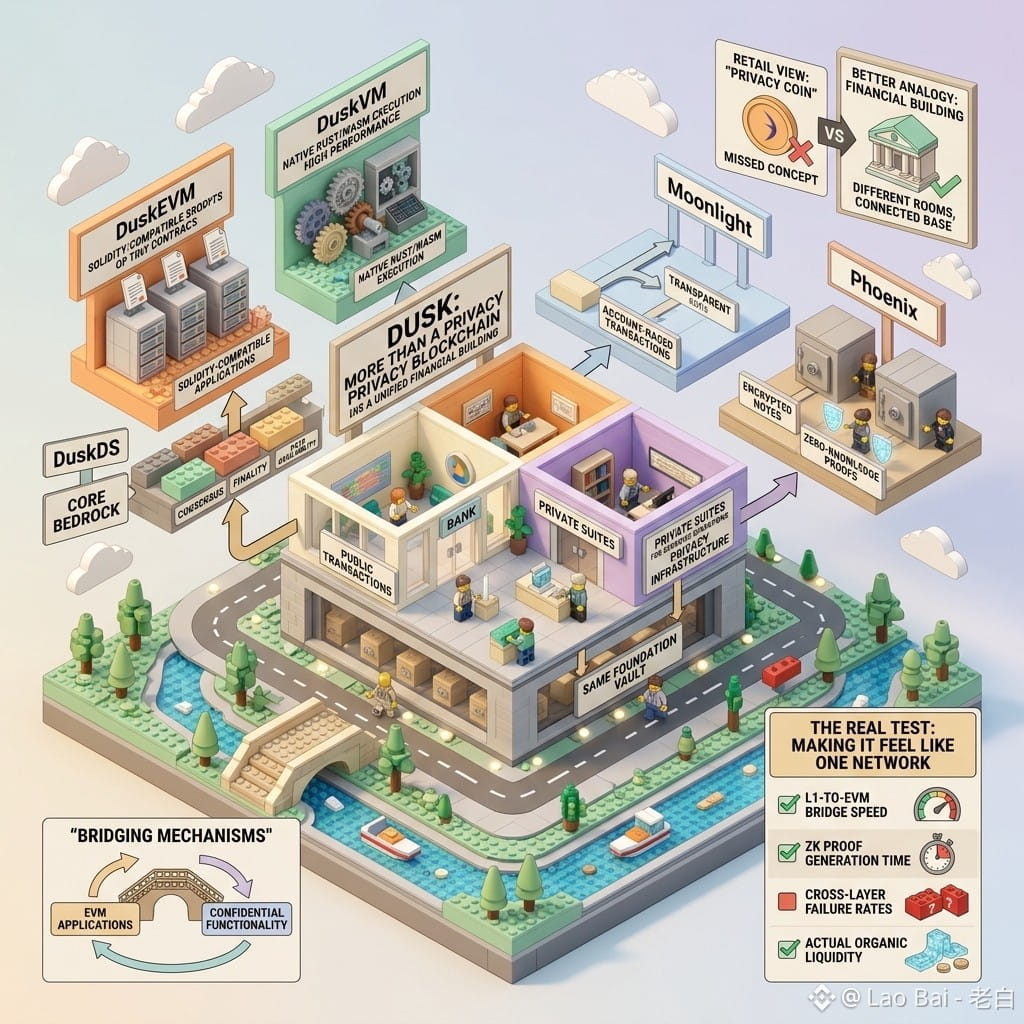
Think of it more like a modern bank building with different rooms. Public, transparent stuff happens right out in the lobby, while sensitive transactions go behind closed doors in private suites. Different levels of visibility, but all tied to the exact same vault.
The way the stack fits together is where things get clever:
DuskDS acts as the core bedrock for consensus, finality, and data availability.
DuskEVM lets Solidity devs drop in their existing smart contracts, while DuskVM handles high-performance native Rust/WASM logic.
Moonlight covers clear, account-based transactions, whereas Phoenix handles encrypted notes using zero knowledge proofs.
Naturally, that kind of multi-engine setup comes with real trade offs. The more execution paths you build, the easier it is to end up with fragmented UX or weird edge case bugs.
I'm keeping an eye on a few key metrics: L1 to EVM bridge speed, zero knowledge proof generation times, cross-layer failure rates, and actual organic liquidity. Building a modular multi VM setup is hard, but making it feel like a single seamless network to the end user is the real challenge.@Dusk #dusk $DUSK
Most retail traders just wave their hands and label Dusk a privacy coin. Honestly that completely misses the point.
Think of it more like a modern bank building with different rooms. Public, transparent stuff happens right out in the lobby, while sensitive transactions go behind closed doors in private suites. Different levels of visibility, but all tied to the exact same vault.
The way the stack fits together is where things get clever:
DuskDS acts as the core bedrock for consensus, finality, and data availability.
DuskEVM lets Solidity devs drop in their existing smart contracts, while DuskVM handles high-performance native Rust/WASM logic.
Moonlight covers clear, account-based transactions, whereas Phoenix handles encrypted notes using zero knowledge proofs.
Naturally, that kind of multi-engine setup comes with real trade offs. The more execution paths you build, the easier it is to end up with fragmented UX or weird edge case bugs.
I'm keeping an eye on a few key metrics: L1 to EVM bridge speed, zero knowledge proof generation times, cross-layer failure rates, and actual organic liquidity. Building a modular multi VM setup is hard, but making it feel like a single seamless network to the end user is the real challenge.@Dusk #dusk $DUSK