The framing that hooked me going into this session — TermMax, #TermMax , fixed-rate markets without banks — sounds clean. Almost obvious. Banks set rates. Remove banks, rates get set by code. Except when you actually trace how rate-setting works inside the protocol, it's not code all the way down.
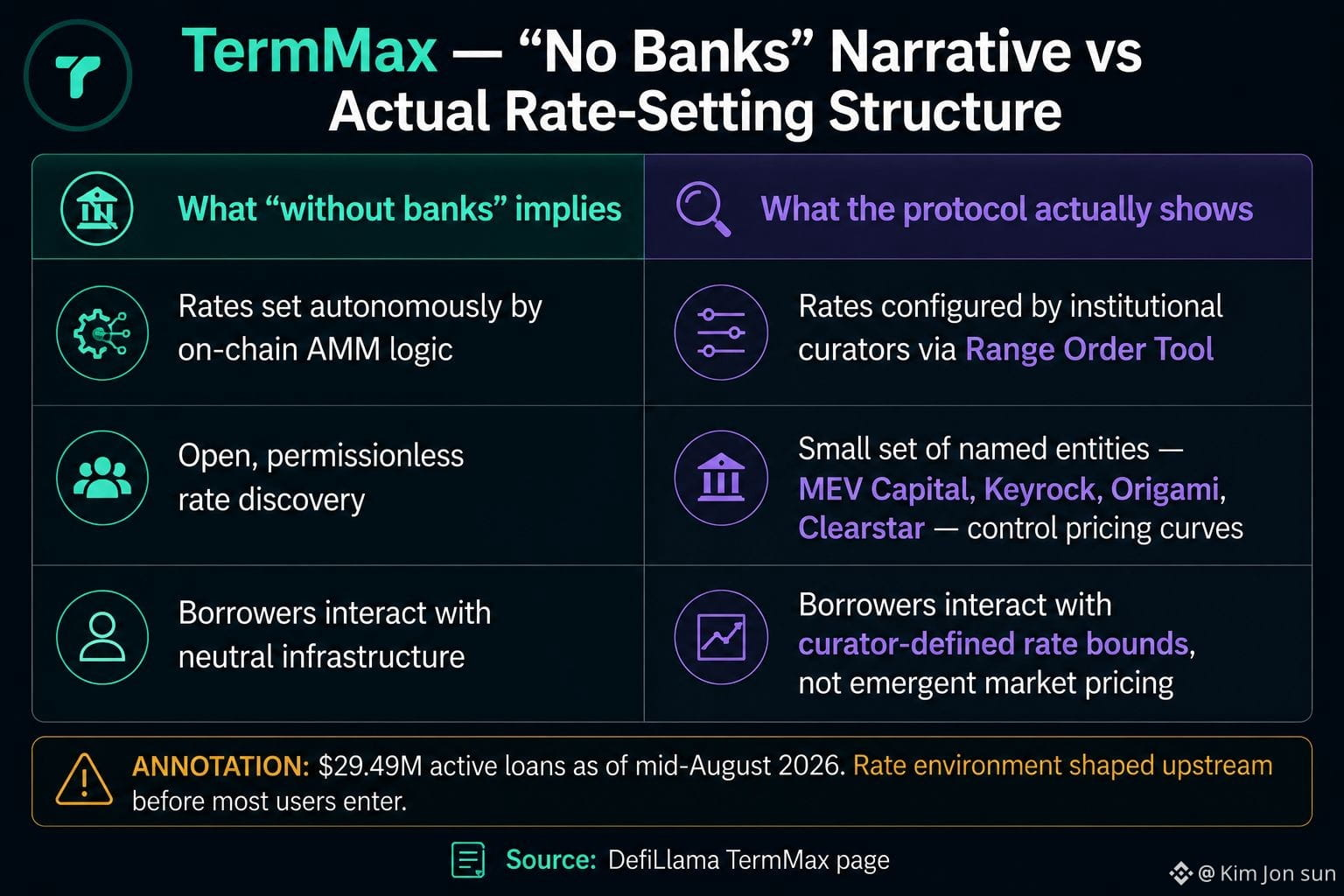
Curators do it. MEV Capital, Keyrock, Origami, Clearstar Labs. These are the entities configuring the Range Order Tool, deciding pricing curves, setting rate bounds across markets. The TGE announcement landed August 15 — token live August 25 — and across that period the protocol held $29.49M in active loans on ~$34M TVL. That loan book didn't price itself. Someone upstream made those decisions, and it wasn't a smart contract acting autonomously.
Which is the thing that quietly reframed the whole topic for me. The "no banks" part is structurally true — no central institution holds custody, no credit officer approves your borrow. But the rate discovery function? That's still a small set of sophisticated actors with outsized influence over what borrowers actually pay. Curators are, in a narrow but real sense, the rate desk.
Hmm. Maybe that's fine. Maybe that's just how fixed-rate markets have to work until order flow deepens enough for the AMM to price itself more organically. But the gap between "decentralized fixed-rate markets" and "curator-managed fixed-rate markets" is worth sitting with a little longer.
@TermMax
Curators do it. MEV Capital, Keyrock, Origami, Clearstar Labs. These are the entities configuring the Range Order Tool, deciding pricing curves, setting rate bounds across markets. The TGE announcement landed August 15 — token live August 25 — and across that period the protocol held $29.49M in active loans on ~$34M TVL. That loan book didn't price itself. Someone upstream made those decisions, and it wasn't a smart contract acting autonomously.
Which is the thing that quietly reframed the whole topic for me. The "no banks" part is structurally true — no central institution holds custody, no credit officer approves your borrow. But the rate discovery function? That's still a small set of sophisticated actors with outsized influence over what borrowers actually pay. Curators are, in a narrow but real sense, the rate desk.
Hmm. Maybe that's fine. Maybe that's just how fixed-rate markets have to work until order flow deepens enough for the AMM to price itself more organically. But the gap between "decentralized fixed-rate markets" and "curator-managed fixed-rate markets" is worth sitting with a little longer.
@TermMax