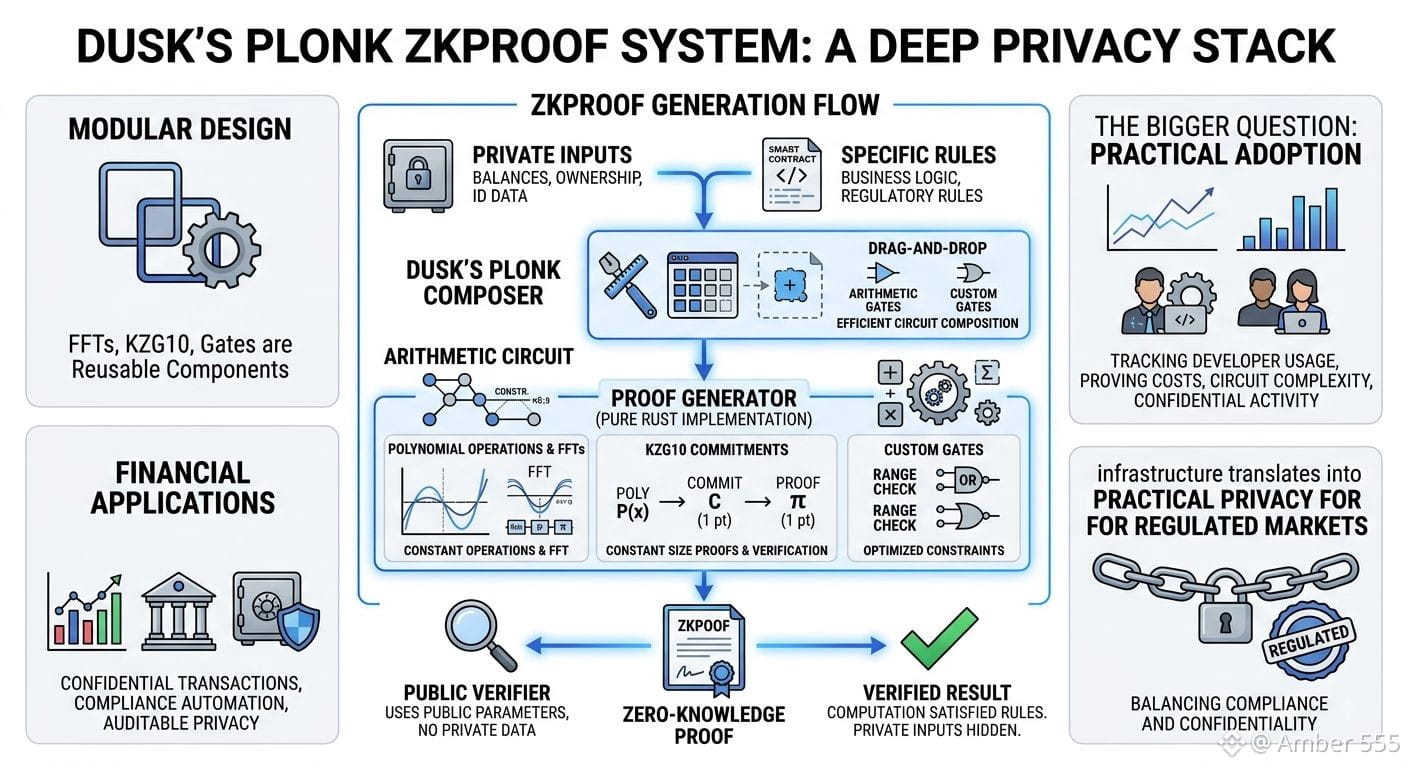
#dusk I think Dusk’s pure Rust implementation of the PLONK ZKProof system is one of the deeper pieces of its privacy stack.
What stands out is the modular design, circuit composition through Composer, polynomial operations, FFTs, KZG10 commitments, custom gates and proof generation are brought together in a reusable framework.
The value is not simply having “ZK” technology. PLONK can let applications prove that computations satisfy specific rules without exposing the underlying private inputs.
For Dusk that is become especially relevant to financial applications where balances, ownership and transaction conditions may need verification without making sensitive information public.
The bigger question is adoption. I actually watch how developers use these primitives, proving costs, circuit complexity, confidential transaction activity and whether this infrastructure translates into practical privacy for regulated markets.
That is where Dusk’s ZK stack gets interesting.
@Dusk_Foundation $DUSK
$PORTAL
$GPS
What stands out is the modular design, circuit composition through Composer, polynomial operations, FFTs, KZG10 commitments, custom gates and proof generation are brought together in a reusable framework.
The value is not simply having “ZK” technology. PLONK can let applications prove that computations satisfy specific rules without exposing the underlying private inputs.
For Dusk that is become especially relevant to financial applications where balances, ownership and transaction conditions may need verification without making sensitive information public.
The bigger question is adoption. I actually watch how developers use these primitives, proving costs, circuit complexity, confidential transaction activity and whether this infrastructure translates into practical privacy for regulated markets.
That is where Dusk’s ZK stack gets interesting.
@Dusk_Foundation $DUSK
$PORTAL
$GPS