#dusk $DUSK @Dusk I went looking at what actually has to happen when someone buys a regulated asset on Dusk, expecting the interesting part to be the trade itself. It isn't.
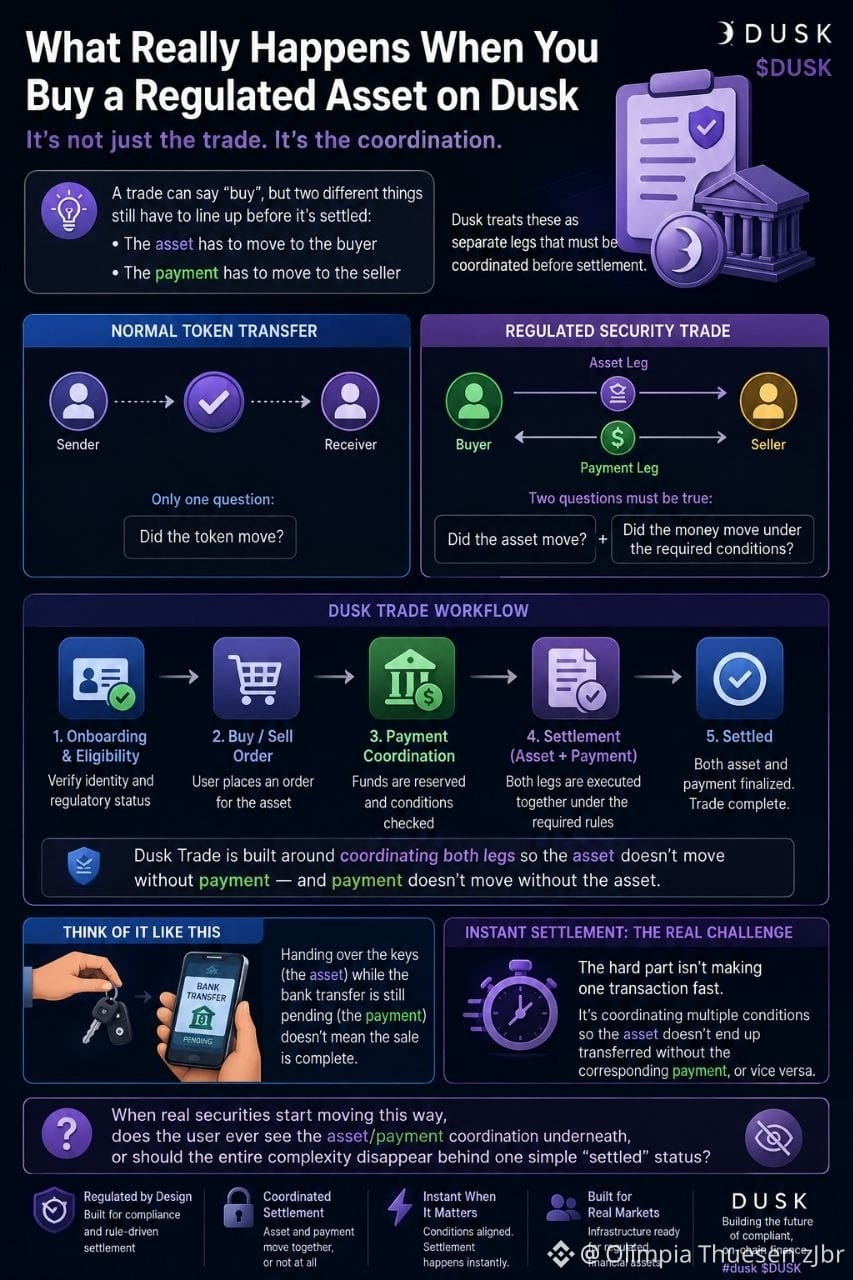
A trade can say "buy" while two different things still have to line up: the asset has to move to the buyer, and the payment has to move to the seller. Dusk's docs treat those as separate legs that need to be coordinated before the transaction is actually settled.
That sounds obvious until you compare it with normal token transfers. Sending a token only answers "did the token move?" A regulated security trade has a second question sitting beside it: "did the money move under the conditions required for this asset transfer?"
That's the part I hadn't really considered. Dusk Trade isn't just a marketplace sitting on top of token balances. Its workflow is built around onboarding, eligibility, buying or selling, payment coordination and settlement — the asset and payment legs have to make sense together.
Like handing someone the keys to a car while the bank transfer for the purchase is still pending. The keys changing hands doesn't automatically mean the sale is complete.
And this is where "instant settlement" gets more interesting to me. The hard part isn't making one transaction fast. It's coordinating multiple conditions so the asset doesn't end up transferred without the corresponding payment, or vice versa.
For regulated markets, that coordination probably matters more than the speed headline.
Still wondering: when real securities start moving this way, does the user ever even see the asset/payment coordination underneath, or should the entire complexity disappear behind one simple "settled" status?@Dusk
#dusk $DUSK