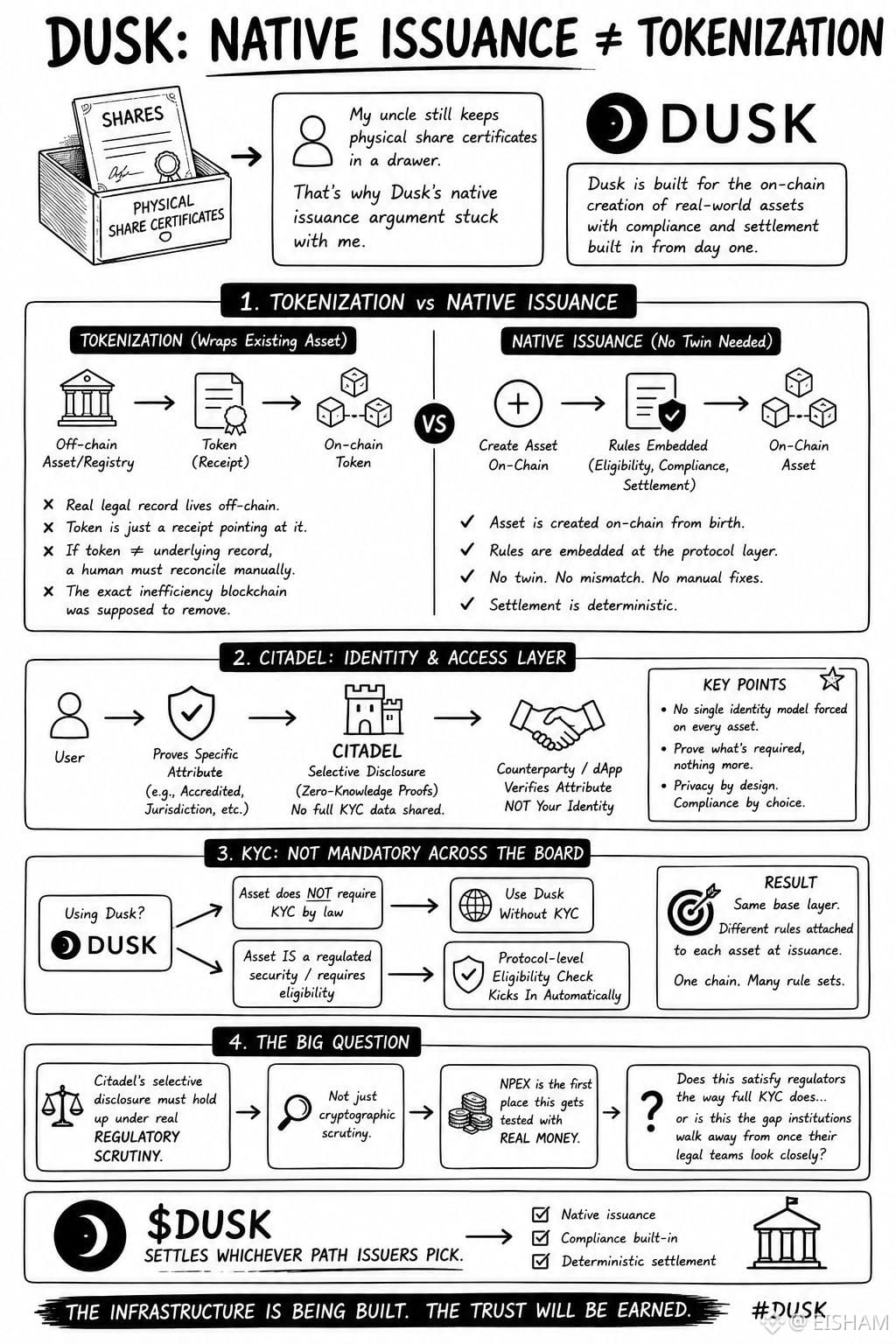
@Dusk #dusk $DUSK My uncle still keeps paper share certificates in a drawer. Never digitized them, doesn't trust it. I brought that up last night trying to explain why @Dusk native issuance argument actually got to me, instead of the usual scroll-past.
Quick distinction most RWA projects blur: tokenization wraps an asset that already exists somewhere else, some registry still holds the real record, and the token's just a receipt. Disagree with that registry and a human has to fix it by hand. Native issuance skips the twin — asset's born on-chain, eligibility and settlement rules already built in.
Here's the part that actually got specific. Citadel, Dusk's identity layer, lets someone prove one attribute — accredited, jurisdiction, whatever — without handing over full KYC. And KYC isn't mandatory everywhere on Dusk. Touch a regulated asset though, and eligibility checks fire automatically at the protocol level. No bolted-on compliance API doing it after the fact.
So the same chain hosts a totally open transfer next to a fully gated security, and the only difference is what got attached at issuance. Neat idea. Still rests entirely on Citadel's proofs surviving actual regulatory scrutiny, not just cryptographic scrutiny — and NPEX is where real money tests that first.
$DUSK settles whichever path issuers choose. Does selective disclosure actually satisfy regulators the way full KYC does, or is that the gap legal teams quietly walk away from?
Quick distinction most RWA projects blur: tokenization wraps an asset that already exists somewhere else, some registry still holds the real record, and the token's just a receipt. Disagree with that registry and a human has to fix it by hand. Native issuance skips the twin — asset's born on-chain, eligibility and settlement rules already built in.
Here's the part that actually got specific. Citadel, Dusk's identity layer, lets someone prove one attribute — accredited, jurisdiction, whatever — without handing over full KYC. And KYC isn't mandatory everywhere on Dusk. Touch a regulated asset though, and eligibility checks fire automatically at the protocol level. No bolted-on compliance API doing it after the fact.
So the same chain hosts a totally open transfer next to a fully gated security, and the only difference is what got attached at issuance. Neat idea. Still rests entirely on Citadel's proofs surviving actual regulatory scrutiny, not just cryptographic scrutiny — and NPEX is where real money tests that first.
$DUSK settles whichever path issuers choose. Does selective disclosure actually satisfy regulators the way full KYC does, or is that the gap legal teams quietly walk away from?