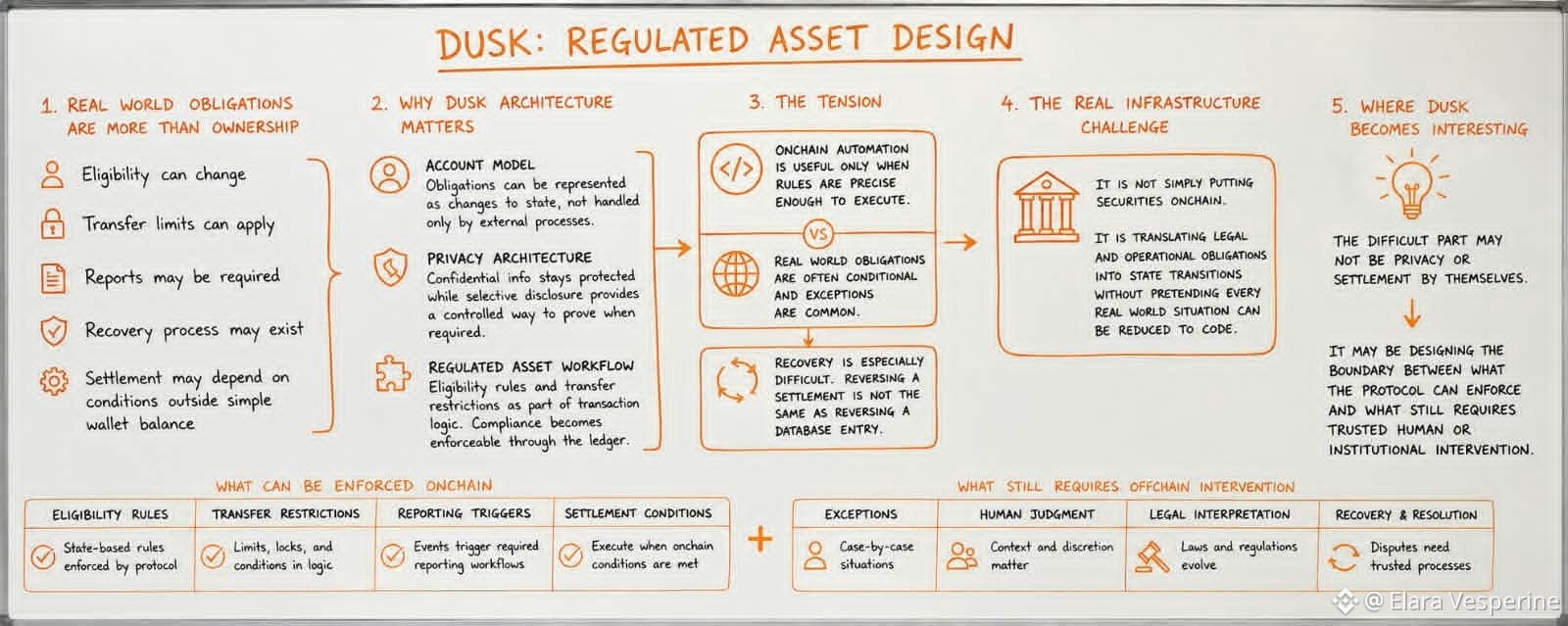
I went looking at Dusk’s regulated asset design and kept coming back to one detail: real world obligations are rarely just about ownership.
Eligibility can change. Transfer limits can apply. Reports may be required. A recovery process may need to exist. Settlement may depend on conditions outside a simple wallet balance.
That made me look at Dusk differently.
The account model matters because obligations can be represented as changes to state rather than being handled entirely by an external process. The privacy architecture matters for a different reason. Confidential information can remain protected while selective disclosure provides a controlled way to prove something when required.
Then there is the regulated asset workflow itself. If eligibility rules and transfer restrictions are treated as part of the transaction logic then compliance is no longer just a document sitting beside the ledger. Some of it can become enforceable through the ledger.
What I found interesting is the tension this creates.
On chain automation is useful only when the rules are precise enough to execute. Real world obligations are often conditional and exceptions are common. Recovery is especially difficult because reversing a settlement is not the same thing as reversing a database entry.
So the real infrastructure challenge is not simply putting securities onchain. It is translating legal and operational obligations into state transitions without pretending every real world situation can be reduced to code.
That is where Dusk’s architecture becomes more interesting to me.
The difficult part may not be privacy or settlement by themselves. It may be designing the boundary between what the protocol can enforce and what still requires trusted human or institutional intervention.#dusk $DUSK @Dusk
Eligibility can change. Transfer limits can apply. Reports may be required. A recovery process may need to exist. Settlement may depend on conditions outside a simple wallet balance.
That made me look at Dusk differently.
The account model matters because obligations can be represented as changes to state rather than being handled entirely by an external process. The privacy architecture matters for a different reason. Confidential information can remain protected while selective disclosure provides a controlled way to prove something when required.
Then there is the regulated asset workflow itself. If eligibility rules and transfer restrictions are treated as part of the transaction logic then compliance is no longer just a document sitting beside the ledger. Some of it can become enforceable through the ledger.
What I found interesting is the tension this creates.
On chain automation is useful only when the rules are precise enough to execute. Real world obligations are often conditional and exceptions are common. Recovery is especially difficult because reversing a settlement is not the same thing as reversing a database entry.
So the real infrastructure challenge is not simply putting securities onchain. It is translating legal and operational obligations into state transitions without pretending every real world situation can be reduced to code.
That is where Dusk’s architecture becomes more interesting to me.
The difficult part may not be privacy or settlement by themselves. It may be designing the boundary between what the protocol can enforce and what still requires trusted human or institutional intervention.#dusk $DUSK @Dusk