I've seen a lot of "real-world asset" projects launch this year, and most of them dodge the same uncomfortable question.
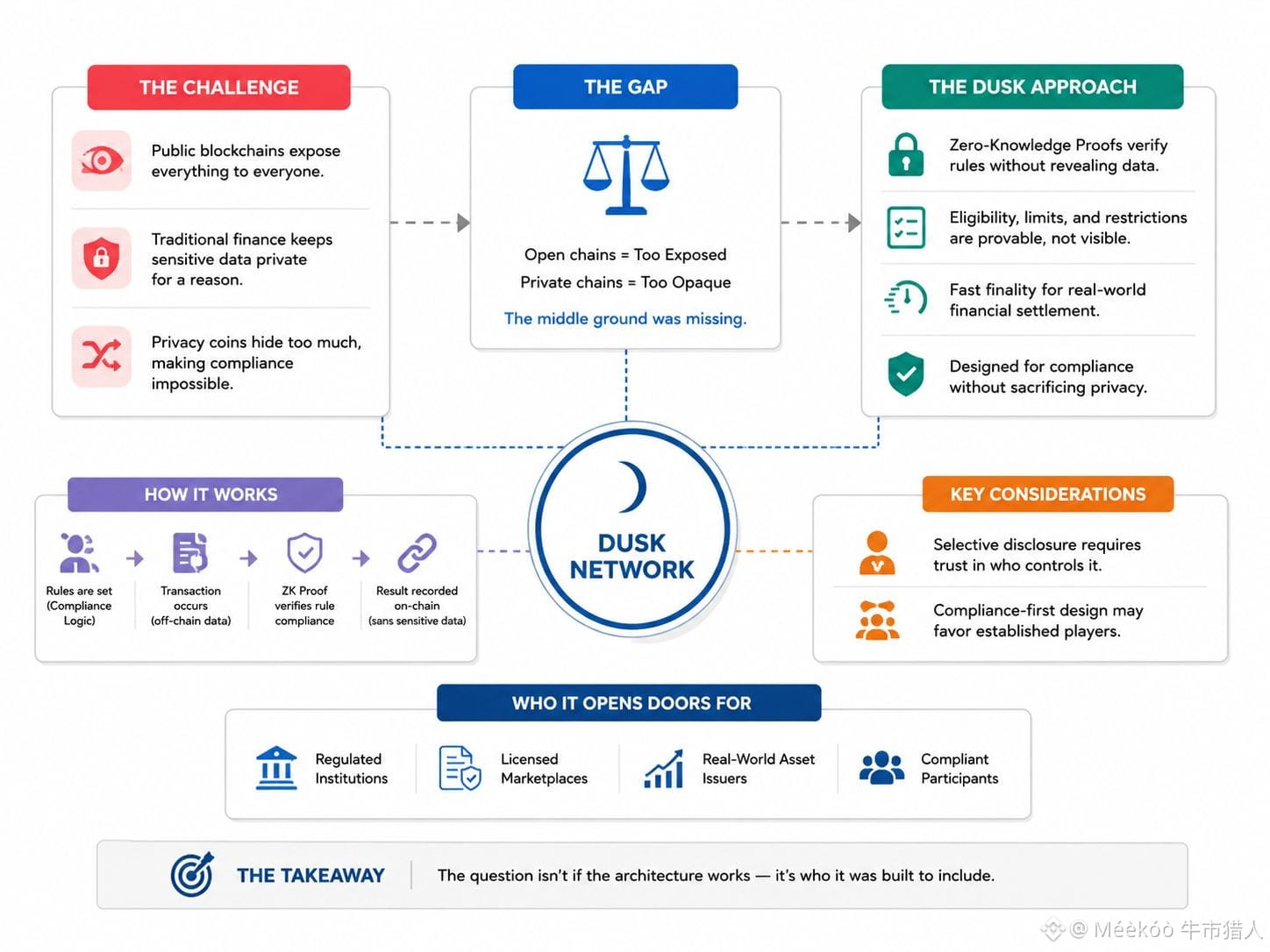
Can a public blockchain, built on the idea that everyone sees everything, ever actually host regulated financial markets?
Traditional exchanges keep client data closed for good reason.
Trade sizes, positions, counterparties — none of that belongs on a screen the whole internet can read.
So when institutions looked at early blockchains, the transparency that crypto people celebrated looked to them like a liability.
Privacy coins tried to answer this years ago, but they went the opposite direction and hid almost everything.
Good for anonymity, terrible for anyone needing to prove a transaction was legitimate.
Regulators couldn't verify ownership limits or eligibility rules if they couldn't see anything at all.
That left a gap neither side of crypto really solved — open chains too exposed, private chains too opaque.
Dusk Network is one attempt to work inside that gap, not erase it.
The idea is fairly simple once you strip away the jargon: zero-knowledge proofs let a transaction prove it followed the rules without showing what the transaction actually contains.
An eligibility check, a transfer restriction, an ownership cap — all confirmable, none of it visible to the public.
Settlement is designed to finalize fast, which matters more in securities markets than most crypto users realize.
None of that erases the harder questions, though.
Selective disclosure only works if the party controlling disclosure is trustworthy, and that's still a human decision, not a cryptographic one.
If issuers or regulators end up holding too much of that control, privacy starts to feel conditional rather than promised.
There's also the matter of who this actually opens doors for.
A system built around compliance tends to reward those who already know how to navigate compliance — established institutions, licensed venues, existing capital.
#dusk $DUSK @Dusk
$HEMI
$PIVX
Can a public blockchain, built on the idea that everyone sees everything, ever actually host regulated financial markets?
Traditional exchanges keep client data closed for good reason.
Trade sizes, positions, counterparties — none of that belongs on a screen the whole internet can read.
So when institutions looked at early blockchains, the transparency that crypto people celebrated looked to them like a liability.
Privacy coins tried to answer this years ago, but they went the opposite direction and hid almost everything.
Good for anonymity, terrible for anyone needing to prove a transaction was legitimate.
Regulators couldn't verify ownership limits or eligibility rules if they couldn't see anything at all.
That left a gap neither side of crypto really solved — open chains too exposed, private chains too opaque.
Dusk Network is one attempt to work inside that gap, not erase it.
The idea is fairly simple once you strip away the jargon: zero-knowledge proofs let a transaction prove it followed the rules without showing what the transaction actually contains.
An eligibility check, a transfer restriction, an ownership cap — all confirmable, none of it visible to the public.
Settlement is designed to finalize fast, which matters more in securities markets than most crypto users realize.
None of that erases the harder questions, though.
Selective disclosure only works if the party controlling disclosure is trustworthy, and that's still a human decision, not a cryptographic one.
If issuers or regulators end up holding too much of that control, privacy starts to feel conditional rather than promised.
There's also the matter of who this actually opens doors for.
A system built around compliance tends to reward those who already know how to navigate compliance — established institutions, licensed venues, existing capital.
#dusk $DUSK @Dusk
$HEMI
$PIVX