
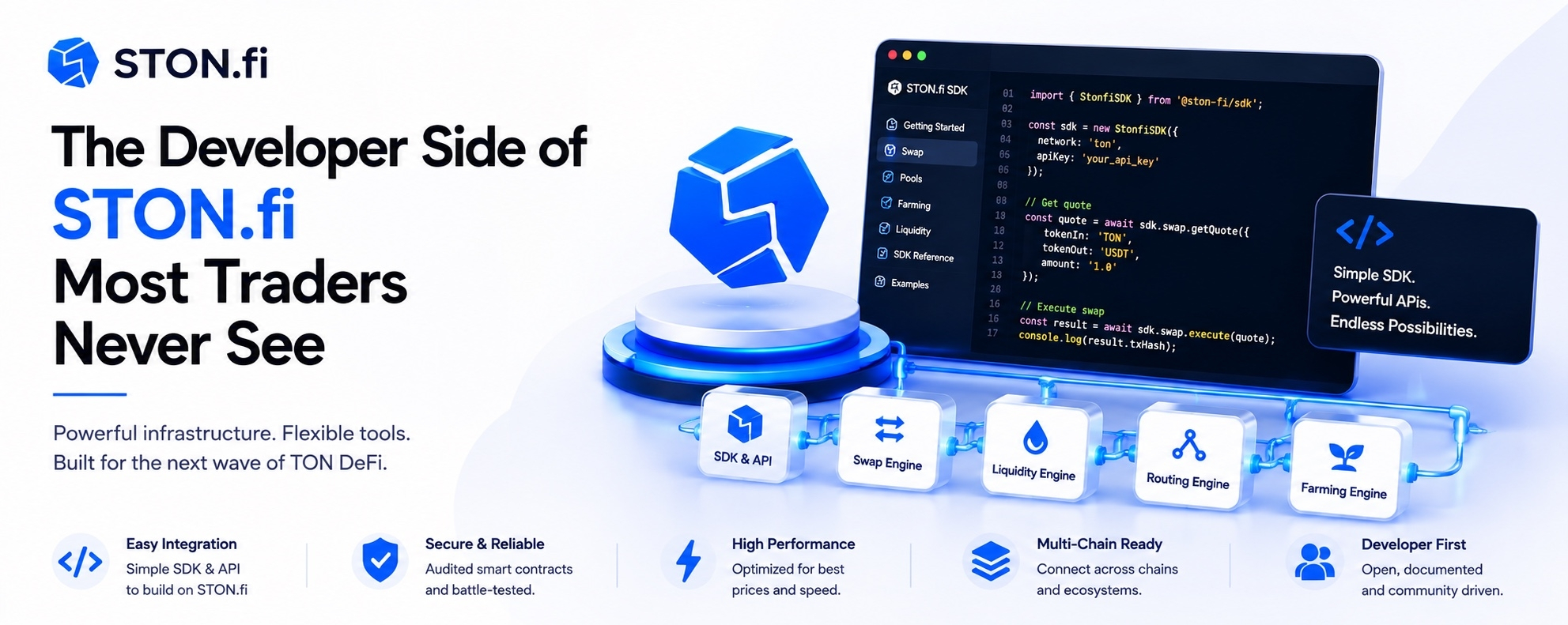
When most people open STONfi, they see a simple trading interface.
Choose a token, enter an amount, review the quote, connect a wallet, and confirm the transaction.
That simplicity is useful for traders, but it can hide how much infrastructure is working underneath the interface.
The developer side of STONfi looks very different.
Instead of asking how to make a swap manually, developers can ask a different question:
How can I bring STONfi’s liquidity and trading capabilities directly into my own application?
That is where the SDK, APIs, widgets, and Omniston become particularly interesting.
STONfi IS ALSO INFRASTRUCTURE
A decentralized exchange can be viewed in two ways.
There is the application that traders interact with.
Then there is the infrastructure that makes those interactions possible.
For developers building wallets, trading applications, games, portfolio tools, or other DeFi products, rebuilding every part of a swap system from scratch would be a major task.
They would need to think about token data, liquidity, routing, transaction construction, wallet interaction, execution, and transaction status.
STONfi provides developer tools designed to make that process easier.
Instead of rebuilding the entire trading infrastructure, developers can integrate STONfi functionality into their own products.
THE SDK GIVES DEVELOPERS A STARTING POINT
One of the most important pieces is the STONfi SDK.
The SDK gives developers programmatic access to STONfi functionality, allowing them to build custom experiences rather than relying entirely on the standard STONfi interface.
This matters because different applications have different needs.
A wallet might want to add a swap button directly inside its interface.
A portfolio application might want users to exchange assets without leaving the dashboard.
A game could potentially integrate token swaps into its economy.
A DeFi application could create a completely customized trading interface.
In each case, the developer can build the experience around the product instead of sending users somewhere else every time they need to swap.
DEVELOPERS DON’T HAVE TO BUILD EVERYTHING FROM ZERO
This is where developer infrastructure becomes valuable.
Imagine a team wants to build a new trading application on TON.
Without existing infrastructure, the team would need to create systems for finding tokens, retrieving pool information, calculating expected output, constructing transactions, handling wallet interactions, and tracking execution.
That is a lot of work before the team even starts building the main product.
Using STONfi’s developer infrastructure can reduce some of that workload.
The team can focus more of its resources on the application itself while using existing infrastructure for the DeFi components.
That can make development faster and reduce unnecessary duplication across the ecosystem.
THE API PROVIDES ACCESS TO IMPORTANT DATA
Another important part of the developer stack is the API.
A trading application needs information to display useful data to users.
Developers may need information about tokens, pools, prices, liquidity, and swap opportunities.
Instead of maintaining every piece of this information independently, developers can use STONfi’s available infrastructure to retrieve relevant data.
This becomes especially useful when building custom interfaces.
The user may never realize where the information comes from because the application can present everything through its own design.
But underneath that interface, the STONfi infrastructure can be helping power the experience.
THE WIDGET MAKES INTEGRATION EVEN SIMPLER
Not every developer wants to build a complete trading interface.
Some teams simply want to give users access to swapping functionality.
This is where the STONfi widget becomes useful.
A developer can integrate a ready made swap experience into an existing application instead of creating every interface component from scratch.
That creates a useful middle ground.
Developers who want full control can build deeper integrations using the SDK and APIs.
Developers who want something faster and simpler can use the widget.
Both approaches allow STONfi functionality to reach users outside the main STONfi application.
THEN THERE IS OMNISTON
This is probably the part of the infrastructure that I find most interesting.
Omniston is designed as an execution and liquidity aggregation layer rather than simply being another interface for swapping tokens.
The problem it addresses is straightforward.
Liquidity can exist across different sources, and the best execution for a particular trade isn’t necessarily available from one place.
If every application had to search through those sources independently, development would become more complicated.
Omniston can handle much of this complexity at the infrastructure level.
Instead of developers having to create their own routing system, they can build on an execution layer designed to find and coordinate available liquidity.
WHY ROUTING MATTERS TO DEVELOPERS
Consider a user who wants to exchange one token for another.
The most obvious approach would be to send the trade through a direct liquidity pool.
But that isn’t always the most efficient option.
There might be deeper liquidity through an intermediate asset.
There might also be better liquidity on another available source.
A good execution system needs to evaluate those possibilities.
Omniston is designed to coordinate liquidity and execution across available sources, allowing applications to access more sophisticated routing without having to recreate the entire system themselves.
For the trader, this can simply look like a quote.
For the developer, there is a considerable amount of infrastructure behind that quote.
CROSS CHAIN MAKES THE INFRASTRUCTURE EVEN MORE COMPLEX
The developer challenge becomes bigger when transactions involve different blockchains.
A normal swap already requires liquidity, routing, transaction construction, and execution.
A cross chain swap introduces another layer of complexity.
The application needs to deal with different networks, assets, wallets, execution environments, and settlement processes.
This is one of the areas where Omniston becomes particularly important.
Its cross chain infrastructure is designed to coordinate execution between different ecosystems while keeping much of that complexity away from the end user.
That means a developer can potentially offer cross chain functionality without building an entire cross chain execution system independently.
RESOLVERS ARE PART OF THE EXECUTION SYSTEM
Another part of Omniston that is easy to miss from the user side is the role of resolvers.
Resolvers can provide execution quotes for orders.
They compete to provide suitable execution opportunities, and the system can evaluate those offers before execution.
This creates a competitive environment around order fulfillment.
For a trader, the interface may simply display an amount to receive.
Behind that number, however, there can be multiple participants competing to execute the transaction.
That is one reason the infrastructure side of STONfi is much more interesting than it initially appears.
THE USER SEES SIMPLICITY
This is perhaps the biggest difference between the trader and developer perspectives.
A trader might see:
Select token → enter amount → confirm
A developer sees a much larger system.
There is token data.
There is liquidity discovery.
There is quote generation.
There is routing.
There is transaction construction.
There is wallet interaction.
There is execution.
There is settlement.
There is transaction tracking.
The goal of good infrastructure is to make all of that complexity manageable for developers and invisible to users.
WHY THIS MATTERS FOR THE TON ECOSYSTEM
A strong ecosystem needs more than individual applications.
It needs infrastructure that allows developers to build new applications without repeatedly solving the same problems.
If every new wallet, game, trading application, and DeFi protocol has to create its own liquidity and execution infrastructure, development becomes slower and more fragmented.
Developer infrastructure can help create common building blocks.
A team can focus on its unique idea while relying on established infrastructure for parts of the trading experience.
That can make it easier for more applications to add DeFi functionality.
THE BIGGER IDEA
The developer side of STONfi changes how I think about the platform.
It isn’t only about where users go to trade.
It can also be part of the infrastructure that other applications use to offer trading functionality.
The SDK gives developers programmability.
The API provides access to useful data and functionality.
The widget makes integration easier for teams that want a ready made experience.
Omniston adds a more sophisticated execution layer for liquidity aggregation, routing, and cross chain execution.
These pieces work toward the same broader goal:
Make DeFi functionality easier to build into other products.
MY TAKE
The most interesting thing about developer infrastructure is that users don’t necessarily notice it when it works well.
A trader doesn’t need to know which API provided the token data.
They don’t need to understand how a route was selected.
They don’t need to know which resolver helped execute their order.
They simply want the transaction to work as expected.
That is why I think the developer side of STONfi deserves more attention.
The interface may be what traders see, but the infrastructure is what allows developers to build new experiences around it.
And as more wallets, applications, games, and DeFi products look for ways to integrate trading functionality, the infrastructure underneath STONfi could become just as important as the DEX that users interact with directly.