#dusk $DUSK @Dusk I checked my stake status on the Rusk Wallet last night expecting a simple yes-or-no, staked or not. Found something with more moving parts than that.
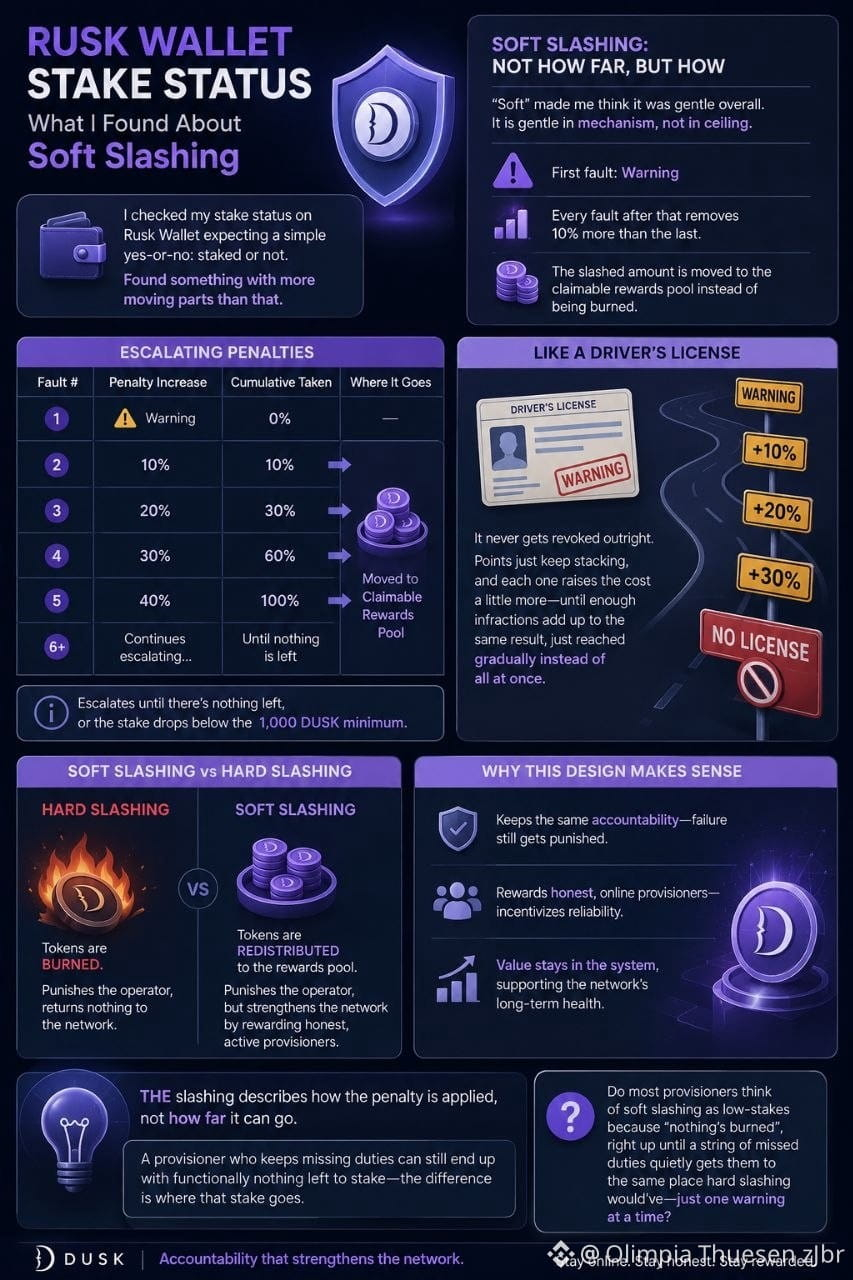
Dusk calls its penalty system soft slashing, and "soft" made me assume it was gentle across the board. It's gentle in mechanism, not in ceiling. First fault gets a warning. Every one after that removes 10% more than the last, 10%, then 20%, then 30%, moved to the claimable rewards pool instead of burned. Technically nothing's destroyed. But the docs are plain that this keeps escalating until there's nothing left, or the stake drops below the 1,000 DUSK minimum.
Like a driver's license that never gets revoked outright, points just keep stacking, and each one raises the cost a little more, until enough infractions add up to the same result as losing the license, just arrived at gradually instead of all at once.
That's the part I hadn't expected from a "not burned" design. Soft slashing describes how the penalty is applied, not how far it can go. A provisioner who keeps missing duties can still end up with functionally nothing left to stake, the difference is where that stake goes. Burned tokens vanish. Soft-slashed tokens get redistributed to the rewards pool other honest provisioners are drawing from.
Makes sense for a chain built around financial infrastructure. Burning stake outright punishes the operator but returns nothing to the network. Redistributing it to active, honest provisioners actually reinforces the incentive to stay online, the same failure gets punished, but the value doesn't just disappear from the system.
Curious whether most provisioners think of soft slashing as low-stakes because "nothing's burned," right up until a string of missed duties quietly gets them to the same place hard slashing would've, just one warning at a time.