One thing that kept bothering me while looking into Dusk Foundation:
Why do we assume the future of finance should be completely public?
Crypto often treats transparency as an absolute good. Every transaction visible. Every wallet traceable. Every movement of capital open for anyone to inspect.
That made sense when the goal was removing blind trust.
But what happens when real businesses, institutions, and regulated financial markets move on-chain?
A company wouldn't publish every financial decision it makes. An investment fund wouldn't reveal every position it holds. A pension fund wouldn't expose its strategy to competitors.
That's not secrecy.
That's normal.
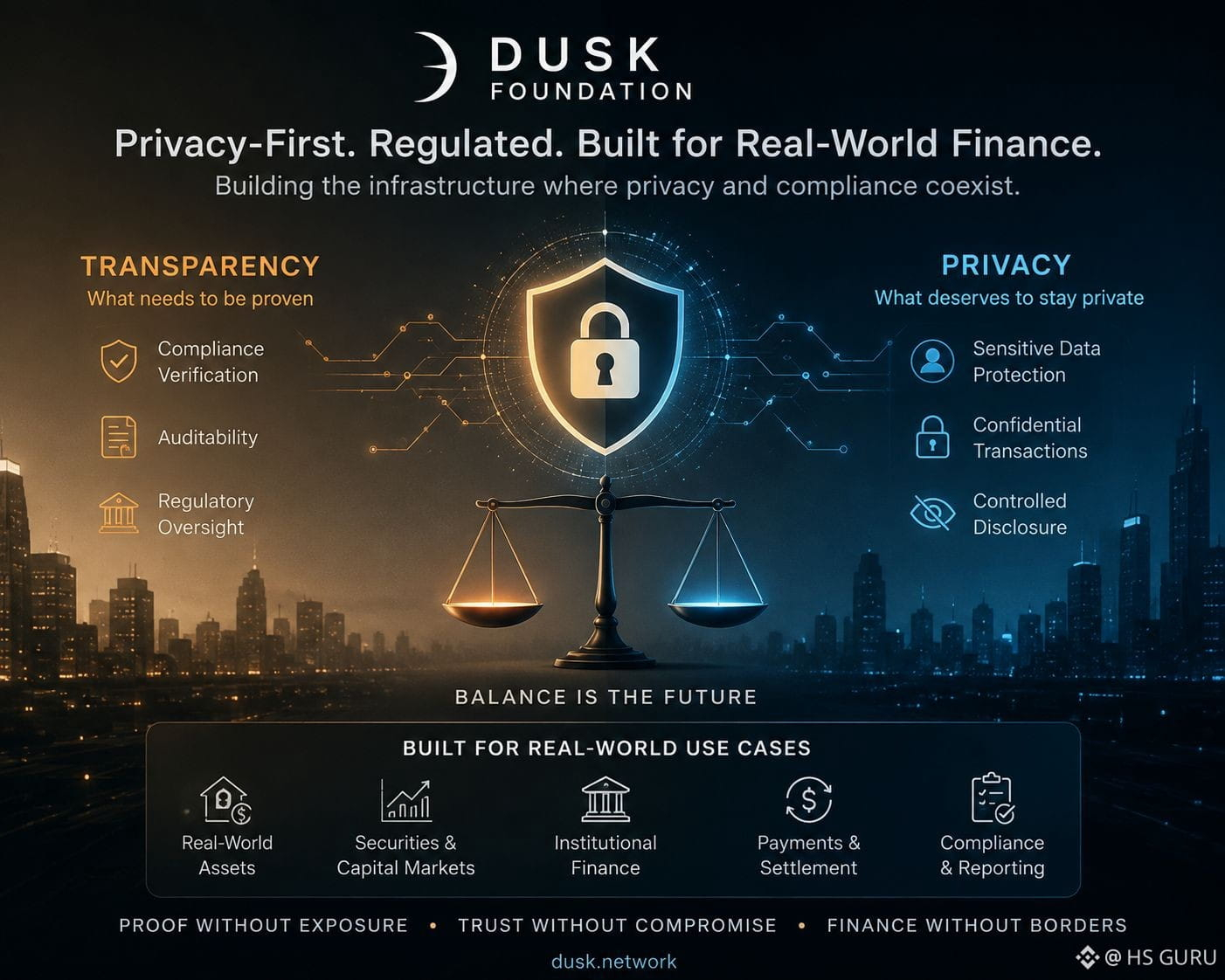
The more I looked at Dusk, the more I felt the project wasn't really trying to solve privacy. It was trying to solve the tension between privacy and accountability.
The idea is surprisingly simple: prove what's necessary without revealing everything underneath it.
Compliance without surveillance.
Verification without exposure.
Trust without forcing participants to become open books.
What's interesting is that Dusk isn't positioning itself against regulation. If anything, it's exploring whether privacy and regulation can coexist inside the same financial infrastructure.
That feels like a much bigger question than most people realize.
Because if blockchain eventually becomes the foundation for real-world assets, securities, and institutional finance, then transparency alone may not be enough.
The future might not belong to systems that reveal everything.
It might belong to systems that know exactly what needs to be revealed—and what deserves to remain private.
Maybe that's where Dusk fits.
Not as a privacy narrative.
But as an attempt to build a financial system where trust and confidentiality don't have to compete.
#dusk
@Dusk_Foundation
$DUSK
Why do we assume the future of finance should be completely public?
Crypto often treats transparency as an absolute good. Every transaction visible. Every wallet traceable. Every movement of capital open for anyone to inspect.
That made sense when the goal was removing blind trust.
But what happens when real businesses, institutions, and regulated financial markets move on-chain?
A company wouldn't publish every financial decision it makes. An investment fund wouldn't reveal every position it holds. A pension fund wouldn't expose its strategy to competitors.
That's not secrecy.
That's normal.
The more I looked at Dusk, the more I felt the project wasn't really trying to solve privacy. It was trying to solve the tension between privacy and accountability.
The idea is surprisingly simple: prove what's necessary without revealing everything underneath it.
Compliance without surveillance.
Verification without exposure.
Trust without forcing participants to become open books.
What's interesting is that Dusk isn't positioning itself against regulation. If anything, it's exploring whether privacy and regulation can coexist inside the same financial infrastructure.
That feels like a much bigger question than most people realize.
Because if blockchain eventually becomes the foundation for real-world assets, securities, and institutional finance, then transparency alone may not be enough.
The future might not belong to systems that reveal everything.
It might belong to systems that know exactly what needs to be revealed—and what deserves to remain private.
Maybe that's where Dusk fits.
Not as a privacy narrative.
But as an attempt to build a financial system where trust and confidentiality don't have to compete.
#dusk
@Dusk_Foundation
$DUSK