#dusk $DUSK @Dusk
I’ve always found the privacy debate in crypto a little strange. People often act like you have to choose one side: keep everything private or make everything transparent for compliance.
Dusk is interesting because it tries to challenge that idea.
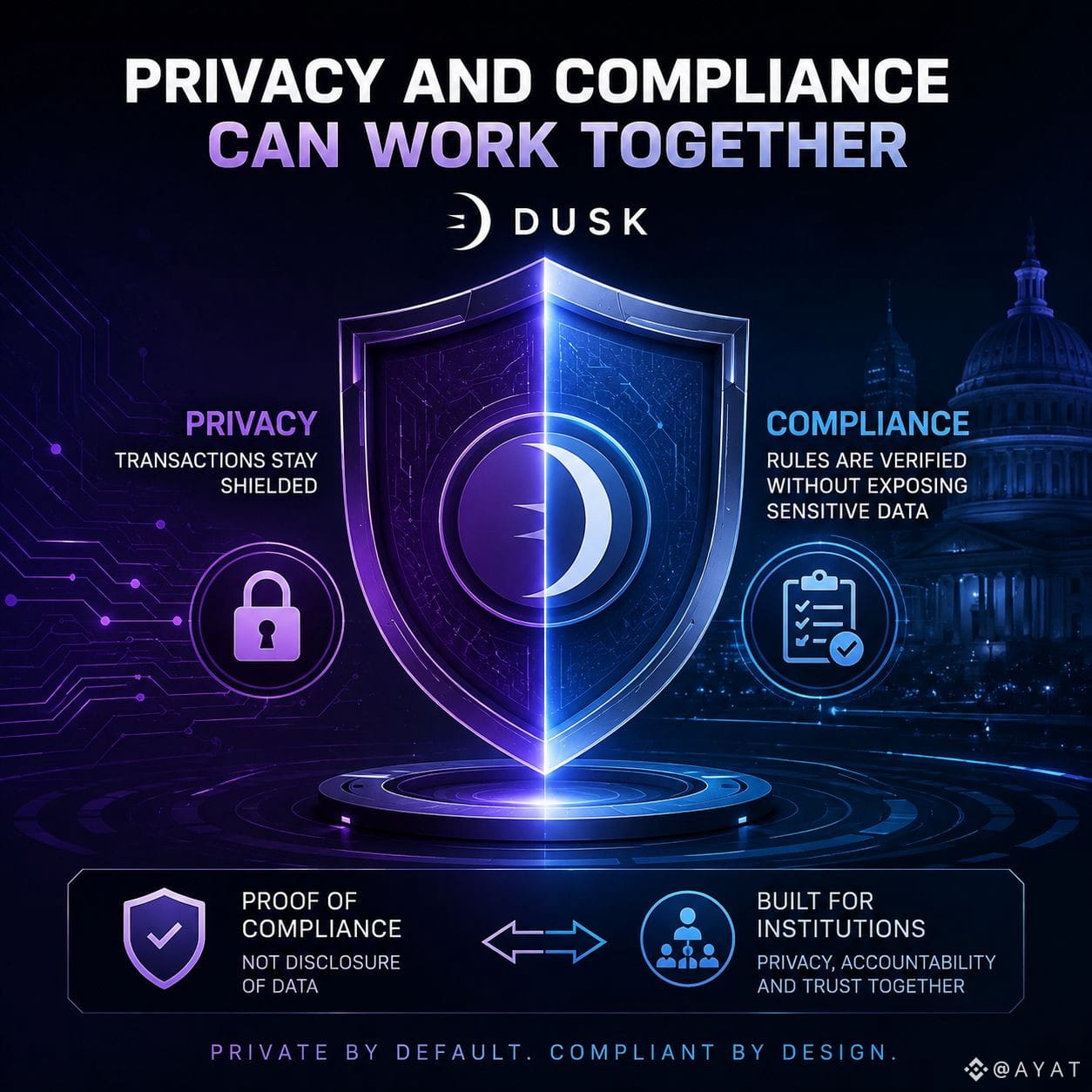
The part that stands out to me is selective disclosure. Instead of putting sensitive transaction details in the open, the network can aim to prove that certain rules were followed without exposing all the information behind the transaction.
Think about an institution dealing with tokenized assets. It may need to prove that an investor is eligible, ownership limits were respected, or a transfer followed specific restrictions.
That doesn’t automatically mean everyone needs to see the investor’s private financial information.
And honestly, that distinction matters.
Making everything public is not the same as being compliant. Sometimes it simply creates another privacy problem.
The bigger question is whether regulators will eventually trust cryptographic proofs enough to replace traditional disclosure in certain situations.
That’s where Dusk has something worth watching. The challenge isn’t just creating private transactions. It’s building a system where privacy, accountability, and regulation can actually coexist.
If that works at scale, privacy could become part of institutional infrastructure rather than a barrier to adoption.
Would you trust a cryptographic proof of compliance, or would you still want access to the underlying data?
#Dusk
I’ve always found the privacy debate in crypto a little strange. People often act like you have to choose one side: keep everything private or make everything transparent for compliance.
Dusk is interesting because it tries to challenge that idea.
The part that stands out to me is selective disclosure. Instead of putting sensitive transaction details in the open, the network can aim to prove that certain rules were followed without exposing all the information behind the transaction.
Think about an institution dealing with tokenized assets. It may need to prove that an investor is eligible, ownership limits were respected, or a transfer followed specific restrictions.
That doesn’t automatically mean everyone needs to see the investor’s private financial information.
And honestly, that distinction matters.
Making everything public is not the same as being compliant. Sometimes it simply creates another privacy problem.
The bigger question is whether regulators will eventually trust cryptographic proofs enough to replace traditional disclosure in certain situations.
That’s where Dusk has something worth watching. The challenge isn’t just creating private transactions. It’s building a system where privacy, accountability, and regulation can actually coexist.
If that works at scale, privacy could become part of institutional infrastructure rather than a barrier to adoption.
Would you trust a cryptographic proof of compliance, or would you still want access to the underlying data?
#Dusk