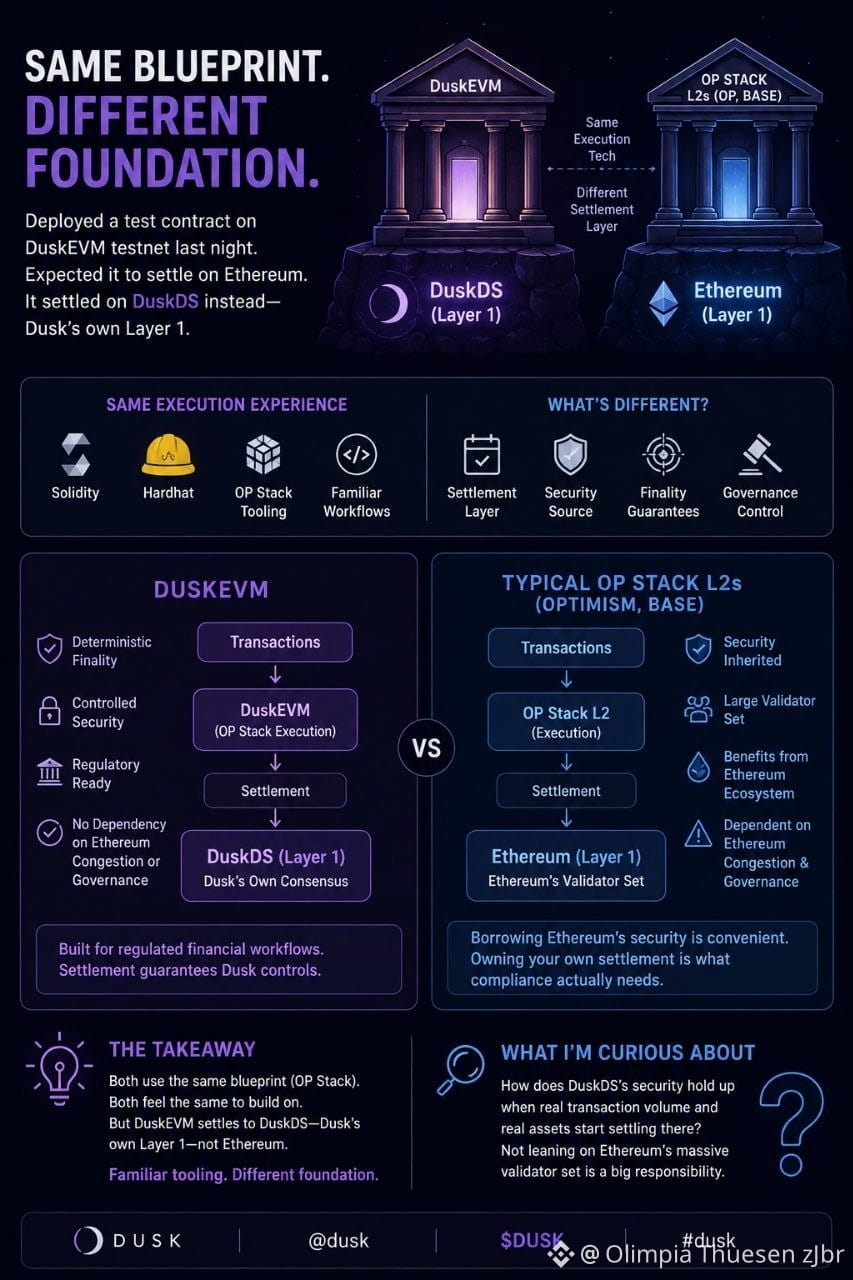
#dusk $DUSK I deployed a simple test contract on DuskEVM testnet last night and went to check where it actually settled, expecting Ethereum since the whole stack is built on OP Stack tooling. Wasn't there. It settled to DuskDS instead, Dusk's own Layer 1.
That's the part that stopped me. Optimism and Base run the same OP Stack architecture and post their state back to Ethereum, borrowing Ethereum's validator set as the security backbone underneath. DuskEVM uses the identical execution tech, Solidity, Hardhat, the familiar tooling, but the settlement layer underneath it is Dusk's own consensus, not Ethereum's.
Like two buildings built from the same blueprint, standing on completely different foundations. Same floor plan. Different ground holding it up.
Makes sense once you think about why: an EVM layer meant for regulated financial workflows needs settlement guarantees Dusk actually controls, deterministic finality, no dependency on Ethereum's own congestion or governance. Borrowing someone else's security is convenient. Owning your own settlement is what a chain built for compliance actually needs.
But it does mean "OP Stack" is doing less work as a trust signal here than it does for a typical Ethereum L2. Familiar tooling, different foundation.
Curious how DuskDS's own security compares in practice once real transaction volume and real assets start settling there, since it's not leaning on Ethereum's much larger validator set to do that job.
@Dusk $DUSK #dusk @Dusk