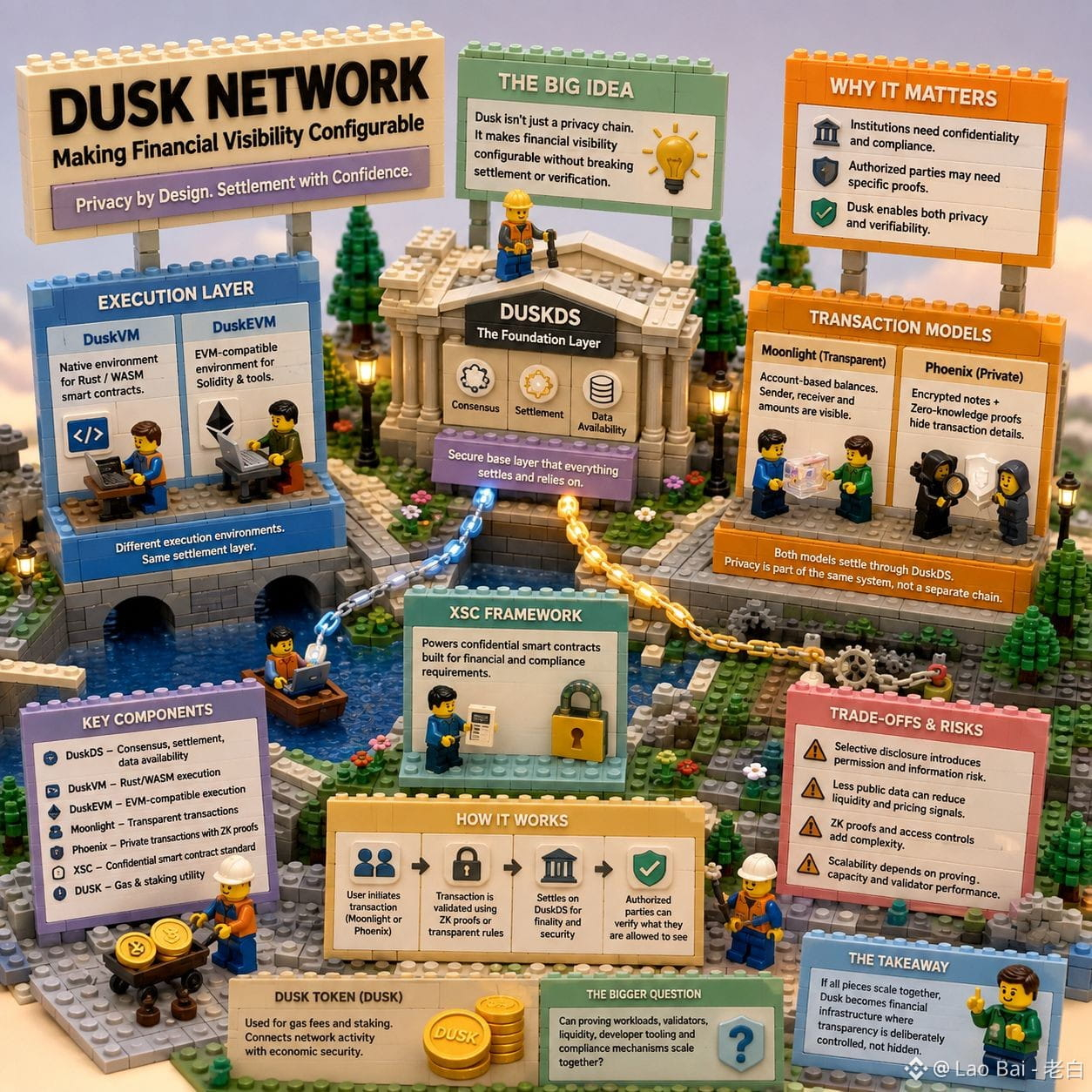
The more I study Dusk the less I think privacy blockchain is a complete description. What interests me is making financial visibility configurable without breaking settlement or verification. DuskDS forms the base layer for consensus settlement and data availability while DuskVM and DuskEVM separate execution from that foundation. This lets developers use different environments while keeping settlement anchored to the same network.
Looking one layer deeper Moonlight and Phoenix show what this architecture is really trying to solve. Moonlight uses transparent account based balances while Phoenix uses encrypted notes and zero knowledge proofs to validate transfers without exposing sensitive details. Both models settle through DuskDS. That matters for financial applications because privacy alone is not enough institutions may need confidentiality while authorized parties still need specific proofs. The XSC framework extends this into confidential smart contracts, but introduces a trade off.selective disclosure can improve compliance while creating permission and information-control risks. Less public data may protect participants, but it can also reduce useful liquidity and pricing signals.
DUSK connects the system through gas and staking. The bigger question is whether proving workloads, validators liquidity, developer tooling and compliance mechanisms can scale together. If they can, Dusk becomes less about hiding transactions and more about financial infrastructure where transparency is deliberately controlled.
@Dusk #dusk $DUSK
Looking one layer deeper Moonlight and Phoenix show what this architecture is really trying to solve. Moonlight uses transparent account based balances while Phoenix uses encrypted notes and zero knowledge proofs to validate transfers without exposing sensitive details. Both models settle through DuskDS. That matters for financial applications because privacy alone is not enough institutions may need confidentiality while authorized parties still need specific proofs. The XSC framework extends this into confidential smart contracts, but introduces a trade off.selective disclosure can improve compliance while creating permission and information-control risks. Less public data may protect participants, but it can also reduce useful liquidity and pricing signals.
DUSK connects the system through gas and staking. The bigger question is whether proving workloads, validators liquidity, developer tooling and compliance mechanisms can scale together. If they can, Dusk becomes less about hiding transactions and more about financial infrastructure where transparency is deliberately controlled.
@Dusk #dusk $DUSK