#globalstocksnearrecordhighs #AlphaFamily
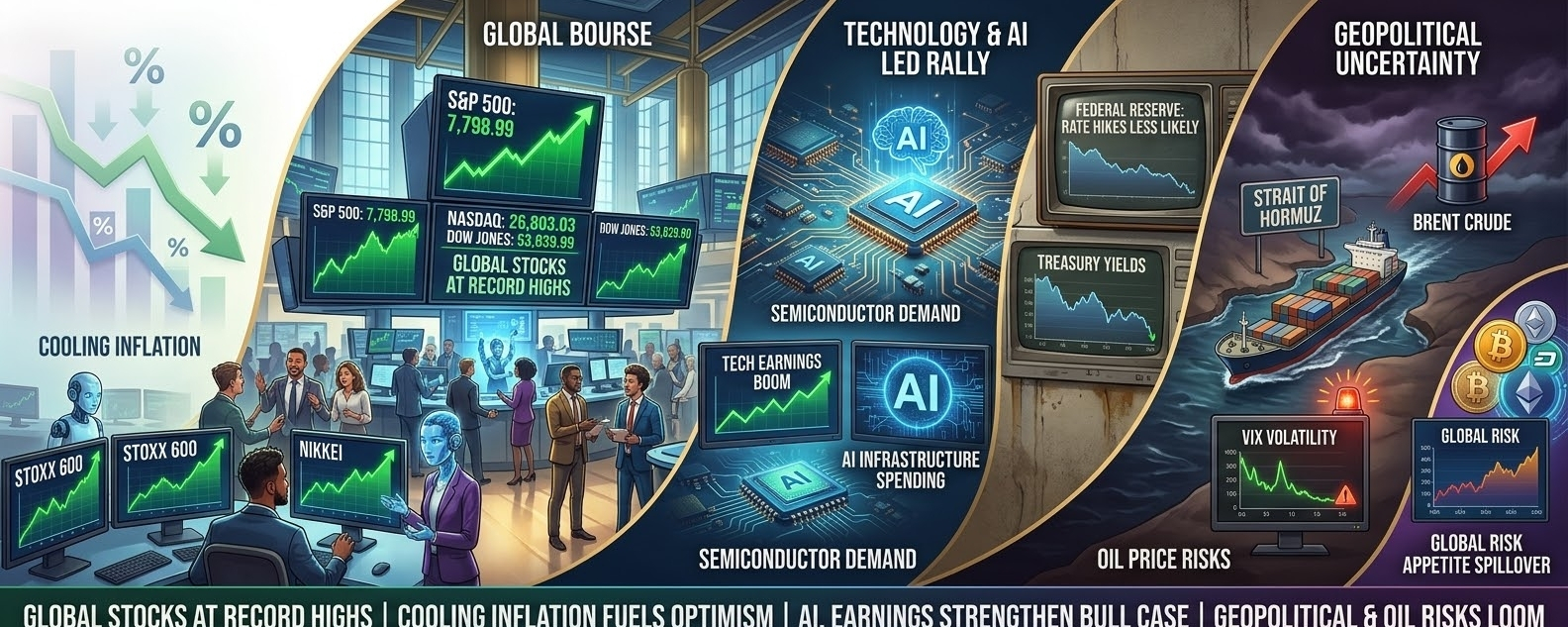
Global stocks are hovering near record levels as investors continue to digest a combination of softer U.S. inflation, strong corporate earnings and growing expectations that the Federal Reserve may have less reason to raise interest rates in the near term. The global rally has pushed major equity benchmarks close to their highest levels ever, showing just how quickly investor confidence has recovered despite persistent geopolitical and economic risks.
Wall Street remains one of the biggest drivers of the move. On Thursday, August 13, the S&P 500 closed at a record 7,798.99 after gaining 0.65%, while the Nasdaq Composite climbed 0.81% to 26,803.03 and the Dow Jones Industrial Average added 0.13% to finish at 53,839.99. The S&P 500 is now up roughly 14% in 2026, while the Nasdaq has gained around 15%, highlighting the strength of the U.S. equity rally.
A major catalyst has been the latest inflation data. July producer prices came in softer than investors had feared, following signs that consumer inflation was also cooling. That combination has reduced expectations for an immediate Federal Reserve rate hike and helped Treasury yields move lower. For equity investors, that matters because lower or more stable borrowing costs can support corporate valuations, particularly in technology and growth stocks where future earnings are heavily influenced by interest-rate expectations.
Technology and artificial-intelligence stocks remain at the center of the rally. Strong earnings expectations and continued enthusiasm around AI infrastructure have helped heavyweight technology companies attract capital even as valuations remain elevated. Recent moves in semiconductor stocks have also reinforced the idea that investors are still willing to pay a premium for companies positioned to benefit from long-term AI spending. At the same time, individual earnings reports have produced sharp differences between winners and losers, showing that investors are becoming increasingly selective rather than simply buying the entire technology sector.
The strength is not limited to the United States. European equities are also trading close to record territory, with the STOXX 600 remaining near its highs. European markets have benefited from solid corporate earnings, attractive valuations compared with some U.S. technology shares, and renewed interest in sectors such as banking, defense, energy and pharmaceuticals. Italy and Spain have been among the stronger European markets this year, while the broader European rally demonstrates that the current equity momentum is more global than it may appear from simply watching Wall Street.
Asian markets have also participated in the broader risk-on environment. Japan's Nikkei remains well above its earlier levels, while semiconductor-heavy markets have benefited from continued demand expectations surrounding artificial intelligence and advanced computing. However, performance across Asia has been uneven, with some markets trading higher while others struggled to maintain the positive momentum coming from Wall Street.
Another important factor is the behavior of the U.S. dollar, Treasury yields and commodities. A softer inflation outlook can reduce pressure on interest rates and potentially weaken the dollar, creating a more supportive environment for global risk assets. Gold has also remained elevated, reflecting the fact that investors are not completely ignoring geopolitical uncertainty even while they continue buying equities. The market is effectively balancing two competing forces: optimism about inflation and economic growth on one side, and concerns about geopolitical tensions and commodity prices on the other.
Oil is one of the biggest risks hanging over the rally. Brent crude has risen sharply over the week as tensions surrounding Iran and the Strait of Hormuz continue to influence energy markets. Higher oil prices can eventually feed into inflation, transportation costs and household spending, potentially making the Federal Reserve's job more difficult. If energy prices remain elevated for an extended period, investors could start questioning whether the current optimism about falling inflation is sustainable.
Geopolitical uncertainty is therefore becoming increasingly important. Markets have so far shown remarkable resilience despite the unresolved conflict involving Iran and continuing concerns around energy supply routes. The VIX volatility index has fallen for four consecutive weeks, suggesting that investors are currently pricing in relatively limited near-term market stress. That calm, however, should not be confused with the disappearance of risk. A sudden escalation in the Middle East could quickly push oil prices higher, lift inflation expectations and reverse some of the recent gains in stocks.
The current market setup is particularly interesting because stocks are reaching record levels while interest rates remain relatively high by recent standards. Historically, rising bond yields can pressure equity valuations, but investors have been willing to look through higher yields when they believe economic growth and corporate earnings are strong enough to compensate. The sustainability of this rally may therefore depend less on whether stocks are already expensive and more on whether earnings growth can continue to justify those valuations.
For investors, the biggest question now is whether the record-high environment represents the beginning of another sustained leg higher or a market that has become vulnerable to disappointment. Positive inflation data, strong AI-related earnings and expectations for easier monetary policy are clearly supporting sentiment. But markets are also pricing in a lot of good news. Any unexpected jump in inflation, renewed surge in oil prices, deterioration in corporate earnings or escalation in geopolitical tensions could quickly change the mood.
For crypto markets, the strength in global equities is also worth watching. When investors become more comfortable taking risk across traditional markets, that broader risk appetite can eventually spill into Bitcoin and other digital assets. Lower expectations for aggressive monetary tightening can also improve liquidity conditions across risk assets. However, crypto remains considerably more volatile than equities, meaning a change in global risk sentiment can produce much larger moves in either direction.
For now, the message from global markets is clear: investors remain optimistic. The S&P 500 has reached another record close, European shares are hovering near historic highs, Asian equities remain strong in key markets, and softer U.S. inflation has reduced immediate fears of another rate increase.
But record highs can create a dangerous illusion of certainty. Markets do not need a major crisis to pull back; sometimes all it takes is a piece of economic data that changes expectations. The next phase will likely depend on inflation, Federal Reserve policy, corporate earnings, oil prices and geopolitical developments. If inflation continues to cool while earnings remain strong, global equities could have room to push even higher. If those conditions reverse, the same record levels that currently look bullish could become the starting point for a much sharper correction.