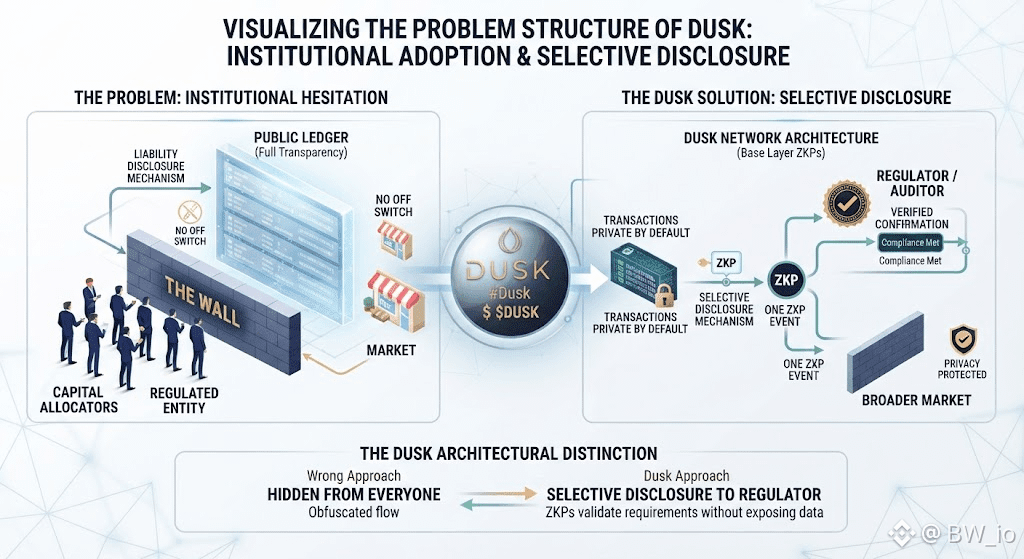
Every serious institution approaching onchain infrastructure hits the same wall. Public ledgers are the feature retail celebrates and the reason institutions hesitate. Full transparency isn't neutrality. For a regulated entity executing meaningful size, a public ledger is a liability disclosure mechanism with no off switch.
That wall is what pulled me into Dusk Foundation three days ago.
The architecture starts from a different assumption entirely. Transactions are private by default. Not obfuscated. Not mixed. Cryptographically private through zero knowledge proofs at the base layer. Selective disclosure then lets a verified participant reveal specific transaction data to a specific regulator without exposing the same data to the broader market.
Every privacy solution I'd examined before answered the wrong question. They asked how to hide transactions from everyone. Institutions don't need to hide from everyone. They need to disclose to someone specific without disclosing to everyone else simultaneously. Those are structurally different problems requiring structurally different cryptography.
Zero knowledge proofs solve the second problem cleanly. You prove a transaction meets regulatory requirements without revealing the transaction itself. The regulator receives verified confirmation. The market receives nothing. Both outcomes from the same cryptographic event.
The question I can't answer yet: whether major regulatory bodies will accept zero knowledge proof verification as legally equivalent to traditional disclosure. The cryptography is sound. The legal framework is not settled.
That gap is where most institutional blockchain infrastructure has quietly stalled before.
$DUSK @Dusk #Dusk #dusk $EDEN $AKE
That wall is what pulled me into Dusk Foundation three days ago.
The architecture starts from a different assumption entirely. Transactions are private by default. Not obfuscated. Not mixed. Cryptographically private through zero knowledge proofs at the base layer. Selective disclosure then lets a verified participant reveal specific transaction data to a specific regulator without exposing the same data to the broader market.
Every privacy solution I'd examined before answered the wrong question. They asked how to hide transactions from everyone. Institutions don't need to hide from everyone. They need to disclose to someone specific without disclosing to everyone else simultaneously. Those are structurally different problems requiring structurally different cryptography.
Zero knowledge proofs solve the second problem cleanly. You prove a transaction meets regulatory requirements without revealing the transaction itself. The regulator receives verified confirmation. The market receives nothing. Both outcomes from the same cryptographic event.
The question I can't answer yet: whether major regulatory bodies will accept zero knowledge proof verification as legally equivalent to traditional disclosure. The cryptography is sound. The legal framework is not settled.
That gap is where most institutional blockchain infrastructure has quietly stalled before.
$DUSK @Dusk #Dusk #dusk $EDEN $AKE