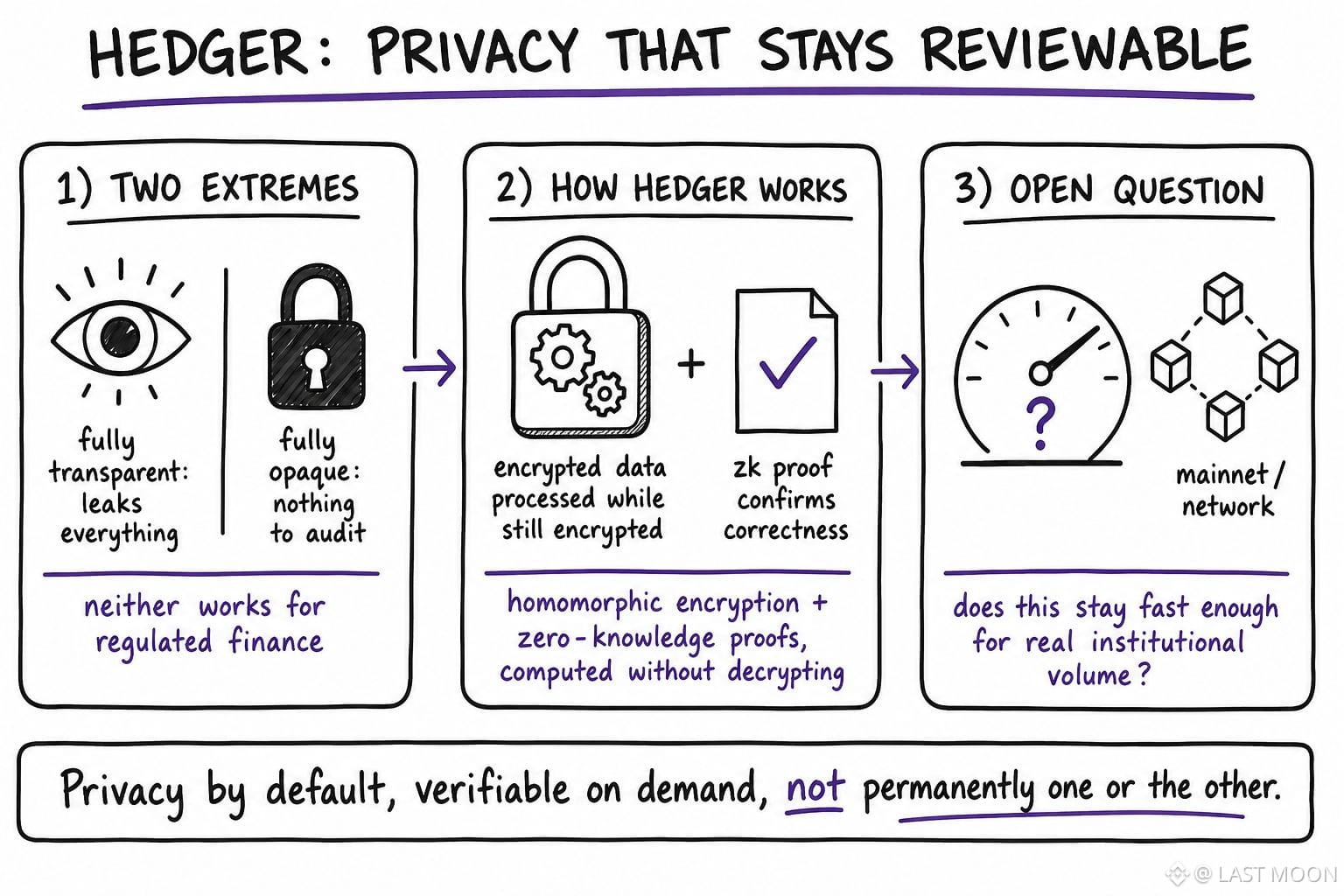
I used to assume privacy on an EVM chain meant picking one of two extremes, either everything's encrypted and unreadable to regulators, or everything's transparent and there's no privacy at all. changed my mind once I looked at how Hedger actually handles this on DuskEVM.
Hedger isn't just encryption bolted onto EVM transactions. it combines homomorphic encryption with zero-knowledge proofs, which means computation can happen on encrypted data without ever decrypting it first, while a separate proof confirms the result is correct. that's what makes selective disclosure possible. the data stays private by default, but an authorized reviewer can still verify what happened without the entire chain being exposed to everyone.
that distinction matters more for regulated finance than it sounds. a fully transparent chain leaks position sizes and counterparty behavior to competitors. a fully opaque chain gives regulators nothing to audit.
Hedger's bet is that neither extreme actually works for institutions, and the harder, more useful problem is building privacy that stays reviewable on demand instead of choosing one side permanently.
what I don't know yet is how this performs once real transaction volume hits DuskEVM mainnet.
homomorphic encryption has historically been computationally expensive. the theory checks out, but whether confidential EVM workflows stay fast enough for actual institutional use is something only mainnet load will answer.
@Dusk $DUSK #dusk
Hedger isn't just encryption bolted onto EVM transactions. it combines homomorphic encryption with zero-knowledge proofs, which means computation can happen on encrypted data without ever decrypting it first, while a separate proof confirms the result is correct. that's what makes selective disclosure possible. the data stays private by default, but an authorized reviewer can still verify what happened without the entire chain being exposed to everyone.
that distinction matters more for regulated finance than it sounds. a fully transparent chain leaks position sizes and counterparty behavior to competitors. a fully opaque chain gives regulators nothing to audit.
Hedger's bet is that neither extreme actually works for institutions, and the harder, more useful problem is building privacy that stays reviewable on demand instead of choosing one side permanently.
what I don't know yet is how this performs once real transaction volume hits DuskEVM mainnet.
homomorphic encryption has historically been computationally expensive. the theory checks out, but whether confidential EVM workflows stay fast enough for actual institutional use is something only mainnet load will answer.
@Dusk $DUSK #dusk