


You park your money in a stablecoin to sleep peacefully at night. While Bitcoin and Ethereum swing violently, your digital dollars are supposed to sit perfectly still. That is the entire selling point of the asset class. But every so often, you wake up, check your portfolio, and realize your digital dollar is suddenly trading for a Hamilton short of 100 cents. Panic floods the timeline and the peg is broken.
To survive in crypto, you must understand that stablecoins are not magical risk free assets. They are also highly complex mechanical systems. When extreme market pressure hits, the gears inside those systems can snap and leaves everyone bewildered.
Today we are going to look under the hood to see exactly how these pegs are maintained and what actually happens when they fail.
❍ The Rubber Band
Before we break the peg, you need to understand what holds it together in the first place. The glue keeping a stablecoin at exactly one dollar is not magic or anything mystic. It is pure human greed working through a process called arbitrage.
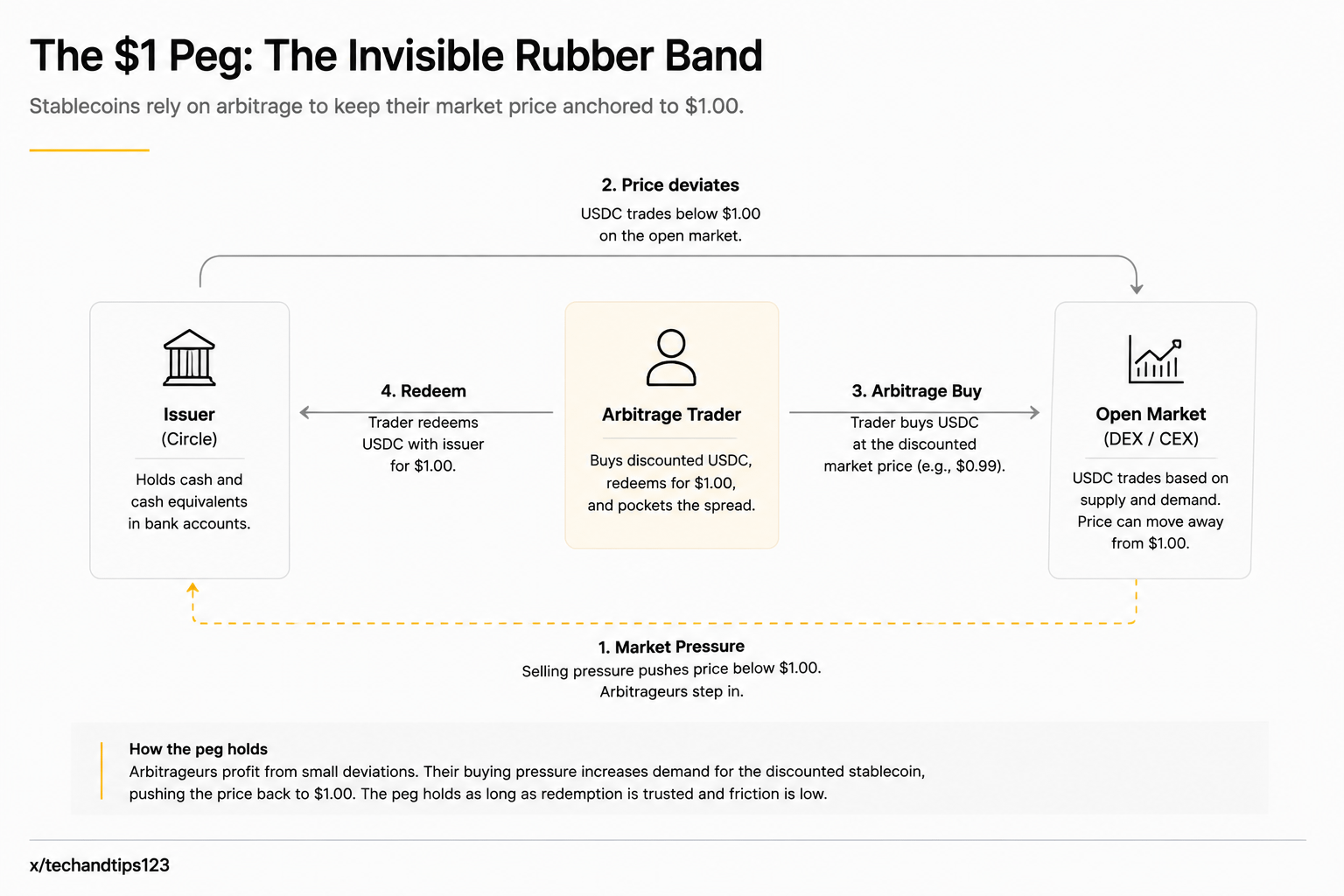
Imagine you hold USD Coin. The issuer, Circle (these guys issues USDC), holds real dollars and cash equivalents in real bank accounts to back every single coin. If the crypto market panics and people start selling USDC on a decentralized exchange, the price might briefly drop to 99 cents.
This creates a massive opportunity for professional traders. They can buy that discounted coin for 99 cents on the open market and immediately redeem it directly with the issuer for one real dollar. They pocket a risk free one cent profit for every coin they flip. Because these traders buy massive amounts of the discounted coin to capture that profit, their buying pressure acts like a giant rubber band. It snaps the open market price right back to one dollar.
The peg survives completely on the trust that the underlying asset can always be redeemed. When that trust cracks, the rubber band breaks.
❍ The Reserve Run: When the Bank Fails
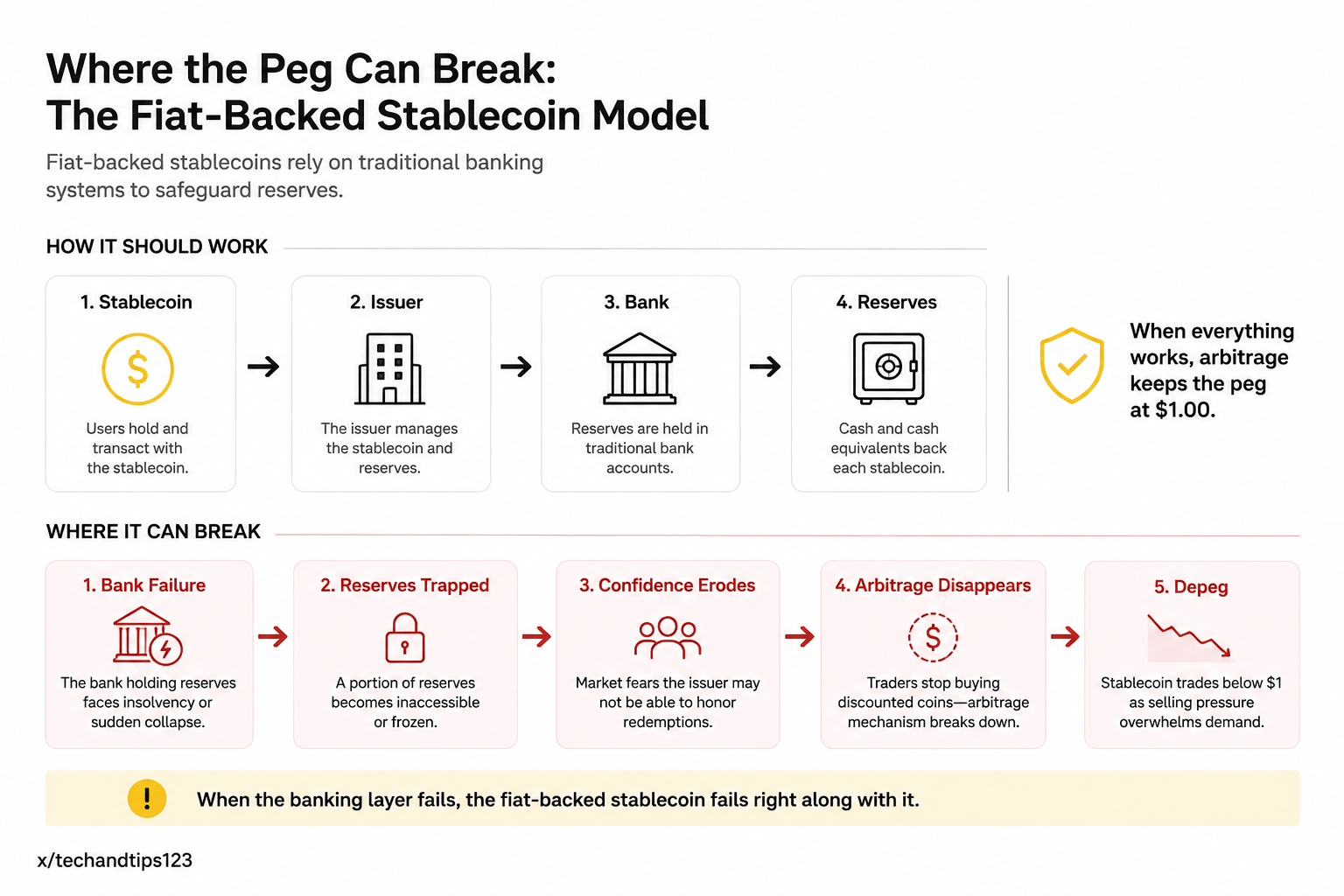
The most common stablecoins in the world are fiat backed. This means they rely on traditional banks to hold their cash reserves. But traditional banks are not invincible.
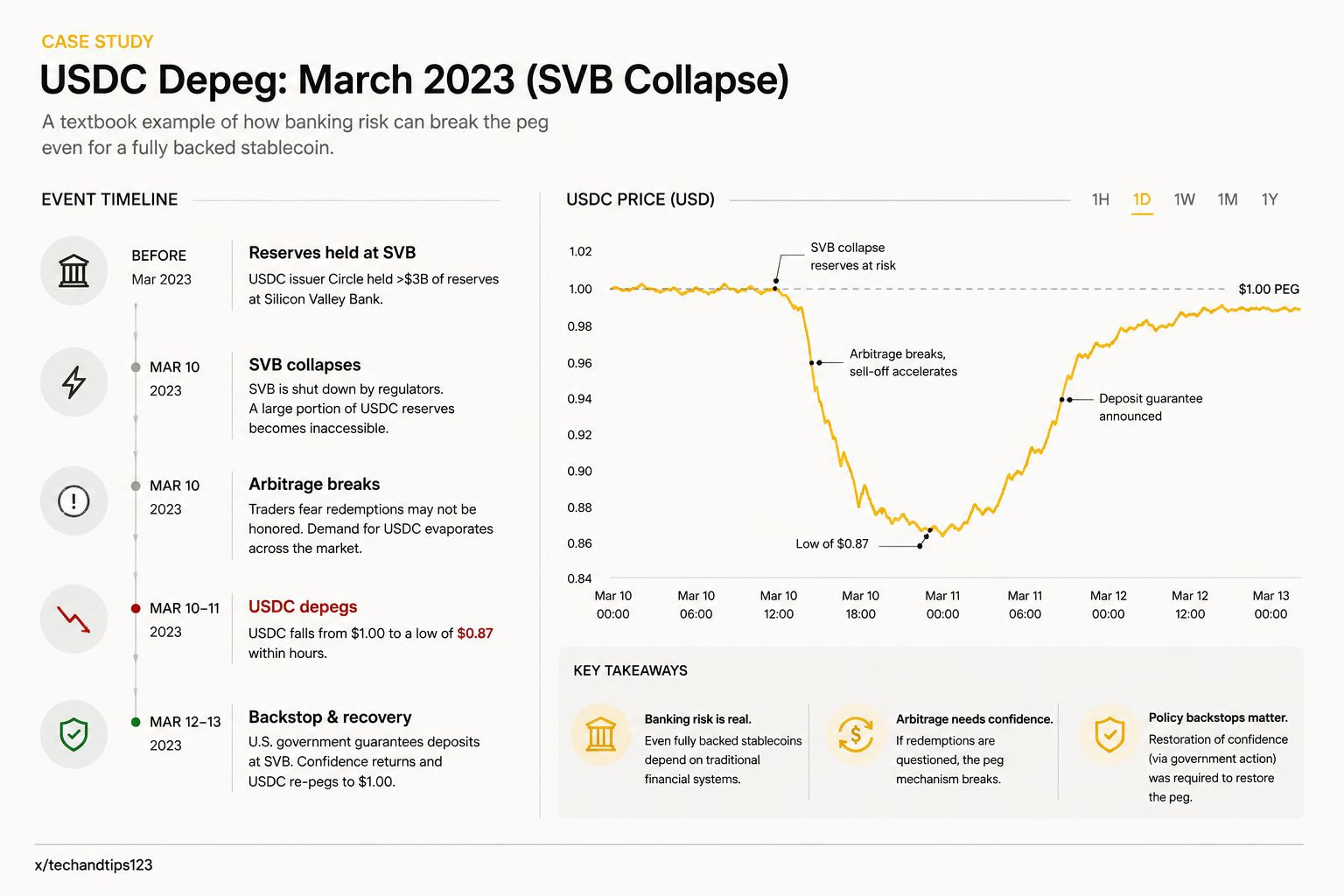
We saw this exact scenario play out perfectly in March 2023. The parent company behind USDC held over three billion dollars of their cash reserves at Silicon Valley Bank. When that traditional bank suddenly collapsed, the crypto market realized that a massive portion of the USDC backing was suddenly trapped.
The arbitrage loop completely broke down. Traders stopped buying the discounted coins because they were terrified the issuer might not be able to honor the one dollar redemptions. Fear took over the steering wheel. The price of USDC plummeted to 87 cents in a matter of hours. It only recovered days later when the United States Federal Reserve stepped in to guarantee the deposits at the failed bank.
When the banking layer fails, the fiat backed stablecoin fails right along with it.
❍ The Death Spiral
Not all stablecoins use actual dollars in a bank account. Some attempt to use pure math and market incentives to maintain their value. We call these algorithmic stablecoins. They are incredibly dangerous.
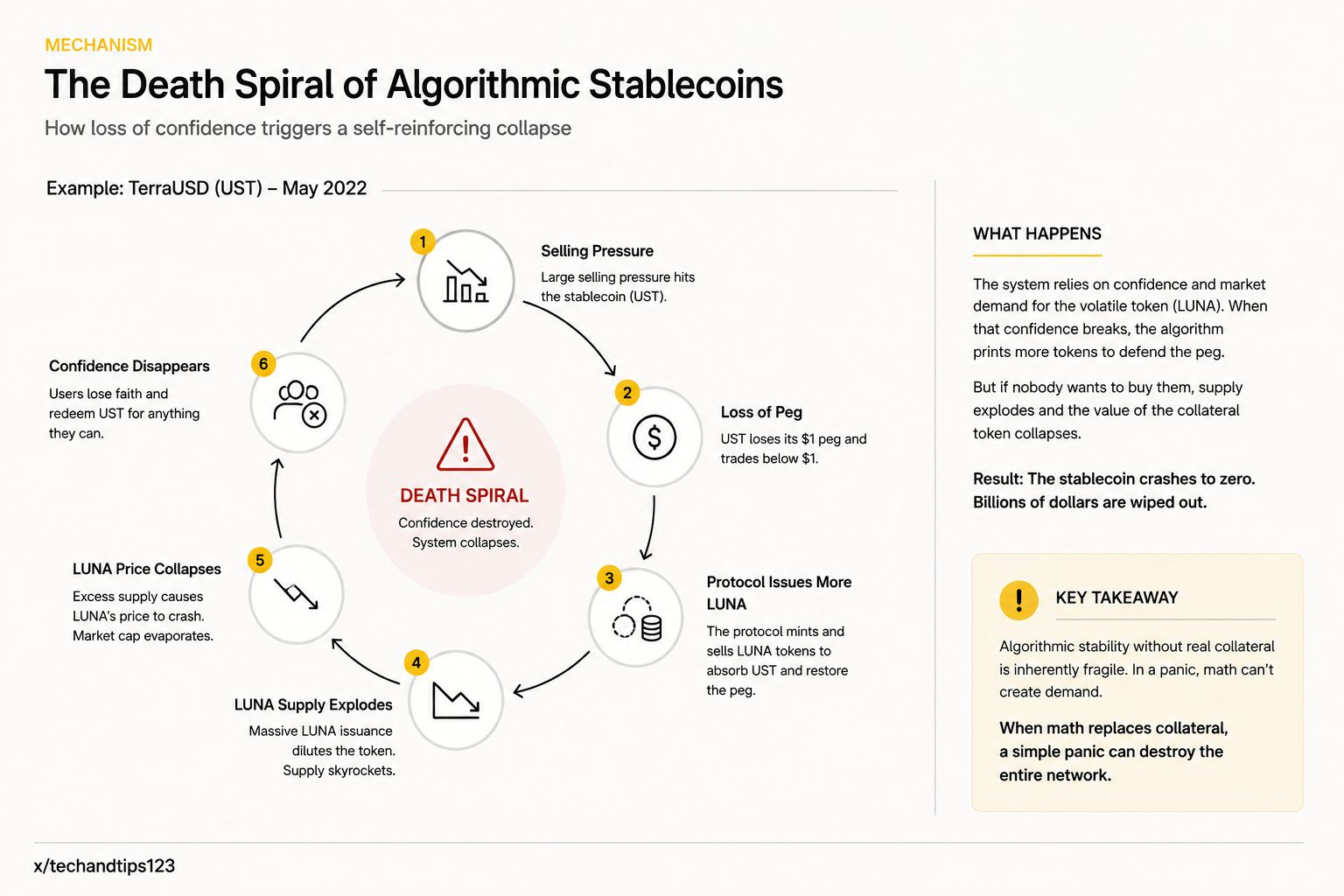
Instead of holding cash, these systems attempt to maintain parity by using automated market operations and paired volatile tokens. The algorithm expands or contracts the supply of the stablecoin based on market demand.
The fatal flaw here is that the entire system relies purely on market confidence. We witnessed the ultimate collapse of this model in May 2022 with TerraUSD. When a massive wave of selling pressure hit the market, the algorithm started printing millions of new volatile LUNA tokens to try and absorb the shock. But nobody wanted to buy them.
Confidence vanished instantly. The system entered a hyperinflationary death spiral. The algorithm printed endless amounts of worthless tokens while the stablecoin crashed to zero. Billions of dollars were wiped out in days. When math replaces collateral, a simple panic can destroy the entire network.
❍ The Liquidity Vacuum
Even if a stablecoin is fully backed and secure, it can still suffer a temporary depeg on decentralized exchanges. This happens through a liquidity vacuum.
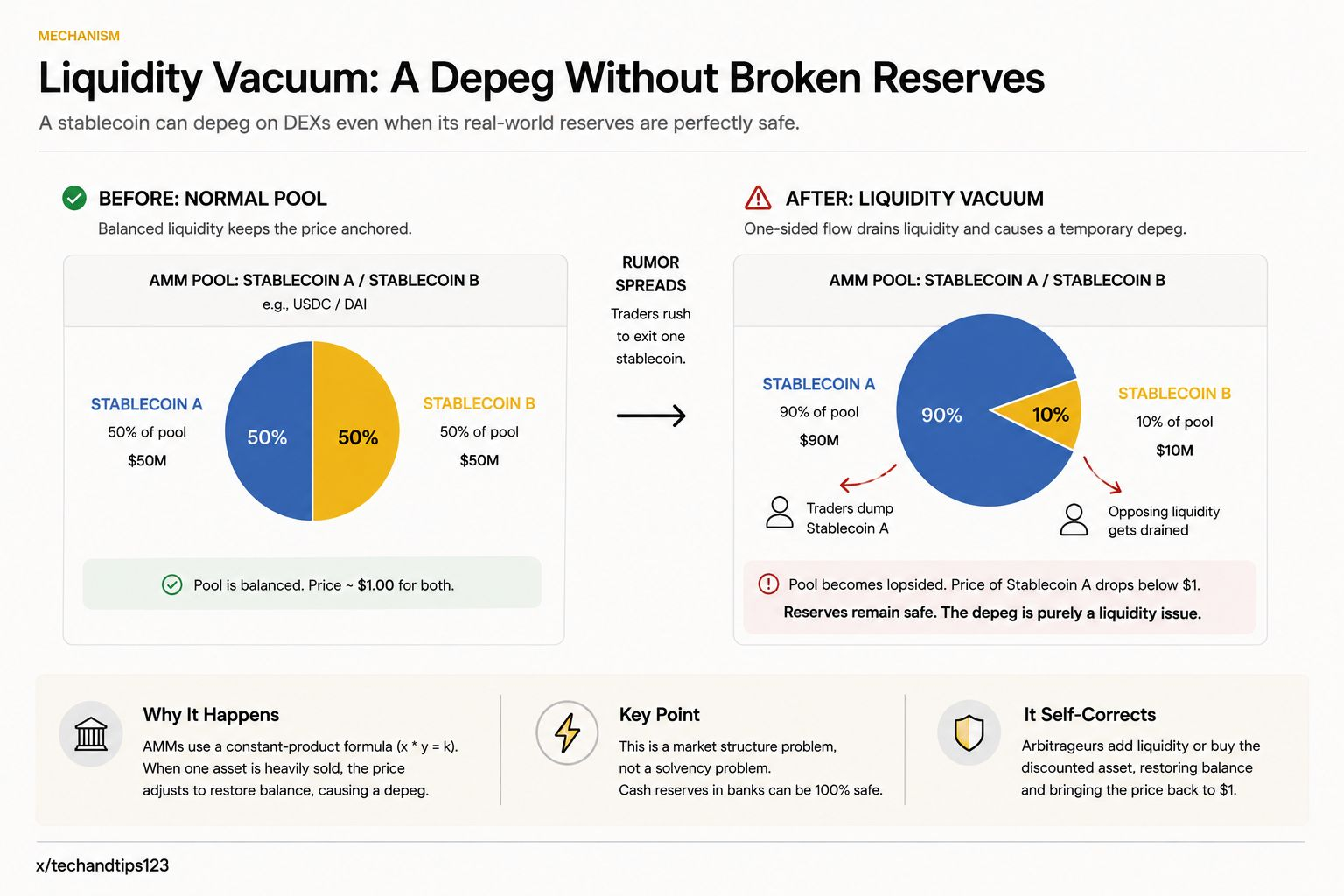
Major decentralized exchanges use liquidity pools where two different stablecoins are paired together. In a normal market, the pool is perfectly balanced. But if a negative rumor spreads on social media, retail traders will rush to swap their coins for a different brand of stablecoin. They dump their bags into the pool and drain all the opposing liquidity.
The pool becomes heavily lopsided. The smart contract formula is forced to drop the price of the heavily dumped coin to attract buyers. The coin depegs simply because the specific decentralized exchange ran out of liquidity, even if the real world cash reserves are perfectly safe in a bank vault.
FIN
A stablecoin is a tool, not a guarantee. The biggest mistake new investors make is treating their digital dollars like a government insured savings account.
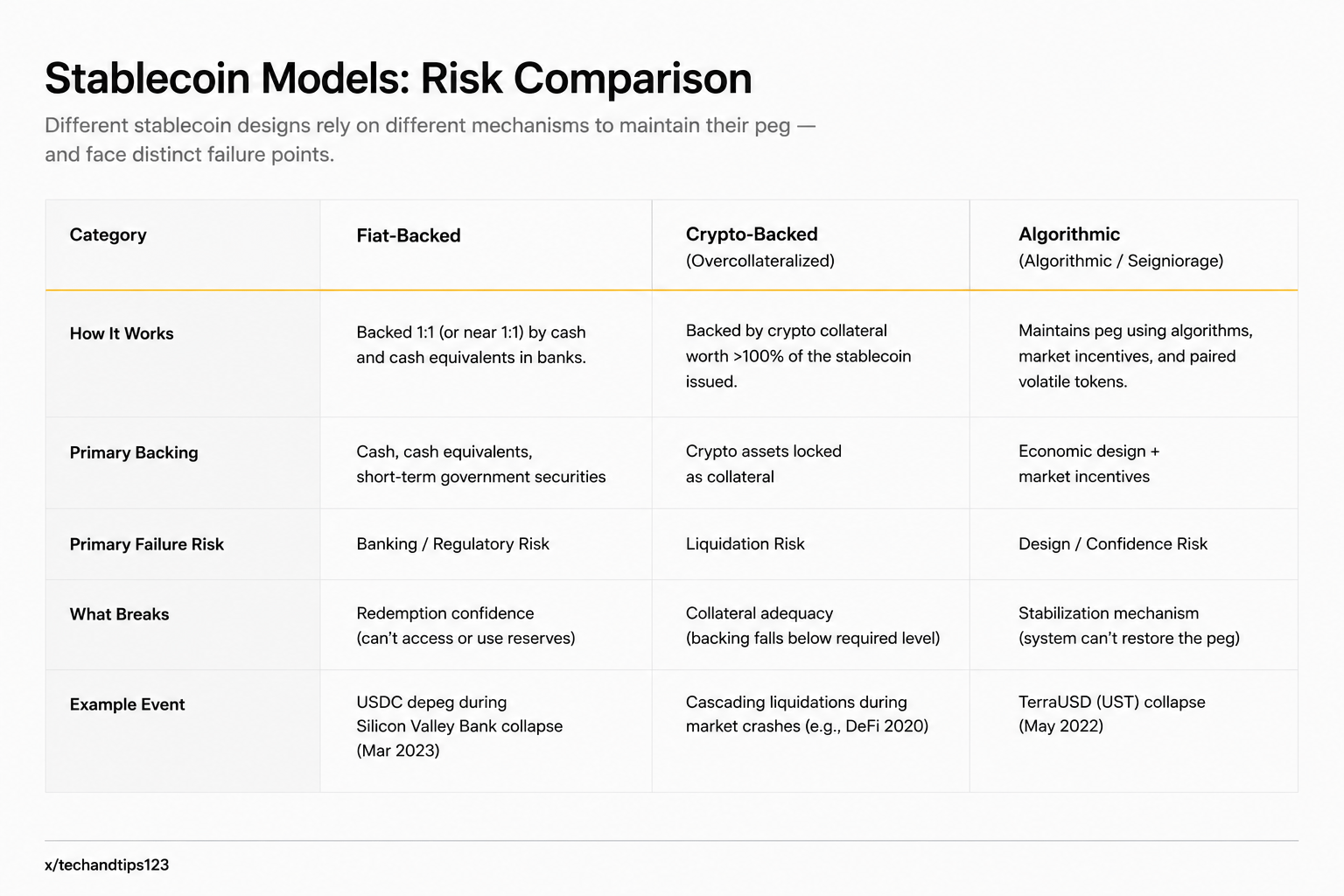
Every single stablecoin carries a unique structural risk. Fiat backed coins carry traditional banking risk and regulatory threats. Crypto backed coins carry liquidation risks. Algorithmic coins carry catastrophic design risks.
You need to apply the exact same risk management to your stablecoins that you apply to your volatile crypto portfolio. Never keep your entire liquid net worth in a single brand of digital dollar. Diversify your cash holdings across different top tier issuers. Read their monthly reserve audits and pay attention to where they actually store their money (that's actually too much to ask of a crypto trader tbh) . When the market starts to panic and the rubber band stretches, you want to be the one holding a diversified portfolio, not the one desperately trying to exit a collapsing liquidity pool.