
Most blockchains were never designed with data availability as a first-order concern. They focused on execution, consensus, and throughput, assuming storage would somehow take care of itself. In practice, this assumption has quietly limited what decentralized applications can become. When data availability is fragile, everything built on top of it inherits that fragility.
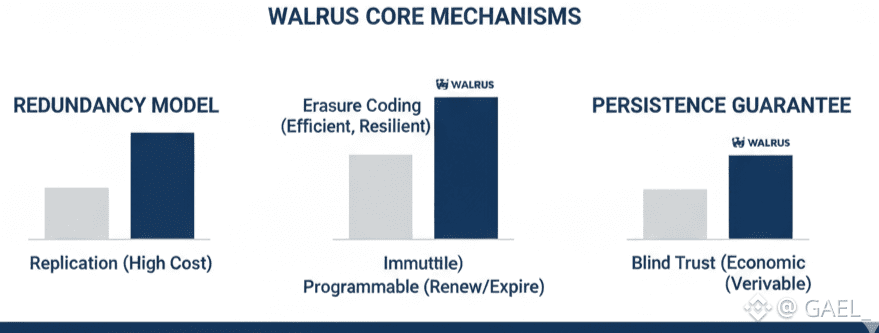
@Walrus 🦭/acc starts from a different premise: if data disappears, decentralization breaks. That belief shapes the entire network. Data availability is not a feature layered on top of Walrus — it is the backbone that everything else relies on. From the moment data enters the system, the network treats its continued accessibility as a collective responsibility, enforced by incentives rather than trust.
@Walrus 🦭/acc recognizes that availability is not the same as storage. Storing a file once does not guarantee it will exist tomorrow, especially in a permissionless environment where nodes come and go. What matters is whether the network can consistently prove that data is still retrievable, even under stress. Walrus addresses this by distributing data across multiple participants using redundancy and cryptographic verification.
Each node holds only fragments, but the network as a whole maintains completeness. More importantly, node operators are economically motivated to remain honest. Availability is continuously enforced through incentives and penalties, ensuring that participation aligns with long-term reliability. This turns data persistence from a voluntary act into a measurable, enforceable network condition.
Treating data availability as infrastructure changes how applications are designed. Developers no longer need to worry about pinning files, running fallback servers, or relying on external providers to keep critical assets online. Walrus allows them to assume that once data is committed, it remains part of the network’s living state.
This unlocks new categories of applications that depend on long-lived data: governance systems with permanent records, financial protocols with auditable histories, and content platforms that cannot afford silent data loss. In each case, availability becomes invisible — not because it is weak, but because it is dependable. The best infrastructure is rarely noticed, and Walrus aims to make data availability feel exactly that way.
What sets Walrus apart is its insistence on verification. Applications do not have to hope that data still exists; they can prove it. Cryptographic checks allow anyone to confirm availability without trusting a single node or operator. This shifts the trust model from people to math. Even during network disruptions or partial failures, @Walrus 🦭/acc continues to function as designed. Data can be reconstructed, validated, and served without compromising integrity. In effect, the network absorbs instability so applications do not have to. This resilience is what transforms availability from a convenience into infrastructure.
By elevating data availability to the same level as consensus and execution, Walrus redefines what it means to build decentralized systems. The network does not assume perfect conditions; it plans for failure and designs around it. That mindset is what makes Walrus relevant not just today, but over the long term. As decentralized applications mature, users will care less about novelty and more about reliability. @Walrus 🦭/acc positions itself ahead of that curve by solving the quiet problem that underpins everything else. When data availability is treated as core infrastructure, decentralization stops being fragile and starts becoming dependable.
