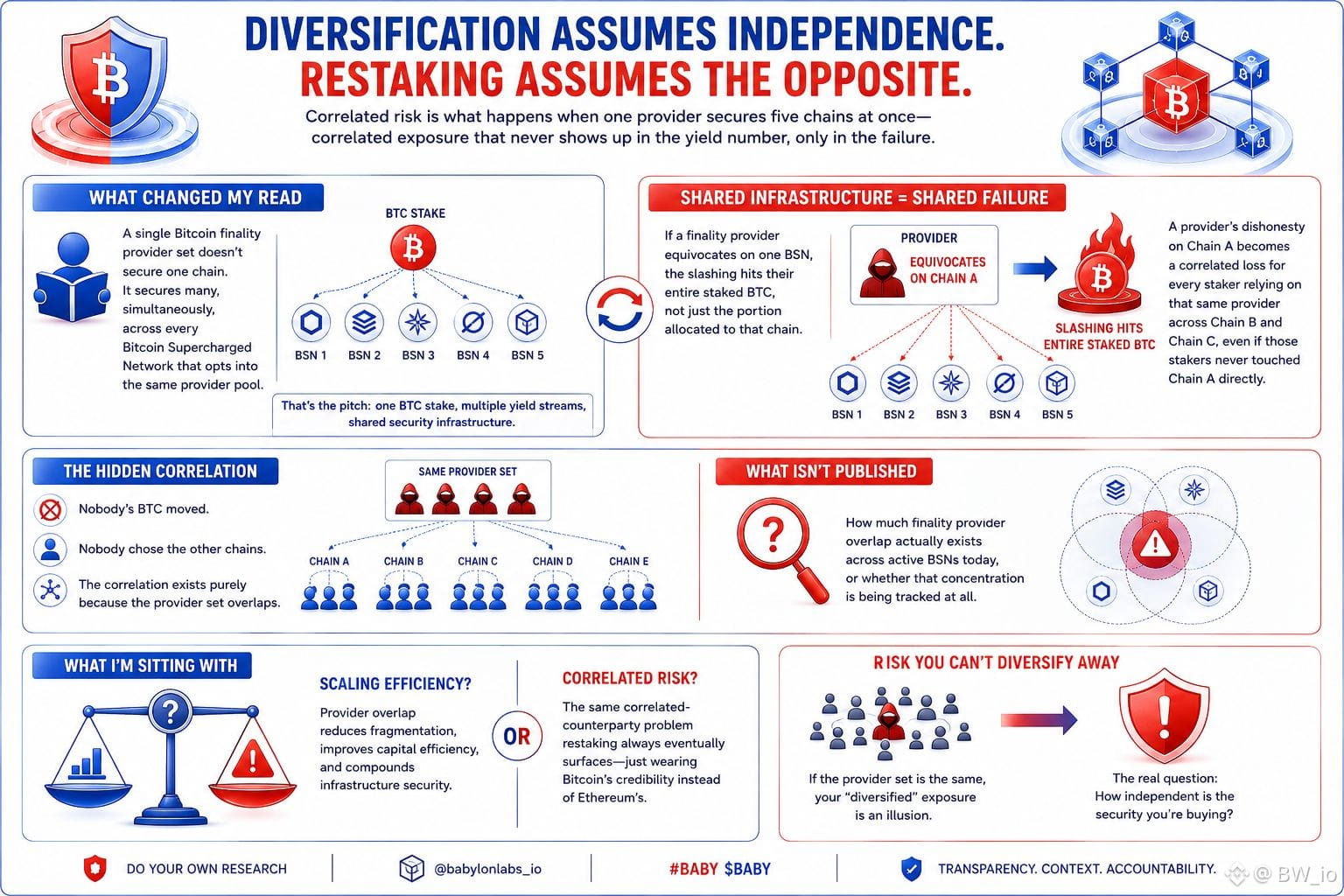
Diversification assumes independence. Restaking assumes the opposite. Correlated risk is what happens when one provider secures five chains at once—correlated exposure that never shows up in the yield number, only in the failure.
Here's what changed my read. A single Bitcoin finality provider set doesn't secure one chain. It secures many, simultaneously, across every Bitcoin Supercharged Network that opts into the same provider pool. That's the pitch: one BTC stake, multiple yield streams, shared security infrastructure.
But shared infrastructure means shared failure. If a finality provider equivocates on one BSN, the slashing hits their entire staked BTC, not just the portion allocated to that chain. A provider's dishonesty on Chain A becomes a correlated loss for every staker relying on that same provider across Chain B and Chain C, even if those stakers never touched Chain A directly.
Nobody's BTC moved. Nobody chose the other chains. The correlation exists purely because the provider set overlaps.
What isn't published anywhere I've found: how much finality provider overlap actually exists across active BSNs today, or whether that concentration is being tracked at all.
What I'm sitting with: is provider overlap a scaling efficiency, or is it the same correlated-counterparty problem restaking always eventually surfaces, just wearing Bitcoin's credibility instead of Ethereum's.
@BabylonLabs_io #BABY $BABY #baby $VIC
Here's what changed my read. A single Bitcoin finality provider set doesn't secure one chain. It secures many, simultaneously, across every Bitcoin Supercharged Network that opts into the same provider pool. That's the pitch: one BTC stake, multiple yield streams, shared security infrastructure.
But shared infrastructure means shared failure. If a finality provider equivocates on one BSN, the slashing hits their entire staked BTC, not just the portion allocated to that chain. A provider's dishonesty on Chain A becomes a correlated loss for every staker relying on that same provider across Chain B and Chain C, even if those stakers never touched Chain A directly.
Nobody's BTC moved. Nobody chose the other chains. The correlation exists purely because the provider set overlaps.
What isn't published anywhere I've found: how much finality provider overlap actually exists across active BSNs today, or whether that concentration is being tracked at all.
What I'm sitting with: is provider overlap a scaling efficiency, or is it the same correlated-counterparty problem restaking always eventually surfaces, just wearing Bitcoin's credibility instead of Ethereum's.
@BabylonLabs_io #BABY $BABY #baby $VIC