
I recently came across new research from Changelly that offers an interesting look at how people actually use stablecoins in crypto trading. The findings caught my attention because they challenge the idea that there is one typical or “average” stablecoin user. Instead, the research identifies three distinct patterns of stablecoin usage, revealing significant differences in trading frequency, transaction size, and asset preferences.
Based on anonymized and aggregated transaction data from the first half of 2026, the research provides a useful perspective on how stablecoins are being used within real trading activity. In this article, we’ll take a closer look at these findings and explore what they reveal about the changing role of stablecoins in the crypto market.
New data from Changelly, an instant crypto exchange, covering the first half of 2026, challenges the idea that stablecoin adoption is moving in a single direction. Instead of a steady climb toward heavier stablecoin use, the platform's transaction history points to three separate usage habits that don't appear to blend into one another over time.
Three Ways Users Relate to Stablecoins
Changelly grouped users by how frequently stablecoins appeared in their trading activity, and observed a sharp split among the three groups that emerged: Firstly, nearly half of all users made no stablecoin transactions at all during the period. On the other hand, up to 45% used stablecoins in almost every trade. Finally, the remaining ~15% moved freely between stablecoins and other crypto assets.
This third, smallest group—those switching between asset types—actually trades the most: They transacted as much as 6.2x more than users who never touch stablecoins. In comparison, heavy stablecoin users traded less often but moved more money per trade, with average transaction sizes reaching 2.5x the platform norm.
Low Transaction and High Volume Share
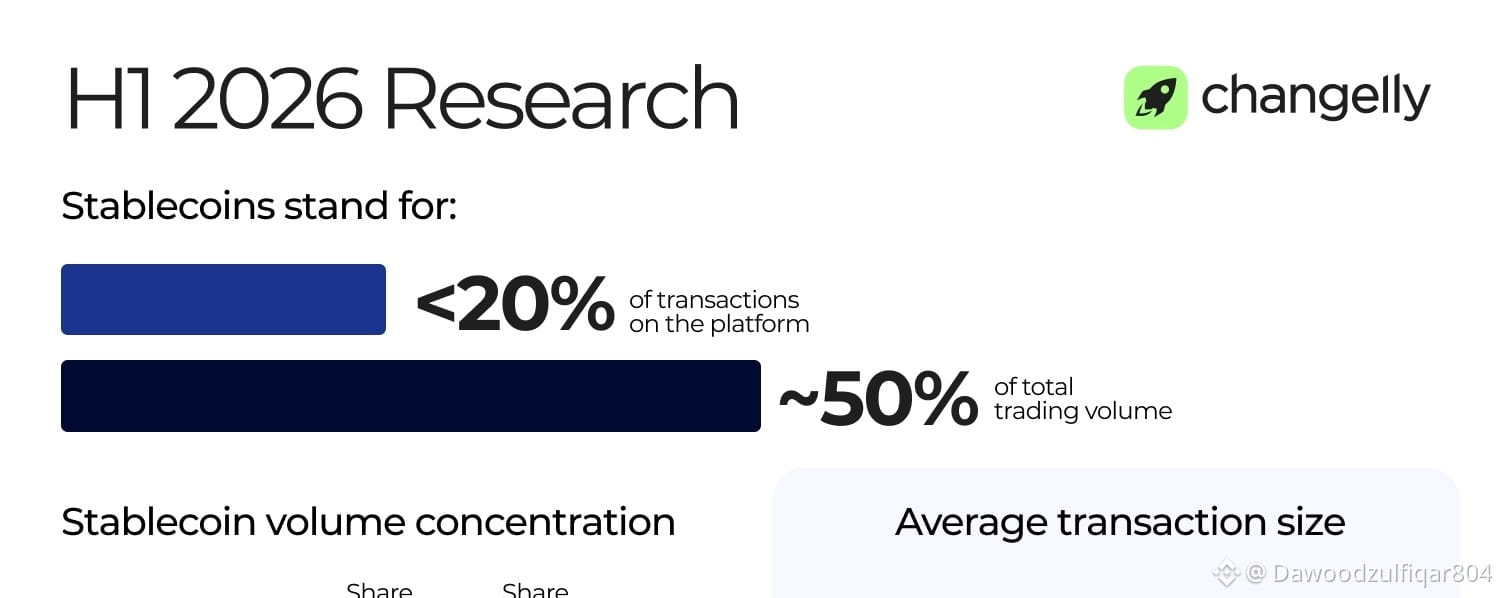
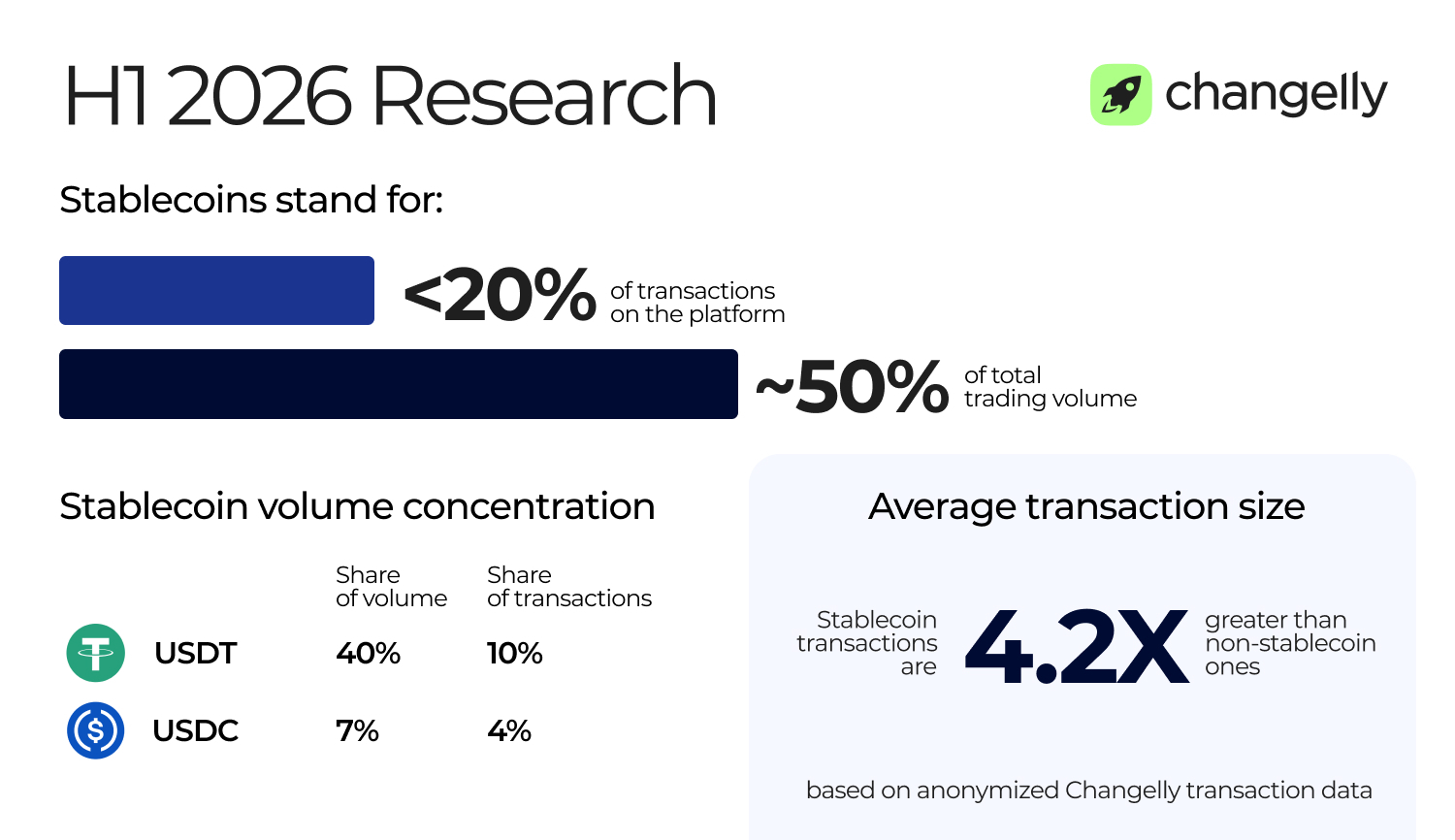
Even though stablecoins were involved in under 20% of all Changelly transactions, they drove nearly 50% of total trading volume—a gap explained almost entirely by the size of trades rather than their frequency.
Stablecoin trades averaged 4.2x the size of non-stablecoin trades on the platform.
USDT led by a wide margin, appearing in about 14% of transactions but responsible for over 40% of trading volume. USDC came in a distant second, with just over 4% of transactions and roughly 7% of volume. All remaining stablecoins combined for a negligible slice of activity.
Stablecoins have also worked their way into the platform's most-used trading routes, appearing in 31% of Changelly's top ten swap pairs—evidence that they are becoming a mainstream trading tool.
Streamlining How Users Move Stablecoins
Because stablecoins already sit inside nearly a third of Changelly's most-traded pairs, giving users an easy way to shift them across chains has become a priority.
Changelly supports this with competitive stablecoin swap rates, including 1:1 pricing on cross-chain exchanges, making it easier for users to move stablecoins across networks.
Methodology
The findings are based on anonymized, aggregated transaction data collected by Changelly across web and mobile platforms during H1 2026. Transactions were grouped by the general share of stablecoin activity within overall trading. The study examined broad trends in trading behavior, volume, and asset preference based on Changelly data, not the whole stablecoin market.
Disclaimer: All data presented is anonymized and generalized. Changelly does not track or disclose personal or identifying user information.