Counterparty risk doesn't disappear just because a protocol is decentralized. Babylon is one counterparty, documented and auditable. The LST that routed your BTC there is a different counterparty entirely — and Babylon told you, in one sentence, that it isn't that counterparty's guarantor.
I used to assume staking directly with Babylon meant Babylon was the counterparty for everything involved. Then I found one sentence in their own launch post — and realized a huge share of Phase-1 participation never went through them at all.
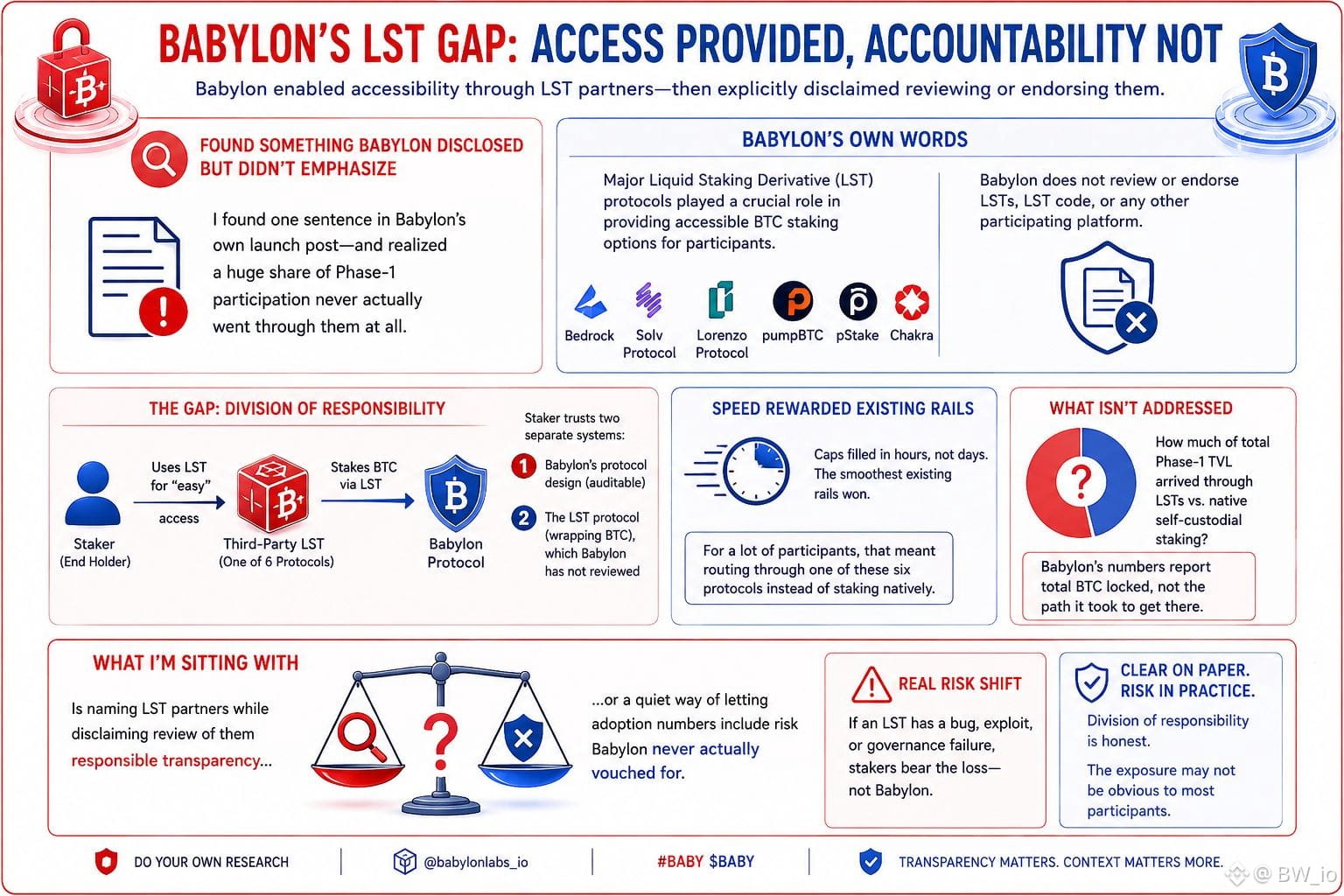
Babylon's Phase-1 post states plainly that Major Liquid Staking Derivative protocols — Bedrock, Solv Protocol, Lorenzo Protocol, pumpBTC, pStake, and Chakra — played a crucial role in providing accessible staking options. In the same documentation, Babylon states just as plainly: it does not review or endorse LSTs, LST code, or any other participating platform.
That's the part I hadn't separated before.
A meaningful share of the BTC that filled Babylon's caps arrived wrapped inside third-party LST products, not staked directly by the end holder. Babylon names those protocols as central to accessibility, then disclaims any review of their code in the same breath. It means a staker choosing the "easy" path through an LST is trusting two separate systems: Babylon's protocol design, documented and auditable, and whichever LST wrapped their BTC to get it there, which Babylon says it hasn't reviewed.
The caps filling in hours only sharpens this — speed rewarded whoever had the smoothest rails in, and for many that meant routing through one of these six protocols instead of staking natively.
What isn't addressed is how much of Phase-1 TVL arrived through LSTs versus native staking — Babylon reports total BTC locked, not the path it took.
What I'm sitting with: is naming LST partners while disclaiming review responsible transparency — or a way of letting adoption numbers include risk Babylon never vouched for.
@BabylonLabs_io #BABY $BABY #baby $TAKE $BLESS
I used to assume staking directly with Babylon meant Babylon was the counterparty for everything involved. Then I found one sentence in their own launch post — and realized a huge share of Phase-1 participation never went through them at all.
Babylon's Phase-1 post states plainly that Major Liquid Staking Derivative protocols — Bedrock, Solv Protocol, Lorenzo Protocol, pumpBTC, pStake, and Chakra — played a crucial role in providing accessible staking options. In the same documentation, Babylon states just as plainly: it does not review or endorse LSTs, LST code, or any other participating platform.
That's the part I hadn't separated before.
A meaningful share of the BTC that filled Babylon's caps arrived wrapped inside third-party LST products, not staked directly by the end holder. Babylon names those protocols as central to accessibility, then disclaims any review of their code in the same breath. It means a staker choosing the "easy" path through an LST is trusting two separate systems: Babylon's protocol design, documented and auditable, and whichever LST wrapped their BTC to get it there, which Babylon says it hasn't reviewed.
The caps filling in hours only sharpens this — speed rewarded whoever had the smoothest rails in, and for many that meant routing through one of these six protocols instead of staking natively.
What isn't addressed is how much of Phase-1 TVL arrived through LSTs versus native staking — Babylon reports total BTC locked, not the path it took.
What I'm sitting with: is naming LST partners while disclaiming review responsible transparency — or a way of letting adoption numbers include risk Babylon never vouched for.
@BabylonLabs_io #BABY $BABY #baby $TAKE $BLESS