At first glance, the part that convinced me wasn't the part I expected. Let's be real, every design instinct says a trustless system should verify more, not less. Because of that, I kept expecting to find the point where that assumption breaks. It doesn't.
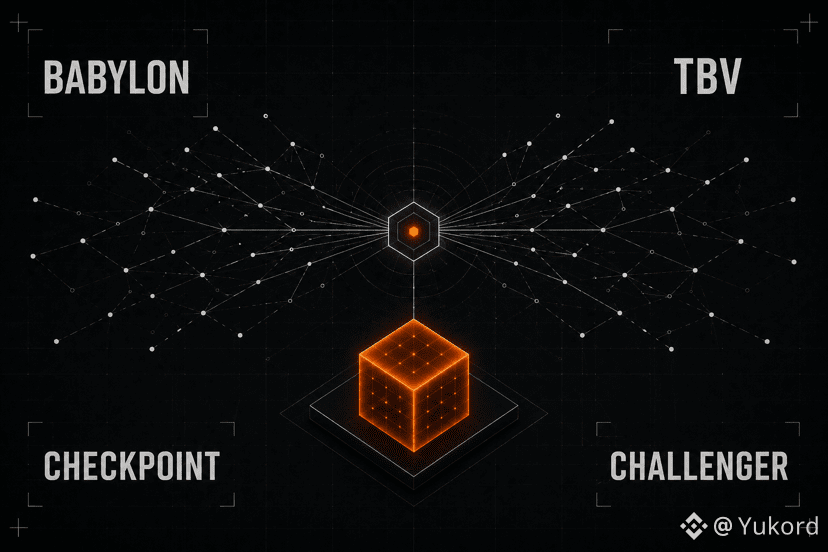
For starters, Trustless Bitcoin Vaults (TBV) pushes verification off-chain entirely. It leaves Bitcoin holding just one binary question: was a secret revealed or not. That made me wonder if "minimal overhead" was even the right way to describe what's happening here.
Make no mistake, it isn't efficiency at proof-checking. It is the refusal to let proof-checking happen on-chain at all. Instead, it hands that job to a challenger.
I kept coming back to how small that job actually is compared to verification. Look at it this way: a challenger isn't proving something is true. They are simply catching someone in a lie.
Once that clicked, TBV stopped looking like a lighter version of on-chain verification. In point of fact, it started looking like a different claim entirely. Whether that's a smaller ask than trust, or just a differently shaped one, remains unclear.
But it made me think about Bitcoin's rigidity. Far from being an obstacle, it might not be the thing these designs work around. It might be the very thing forcing them to be honest about what they're actually assuming. Bottom line.
@BabylonLabs_io #baby $BABY
For starters, Trustless Bitcoin Vaults (TBV) pushes verification off-chain entirely. It leaves Bitcoin holding just one binary question: was a secret revealed or not. That made me wonder if "minimal overhead" was even the right way to describe what's happening here.
Make no mistake, it isn't efficiency at proof-checking. It is the refusal to let proof-checking happen on-chain at all. Instead, it hands that job to a challenger.
I kept coming back to how small that job actually is compared to verification. Look at it this way: a challenger isn't proving something is true. They are simply catching someone in a lie.
Once that clicked, TBV stopped looking like a lighter version of on-chain verification. In point of fact, it started looking like a different claim entirely. Whether that's a smaller ask than trust, or just a differently shaped one, remains unclear.
But it made me think about Bitcoin's rigidity. Far from being an obstacle, it might not be the thing these designs work around. It might be the very thing forcing them to be honest about what they're actually assuming. Bottom line.
@BabylonLabs_io #baby $BABY