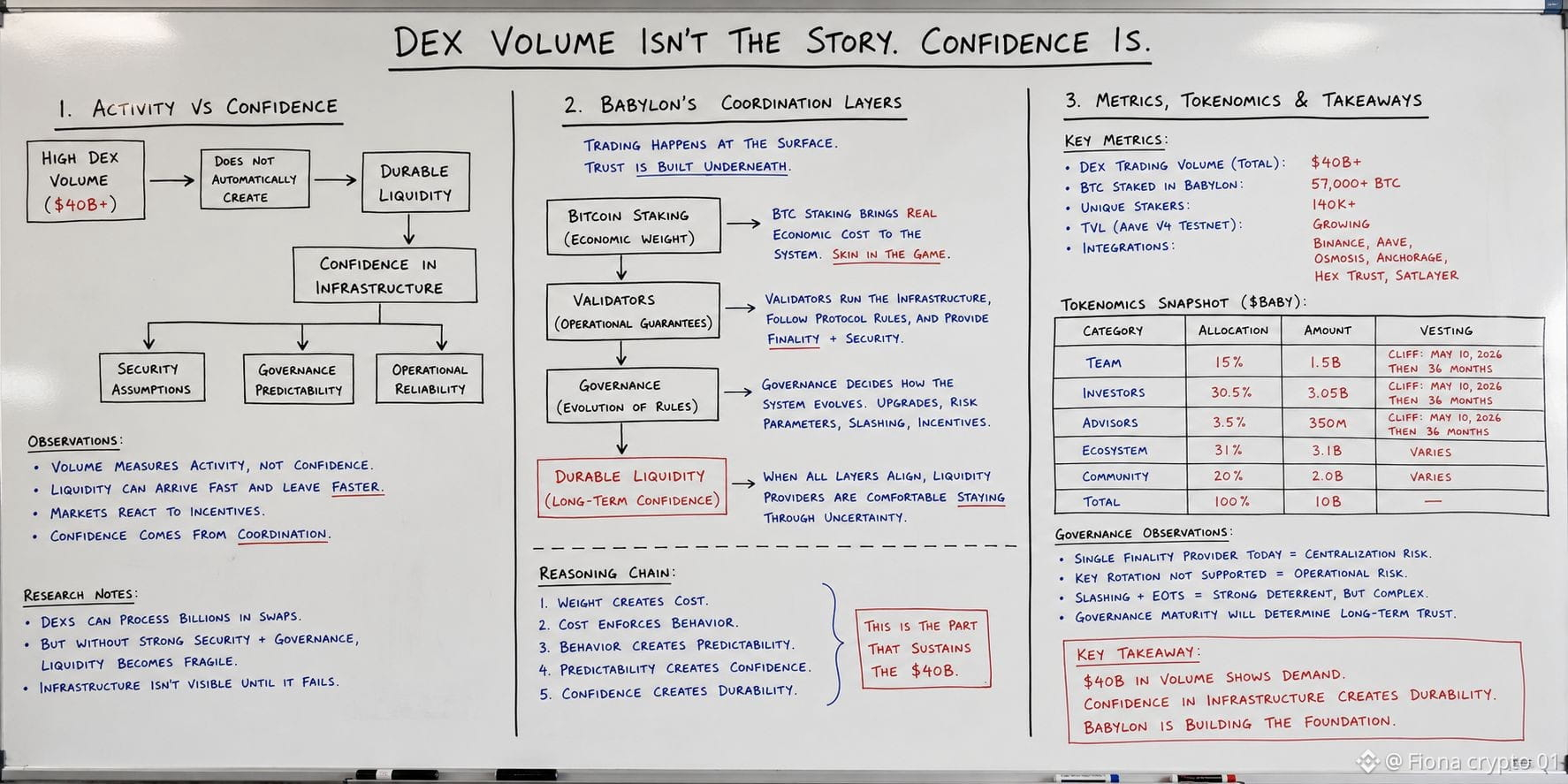
I thought the interesting number would be the $40 billion in DEX trading volume. After staring at it for a while, it became the least interesting part.
What kept pulling me back was where that liquidity actually sits in relation to Babylon's security model. Trading volume looks impressive on its own, but liquidity only becomes durable when participants trust the infrastructure underneath it. That sent me from DEX dashboards to validator design, staking mechanics, and governance discussions.
The more I compared them, the more I felt the trading activity and the security architecture are solving different parts of the same coordination problem.
A DEX can process billions in swaps, but that does not automatically create resilient liquidity. Market makers, validators, and governance participants all react to different incentives. If security assumptions weaken or governance becomes unpredictable, liquidity can disappear much faster than it arrived. High volume measures activity. It does not measure confidence.
Babylon made me think about that distinction differently. Bitcoin staking brings economic weight, validators provide operational guarantees, and governance decides how those guarantees evolve over time. None of those pieces directly increase trading volume, yet together they influence whether liquidity providers are comfortable staying through periods of uncertainty instead of only showing up when conditions are favorable.
I started by looking at a trading statistic. I ended up paying far more attention to the coordination required to make that statistic sustainable, because infrastructure usually becomes visible only after the market stops taking it for granted.
@BabylonLabs_io
#baby $BABY
What kept pulling me back was where that liquidity actually sits in relation to Babylon's security model. Trading volume looks impressive on its own, but liquidity only becomes durable when participants trust the infrastructure underneath it. That sent me from DEX dashboards to validator design, staking mechanics, and governance discussions.
The more I compared them, the more I felt the trading activity and the security architecture are solving different parts of the same coordination problem.
A DEX can process billions in swaps, but that does not automatically create resilient liquidity. Market makers, validators, and governance participants all react to different incentives. If security assumptions weaken or governance becomes unpredictable, liquidity can disappear much faster than it arrived. High volume measures activity. It does not measure confidence.
Babylon made me think about that distinction differently. Bitcoin staking brings economic weight, validators provide operational guarantees, and governance decides how those guarantees evolve over time. None of those pieces directly increase trading volume, yet together they influence whether liquidity providers are comfortable staying through periods of uncertainty instead of only showing up when conditions are favorable.
I started by looking at a trading statistic. I ended up paying far more attention to the coordination required to make that statistic sustainable, because infrastructure usually becomes visible only after the market stops taking it for granted.
@BabylonLabs_io
#baby $BABY