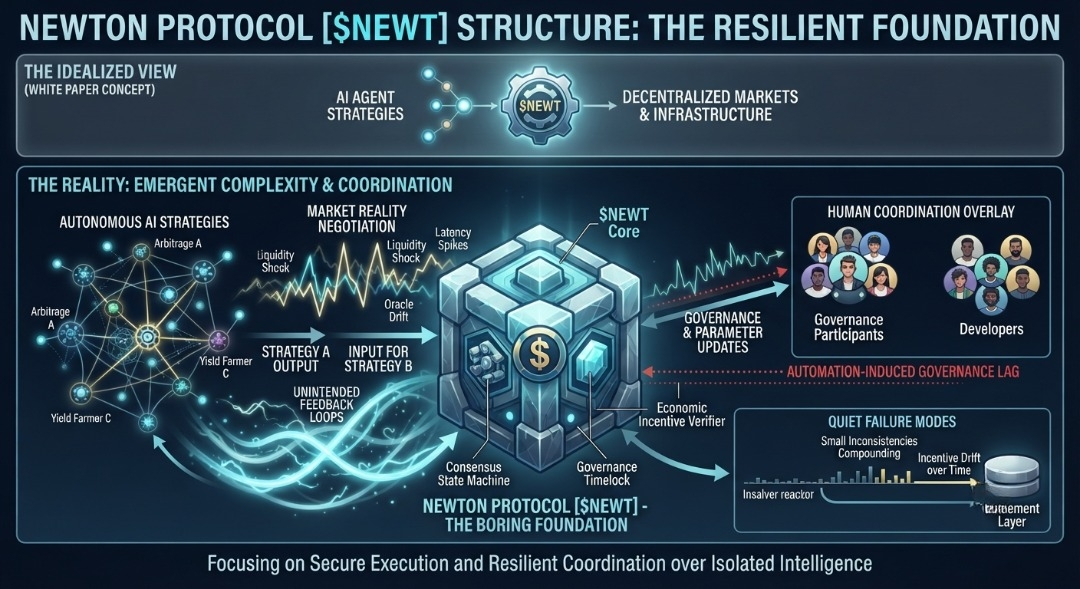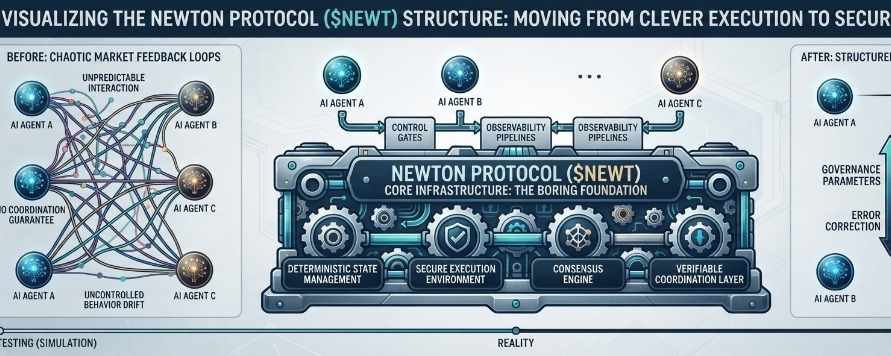

The first reaction I had wasn't excitement. It was something closer to hesitation the kind that comes from watching enough ambitious ideas age in public.

Not because Newton Protocol sounded unrealistic. If anything it sounded almost reasonable. And that's become its own reason to slow down.

I've spent years around crypto long enough to notice that the interesting questions usually appear after the whitepapers stop talking. Once the diagrams are finished and everyone agrees on what the system is supposed to do reality quietly begins negotiating its own version.

That's the part I keep thinking about.

People naturally focus on AI making decisions. I don't blame them. It's easier to imagine an intelligent strategy than to think about the infrastructure carrying thousands of those strategies at the same time all reacting to one another all operating under conditions that are never quite as clean as they looked during testing.

Markets aren't laboratories.

Neither are decentralized networks.

A strategy doesn't exist by itself once it's deployed. It starts influencing the environment that other strategies are observing. One automated decision becomes another system's input. Feedback loops emerge where nobody intentionally designed them. The result isn't necessarily failure. Sometimes it's simply behavior that nobody predicted because each individual component looked perfectly sensible on its own.

That possibility feels strangely underappreciated.

When I hear discussions around AI execution I notice how often intelligence gets treated as the scarce resource. I'm not convinced anymore. Reliable coordination seems far rarer.

A model can improve every few months. Infrastructure doesn't enjoy that luxury. It has to remain dependable while upgrades happen while incentives shift while participants come and go. Those slow changes are usually where confidence begins to separate from reality.

Maybe that's why secure execution feels more interesting to me than clever execution.

I don't mean security in the dramatic sense. Not hacks or catastrophic exploits although they're impossible to ignore. I'm thinking about quieter failures. Small inconsistencies that compound over time. Delays that seem harmless until markets become volatile. Economic incentives that gradually reward behavior nobody originally intended.

Those things almost never arrive with a warning label.

Newton Protocol seems to orbit around those deeper concerns, even if most conversations drift toward AI itself. I keep wondering whether the real challenge isn't building autonomous systems, but making sure those systems continue behaving predictably once they're surrounded by other autonomous systems with different objectives.

That sounds less like an engineering problem and more like an ongoing negotiation.

I've seen enough crypto infrastructure survive technical stress only to struggle with human coordination later. Governance changes. Developer attention fades. Economic priorities evolve. None of those issues disappear simply because another layer of automation exists.

If anything automation might make them harder to notice.

So I find myself reading about projects like Newton Protocol without trying to decide whether they're promising or disappointing. That feels too early maybe even the wrong question altogether.

Instead I keep returning to the same quiet thought.

The future probably won't depend on whichever AI makes the smartest decisions.

It may depend on whether anyone can build the boring foundation that keeps those decisions from slowly drifting into something none of us expected.

I'm still not sure where that leaves my skepticism. or whether it's supposed to disappear at all.

@NewtonProtocol $NEWT #Newt

NEWT
NEWTUSDT
0.0374
-1.18%