while scanning the chain last night
While waiting on a batch of unrelated transactions to confirm, I ended up pulling the Newton Protocol(@NewtonProtocol ,#Newt ,$NEWT) contract back up just to recheck something that had been bugging me about $NEWT since the last unlock chatter.
Not the price. Not #Newton or the @newton_xyz feed. The vesting mechanics themselves.
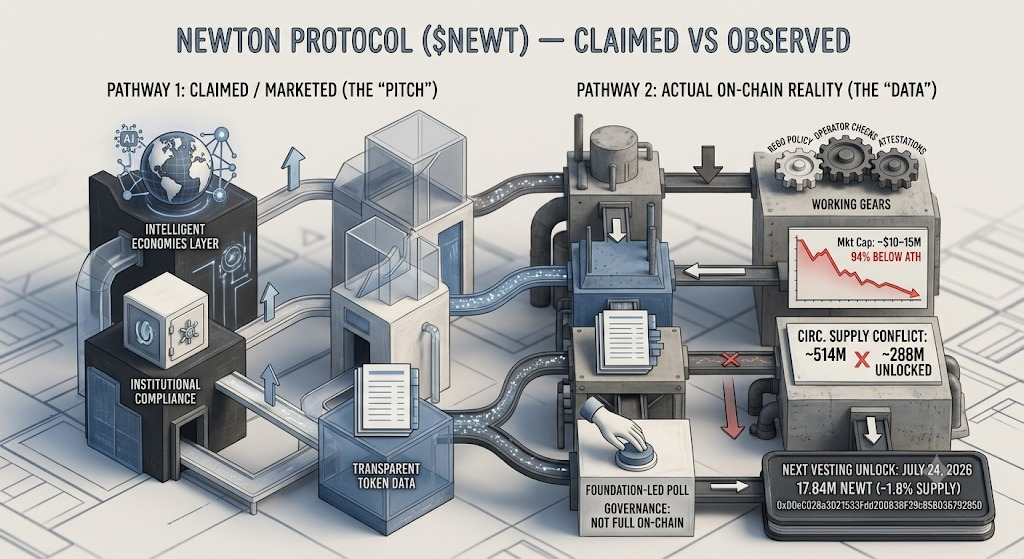
Here's the thing I keep circling: NEWT's schedule shows the next release landing July 24, 2026 — about 17.84 million tokens, close to 1.8% of total supply, already sitting encoded in the contract right now. That's not speculation. Anyone can verify the figures directly on-chain.
The gap I noticed, though, wasn't in the unlock. It was in circulating supply reporting. One tracker shows roughly 514 million NEWT unlocked. Another shows closer to 288 million. Same chain, same token, and the numbers don't reconcile.
If you're watching this token, don't anchor to the unlock date itself — watch volume in the days leading into it, since that's usually where positioning actually shows up. Also worth checking which wallets receive the release, since Newton's transparency reports tag Foundation and Magic Labs allocations separately from community rewards.
the contrast that stuck with me
While Newton markets itself as compliance-as-code for "intelligent economies," the part that actually functions right now is narrower than that framing suggests.
The pitch is broad: AI agents, cross-chain automation, institutional-grade policy enforcement. The live mechanism is three gears — a policy layer written in Rego, a restaked operator network that checks transactions against those rules, and an attestation layer that proves the check happened honestly.
That third gear is genuinely clever. Most compliance in crypto today happens after the fact — a transaction clears, then gets flagged, then maybe gets unwound. Newton flips the order, so the check happens before settlement.
But here's my honest reevaluation: elegant architecture and adopted architecture aren't the same thing. NEWT's market cap sits somewhere between $10M and $15M depending on the tracker, down roughly 94% from its all-time high near $0.82.
I keep thinking of a smaller vesting cliff I tracked years ago on a lending protocol token — I mistimed it by a single day, sold into what looked like weakness, and watched it rip 12% the next morning because the market had already priced the unlock weeks earlier. The lesson wasn't about the date. It was about how much slower on-chain reality moves than the narrative built around it.
hmm... this mechanic in practice
While the restaking security model borrows directly from what EigenLayer normalized — operators with collateral at risk if they approve something wrong — pointing that same mechanism at compliance instead of oracle data is the part I hadn't fully appreciated until I sat with it.
It's a genuinely different use of restaking dynamics than most projects reaching for the term.
Compare that to how XRP moved in the first days of July — a double-digit run on positioning and seasonal flow, no new infrastructure shipped, just liquidity finding a story. Or Ethereum climbing back into the global top 100 assets by market cap in early July, mostly macro rotation, nothing mechanically new at the base layer.
Neither of those had anything to do with Newton. But they both remind me that infrastructure quality and price action run on separate clocks, sometimes for years apart.
That's the contrast I keep returning to — a protocol built on the promise of pre-transaction trust, still waiting for the market to actually price that trust.
It's late enough now that I'm less interested in defending the thesis and more interested in just sitting with the discomfort of it. If a stablecoin issuer or RWA platform actually puts this policy layer into production — not a partnership announcement, an actual integration — the current valuation looks almost quaint in hindsight. If adoption stalls, the same number looks generous.
I don't think the next couple months resolve that either way, and I've stopped expecting them to.
What I'd actually watch going forward: whether the planned Verifiable Automation Marketplace turns fee demand into something that compounds rather than just dilutes with each unlock. Whether governance moves past Foundation-led sentiment polls into staking that actually controls treasury decisions. And whether anyone outside the existing ecosystem starts building on the policy layer without being paid to.
If anyone's been running the operator node or actually using the live Recurring Buy agent, I'd genuinely like to compare notes — not pitching anything, just trying to see if I'm reading the mechanics right.
So I'll leave the tab open on this one: does compliance-as-code quietly become boring, load-bearing infrastructure the way TCP/IP did, or does it stay an elegant idea still waiting for a market willing to price it?