
@Pixels $PIXEL #pixel Chubkins did not start as a proof of concept. It started as a pet game. The kind of casual, low-friction mobile experience that any regular app store gamer would recognize instantly collect creatures, nurture them, build something over time. Nothing about the surface of it announces that it is also functioning as a live laboratory for one of the most ambitious infrastructure bets in web3 gaming. But that is what it is.
The Pixels team has described the advantage of this arrangement with unusual directness. The Chubkins team can stay fully dedicated to making the game, because the reward layer comes on top separately. They do not have to make sacrifices in the game loop to accommodate the web3 layers. That problem is handled elsewhere. What they are describing is a clean separation that almost no other web3 game development team has managed to achieve. Usually the token design and the game design are entangled from the beginning, pulling each other in conflicting directions, producing something that is neither a good game nor a healthy economy.
Most people who pick up Chubkins will not know any of this is happening underneath. They will see a pet game. They will complete tasks, earn something, feel the small satisfactions that well-designed casual games are built to deliver. What they will not see is the system deciding in real time which of those tasks to surface to them specifically, based on what their play pattern suggests about their likelihood to stay, spend, or drift away. That invisible layer is Stacked, and the fact that it is invisible is not a bug in the design. It is the entire design.
When asked why Stacked is not simply positioned as a web3 tool, the answer the team gives is straightforward. Stacked turns any game into a web3 game without requiring that game to build out web3 infrastructure itself. Read that slowly. It is not saying that Stacked helps web3 games run better. It is saying that a completely ordinary game, one that has never thought about blockchains or tokens or on-chain ownership, can integrate Stacked and suddenly have a functioning play-to-earn economy sitting on top of whatever it already built. The game does not change. The economic layer appears around it.
This is what separates Stacked from the crowded field of web3 gaming toolkits that have come and gone. Those tools generally required the game to be designed around them from the start. They asked studios to make fundamental architectural choices early that most studios are not positioned to make correctly, because the knowledge required to make those choices correctly only comes from having already failed at them. Stacked was built after four years inside that exact failure cycle, through twenty-five million dollars in revenue and one million daily active users who generated real data about what works and what does not at scale. The tool did not come before the knowledge. The knowledge came first, painfully, and the tool was what it left behind.
Pixels CEO Luke Barwikowski has referred to Stacked as the Appsflyer of play-to-earn, a reference that lands differently depending on which world you come from. In mobile gaming, Appsflyer is the attribution platform that tells studios where their players came from, which acquisition channels are worth paying for, and which users are likely to stick around. It is unglamorous, invisible infrastructure that every serious mobile studio depends on but almost no player ever thinks about. Calling Stacked the Appsflyer of play-to-earn is a way of saying the ambition here is not to be a game. It is to be the thing all the games need underneath them.
Pixel Dungeons has been carrying a meaningful share of this proof. It is a harder game than Pixels, procedurally generated dungeons where the risk and reward relationship is tighter and more immediate. After the mission system inside Pixel Dungeons was reworked through Stacked, daily revenue doubled. The team reported the highest revenue day in the previous thirty days and the highest number of membership purchases since the feature launched. Numbers like that in isolation sound like a good patch. Inside the context of what Stacked is trying to prove, they are data points in a much longer argument: that precision reward targeting produces better economics than broad reward distribution, consistently, across different game types and different player behaviors.
The reward types Stacked supports are deliberately not limited to crypto. Players can claim through PayPal, gift cards, or direct cryptocurrency withdrawal depending on how they want to receive value. That decision reflects something important about who the system is actually being built for. Crypto-native players already know how to manage a wallet and navigate exchange withdrawals. They do not need help with any of that. The players who have never touched a blockchain, the ones who downloaded Chubkins because they like pet games and saw an ad on their phone, those players need a reward they can understand immediately. A PayPal deposit is something everyone understands. That accessibility is not a concession to the mainstream. It is the whole strategy.
The response to skepticism about whether building Stacked dilutes focus from Pixels has been consistent from the team. Stacked is the reason scaling Pixels on mobile is possible at all. Running paid user acquisition campaigns requires reward infrastructure capable of meeting ordinary players where they are. Without Stacked, mobile growth hits a ceiling. With it, every new player who arrives through a regular app store ad enters an economy that already knows something about who they are likely to be and what is likely to keep them around.
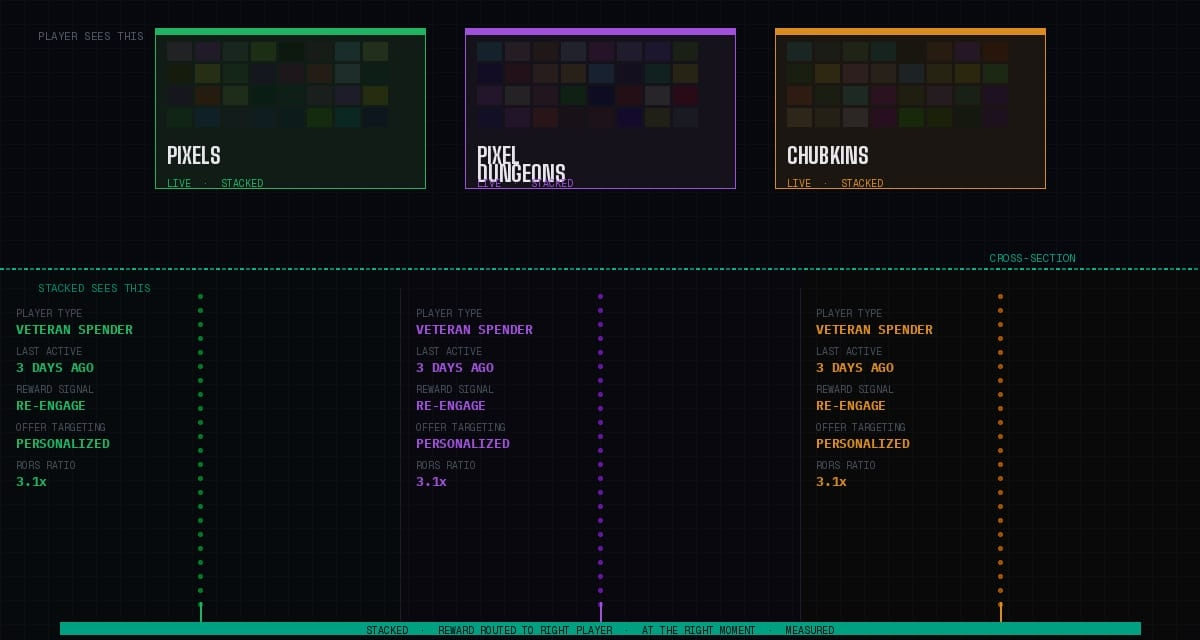
The other studios watching from outside the Pixels ecosystem are looking at three live games running on the same reward layer and asking a simple question. If this works for Pixels, Pixel Dungeons, and Chubkins, does it work for us too? That question is the whole market Stacked is preparing to address. The first-party games are not just the revenue. They are the answer to that question, running in public, in production, updated every week, producing results that anyone paying attention can observe. That is a very different sales pitch than a whitepaper. It is a track record.