
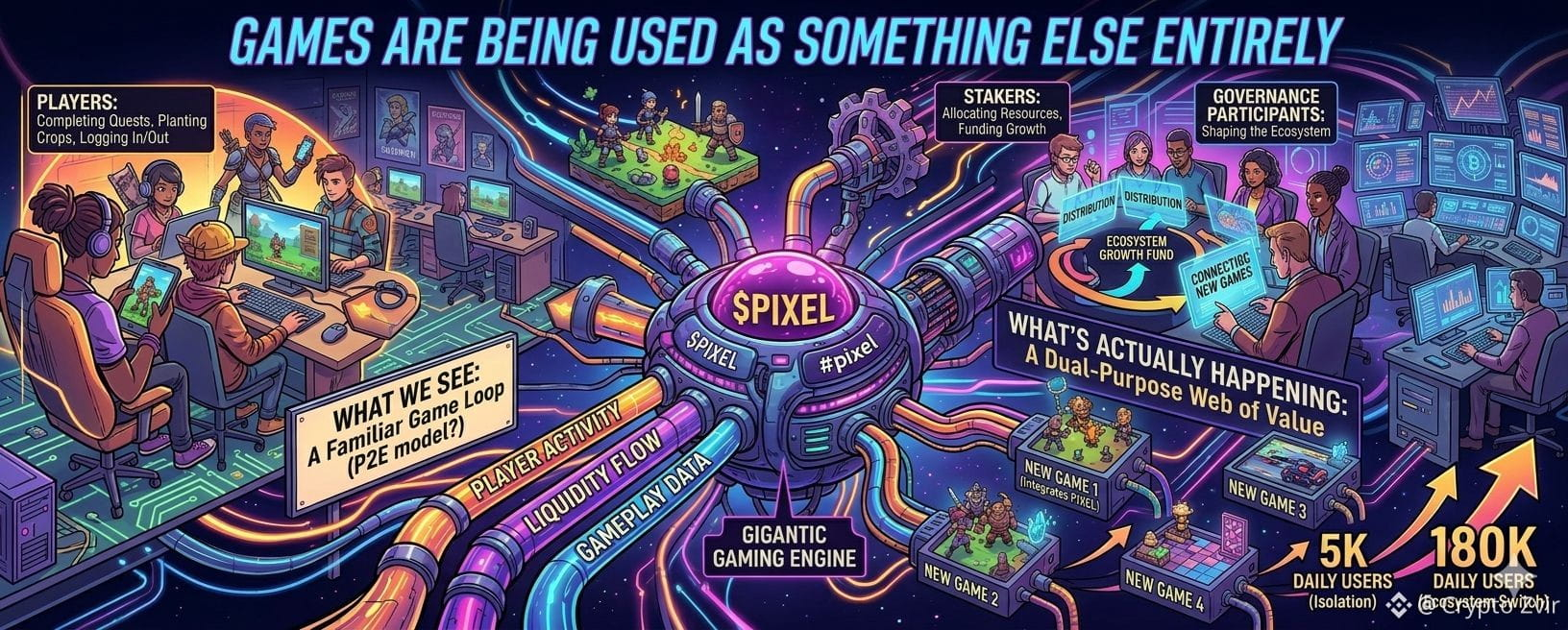
It still looks like a game.
You plant crops.
You complete quests.
You log in, play, log out.
From the surface, nothing unusual.
That’s the part that makes it easy to ignore.
Then the structure starts to look different.
Players aren’t just playing.
Stakers aren’t just earning.
Games aren’t just competing.
They’re connected.
The same activity that looks like gameplay on one side is funding growth on another.
The same system that looks like rewards is being used as distribution.
The same environment that looks like a single game keeps expanding as more games plug into it.
That’s not how most P2E systems worked.
They were isolated.
One game. One loop. One token flow.
This behaves differently.
New games don’t compete for attention in the same way.
They connect to the same underlying mechanism.
Growth doesn’t come from ads.
It comes from what’s already inside the system.
Stakers allocate.
Games attract.
Players stay or leave.
The feedback loop isn’t obvious from the interface.
It just looks like people playing.
5K to 180K daily users after Ronin didn’t look like gradual growth.
It looked like something switching on.
Still not clear what exactly switched.
The token exists.
The game exists.
The players are there.
But the behavior around them doesn’t fully match what people expect from P2E.
It still looks like that model.
It might not be.
I’m still trying to understand whether this is actually a new structure
or just a more efficient version of the same loop.
Because if it is different, then most of what people are measuring might not matter as much as they think.
And if it isn’t, then the outcome probably looks familiar.
Which one it is isn’t obvious yet.
What exactly are these games being used for gameplay, or something underneath it?
