
I remember watching a token spike after listing and assuming demand was coming from real usage. Later, it looked more like positioning than activity. That’s when I started paying attention to what’s actually being traded. With $SIGN , it doesn’t feel like data is the asset. It’s the control over proof.
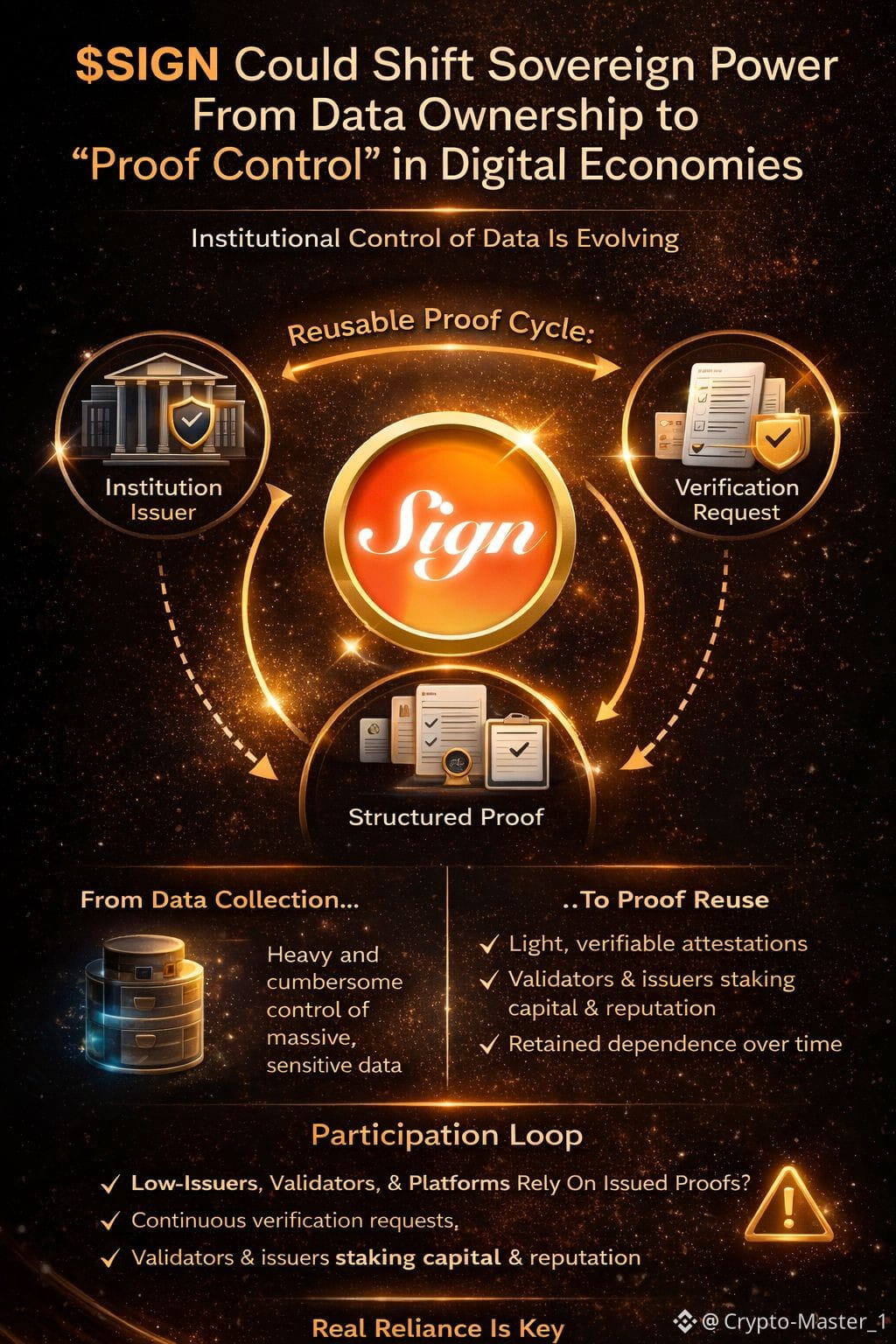
At first I thought sovereign systems compete on data ownership. Now it feels different. Data is heavy and hard to move. Proof is lighter. If institutions can issue attestations once and reuse them across systems, the advantage shifts from holding data to controlling valid proof.
But the economics depend on repetition. One-off proofs don’t create demand. The system needs constant verification requests, real dependency between participants, maybe even staking of reputation or capital behind those proofs.
If supply expands faster than that demand, price drifts. I’ve seen that before.
So the real signal is simple. Are proofs reused, or recreated every time? If reuse compounds, this starts to look like infrastructure. If not, it stays a narrative.
#signdigitalsovereigninfra #Sign $SIGN @SignOfficial
At first I thought sovereign systems compete on data ownership. Now it feels different. Data is heavy and hard to move. Proof is lighter. If institutions can issue attestations once and reuse them across systems, the advantage shifts from holding data to controlling valid proof.
But the economics depend on repetition. One-off proofs don’t create demand. The system needs constant verification requests, real dependency between participants, maybe even staking of reputation or capital behind those proofs.
If supply expands faster than that demand, price drifts. I’ve seen that before.
So the real signal is simple. Are proofs reused, or recreated every time? If reuse compounds, this starts to look like infrastructure. If not, it stays a narrative.
#signdigitalsovereigninfra #Sign $SIGN @SignOfficial