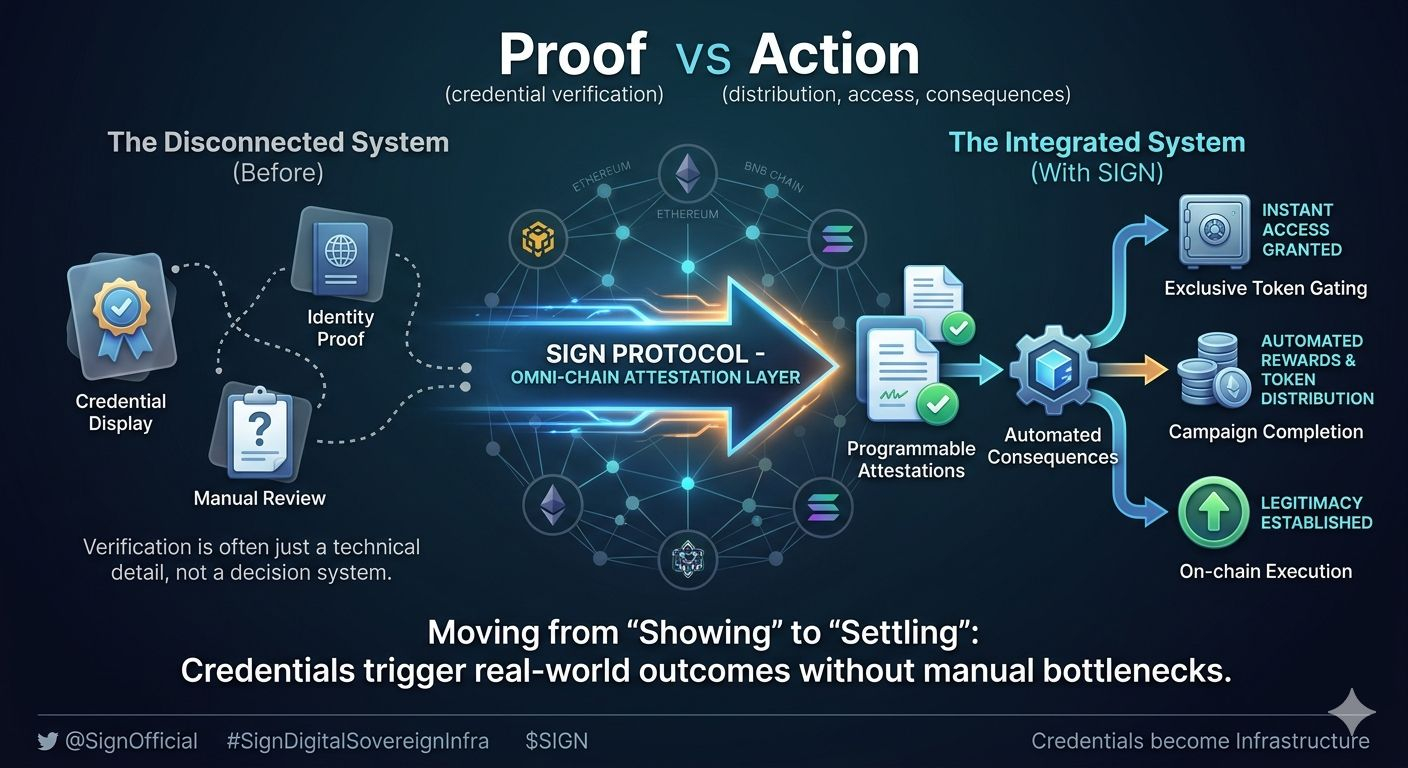
When you participate in crypto campaigns, climb leaderboards, or qualify for airdrops, you quickly realize that a digital credential is never just a static record.
It is a threshold. It decides if you get access. It dictates if you qualify for a reward pool. It determines if you are recognized as a legitimate participant or filtered out as a bot. The "proof" might just look like a small badge or a green checkmark on your screen, but the consequences of that verification are massive. Once you look at it from that angle, credential verification stops feeling like boring tech and reveals itself as the ultimate decision-making engine for token distribution.
This is exactly where the architecture of the SIGN Protocol ($SIGN) steps in to change the game.
The Flaw in Current Reward Systems
The crypto space knows how to display things perfectly. It can show a wallet balance, a leaderboard rank, or a history of swapped tokens. But showing is fundamentally different from settling. The exact moment a record is supposed to trigger a real-world outcome—like dropping tokens into your wallet—the stakes are raised.
You can usually tell when a project's digital system was built for presentation rather than for consequence. It looks incredibly clean until a real decision involving value has to be made. Then, the entire process grinds to a halt. Manual reviews are needed. Airdrops get delayed. Sybil attackers slip through while genuine community members are excluded.
A lot of today’s digital infrastructure is deeply fragmented. Verification sits in one silo, identity lives in another, and the actual token transfers happen somewhere else entirely. You are forced into repeating the same tedious KYC or wallet-signing steps because the platforms around you do not trust each other enough to share verified meaning cleanly.
How SIGN Protocol Bridges the Gap
As an omni-chain attestation protocol, SIGN is not just about creating new types of digital claims. It is about collapsing the distance between cryptographic proof and actual execution.
If a system confirms that you completed a campaign task, earned a specific role, or qualified for a reward, that proof should not degrade into spreadsheets or manual team reviews the moment real value is on the line. By utilizing programmable attestations, SIGN allows decentralized systems to trust verified data natively.
Think about token distribution. People often talk about tokenomics as though the most important metric is just the movement of assets. But movement without logic is chaos; distribution carries judgment.
Why did this token move to this specific wallet?
Was the eligibility rule provable on-chain before the value moved?
Can the community verify the logic later?
Verification and distribution belong in the exact same conversation. One establishes what can be trusted; the other dictates what should happen because of that trust. When those two layers are fused together through SIGN's verifiable attestations, you get actual digital sovereignty.
The Invisible Infrastructure of Trust
This is why the quieter, highly technical parts of the protocol matter the most to your portfolio. Cryptographic signatures, omni-chain attestations, immutable timestamps, and standardized schemas allow a smart contract on one network to instantly read a proof from another. It eliminates the human translator in the middle.
Good infrastructure does not just verify facts—it completely changes how often you have to negotiate those facts. It transforms the user experience from waiting and uncertainty into smooth passage and guaranteed execution.
The primary strain in Web3 is no longer generating proof; it is making that proof matter without creating a new layer of friction. SIGN is a fundamental attempt to make digital outcomes less fragile, ensuring your claims hold together across different networks, and allowing value to move with undeniable, programmatic justification attached to it.
And that kind of foundational work usually stays quietly in the background, shaping exactly what the rest of the crypto ecosystem is eventually able to trust.
What are your thoughts on how verifiable credentials will change future airdrops and campaigns? Drop your thoughts below! 👇
@SignOfficial #SignDigitalSovereignInfra $SIGN