Picture this: just minutes after a Binance Alpha snapshot window closes, you find yourself diving much deeper than intended. You open the charts to glance at major assets like $BTC and $ETH , and they are unusually quiet. But that kind of stillness usually pulls you into looking for structural movements underneath the surface. When you start tracing the on-chain flows tied to @SignOfficial , what starts as a routine check quickly turns into a fascinating field observation of digital infrastructure.
When you look closely at the repeating contract patterns, you do not see loud, speculative retail chaos. You see precision. Transactions are grouped, attestations execute in tight sequences, and gas usage slightly elevates during those bursts, especially on Layer 2 networks. It feels like sovereign infrastructure quietly being stress-tested under real-world conditions. That is the exact moment you stop viewing it as just another token and start seeing it as an attempt to redefine what blockchains actually record.
The Technical Vacuum: Flawless Execution
Imagine running a simple selective disclosure flow through their system, like using their EthSign product. The idea is brilliant: you prove a specific qualification without exposing the entire identity behind it. And within that digital sandbox, the system works flawlessly. The zero-knowledge (ZK) proof verifies instantly—no data leakage, no redundancy, exactly as designed.
In that controlled environment, the proof is accepted without question. There is no friction, no external authority pushing back, and no ambiguity. And the numbers back up this technical elegance: the protocol has already processed over 6 million attestations and handled more than $4 billion in distributions.
You begin to realize how Sign Protocol reframes the blockchain itself. It is no longer just a ledger recording that a transaction happened; it is an evidence layer standardizing why it happened. Instead of raw data logs, it creates structured, verifiable intent. This solves one of the biggest barriers to institutional adoption—privacy—by reducing unnecessary data exposure while maintaining absolute verifiability.
The Geopolitical Collision
But then you step outside the simulation. In the real world, a proof does not exist in isolation. It collides with systems built not on mathematical truth, but on jurisdiction, policy, and power.
The economic promise of efficient attestations and cross-chain compatibility depends entirely on whether those attestations are actually recognized. And that recognition does not come from smart contracts; it comes from institutions. The technical layer produces the truth, and the economic layer scales it, but the governance layer determines if that truth is accepted at all. Governments do not inherently trust decentralized validators. They rely on enforceable legal frameworks and entities they can hold accountable.
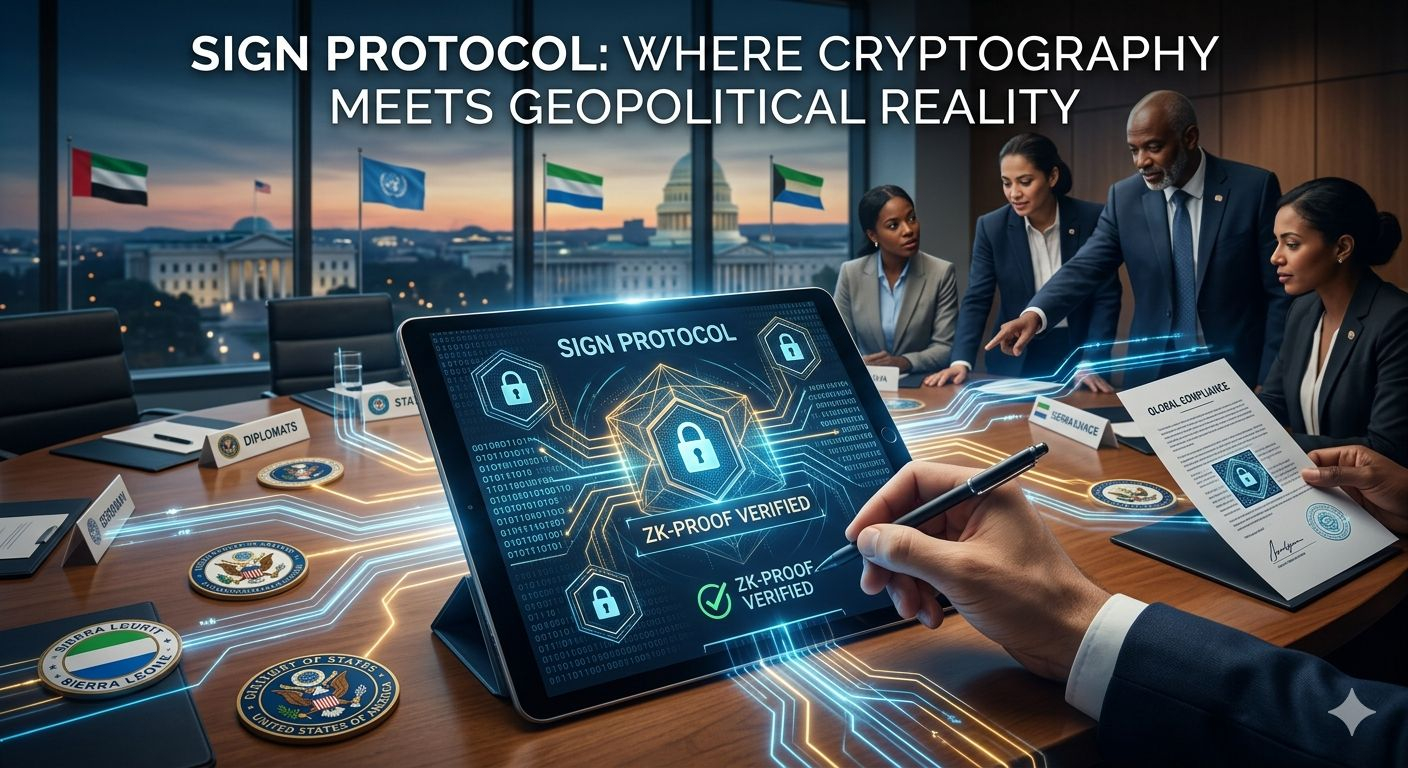
Look at regions pushing aggressively into digital identity and cross-border infrastructure. Real governments, like the UAE and Sierra Leone, are already integrating this technology. On paper, Sign Protocol is the ideal toolkit for these sovereign digital systems. But the underlying tension is impossible to ignore: these nation-states do not just need efficiency; they demand control.
Control does not naturally align with permissionless verification. Even if a ZK circuit validates a document perfectly, that validation relies on a sovereign authority choosing to honor it. If they refuse, the proof becomes technically perfect but practically useless. Heavyweight backing like CZ’s $16M investment proves the massive institutional interest in solving this, but the bridge between code and law remains precarious.
The Economic Reality and the Ultimate Question
When you compare this to networks like Fetch.ai or Bittensor, the distinction is clear. Those protocols optimize how machines coordinate and compute. Sign Protocol is attempting something much more complex: standardizing human trust and the reasons behind our agreements.
But you cannot ignore the market realities attached to this grand vision. Out of a 10 billion total supply, only 1.2 billion $SIGN tokens are circulating. This creates a massive gap between the protocol's architectural brilliance and the economic risk of heavy future inflation for token holders.
The architecture is undeniably impressive, but it does not dissolve the realities of power. A transaction can execute flawlessly on-chain while the real-world outcome remains blocked by politics. That gap between verification and recognition is where this entire model will be tested.
It leaves you sitting with a profound question that extends far beyond the protocol itself: If systems like Sign succeed in turning human trust into something cryptographically provable, who ultimately decides which proofs matter? And what does that mean for the people building on top of networks when they do not control the frameworks validating their truth?