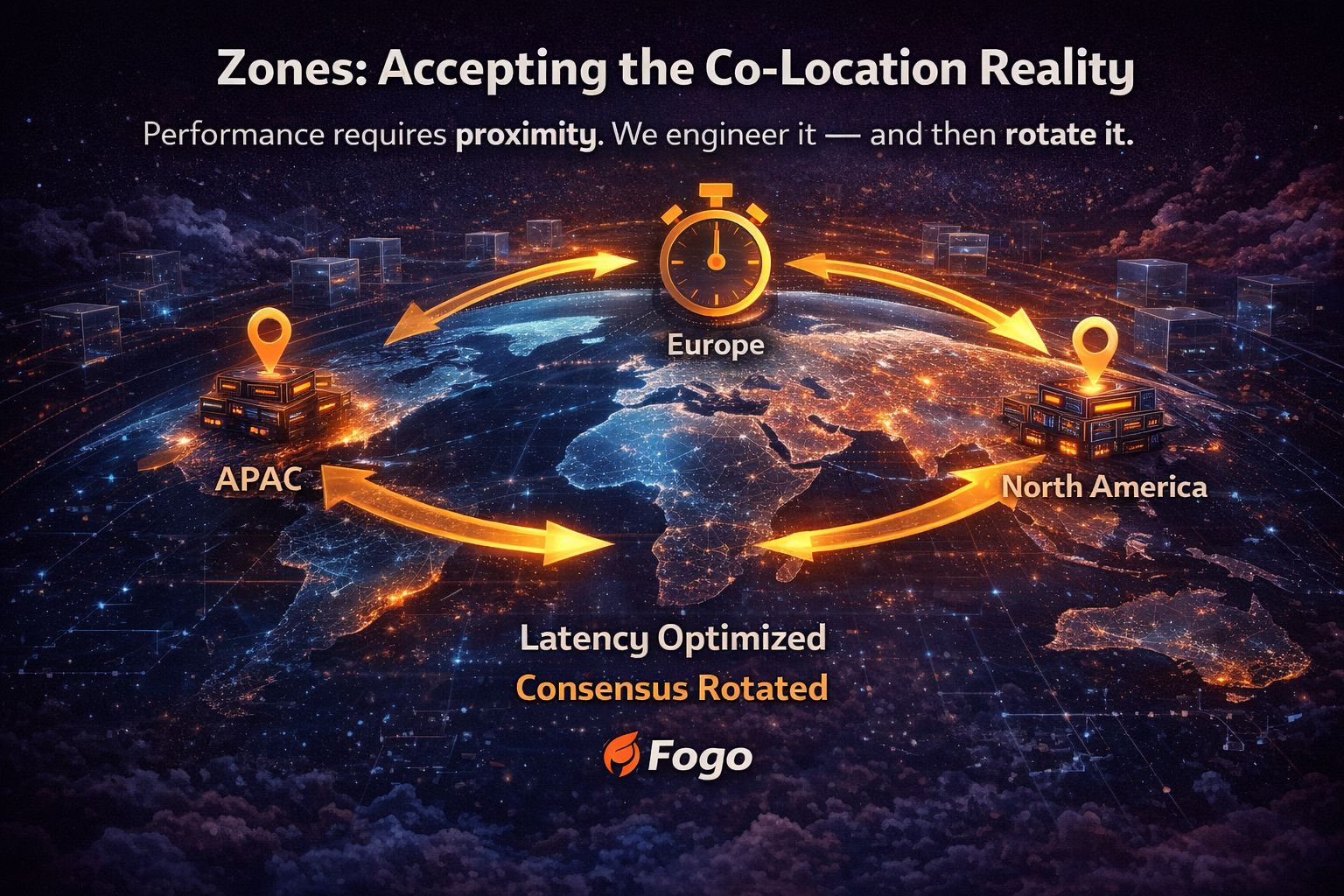
The first time I heard about Fogo, the conversation sounded familiar. Speed. Throughput. Low latency. The usual vocabulary of high-performance chains. I have watched this cycle long enough to know that performance claims are easy to market and difficult to operationalize. Fast chains are simple to describe and extraordinarily complex to run.
What interested me about Fogo was not the headline metrics. It was a different question:
What happens when nobody is watching?
Not during a demo. Not during a carefully staged benchmark. I mean during ordinary operations — when leadership rotates, when validators are under load, when RPC endpoints are stressed, when geography shifts, when real trading volume appears.
From that perspective, Fogo does not look like a typical crypto project. It looks like a real-time systems experiment that happens to use a blockchain as its coordination layer.
My thesis is simple: Fogo is not only building speed. It is attempting to engineer time discipline.
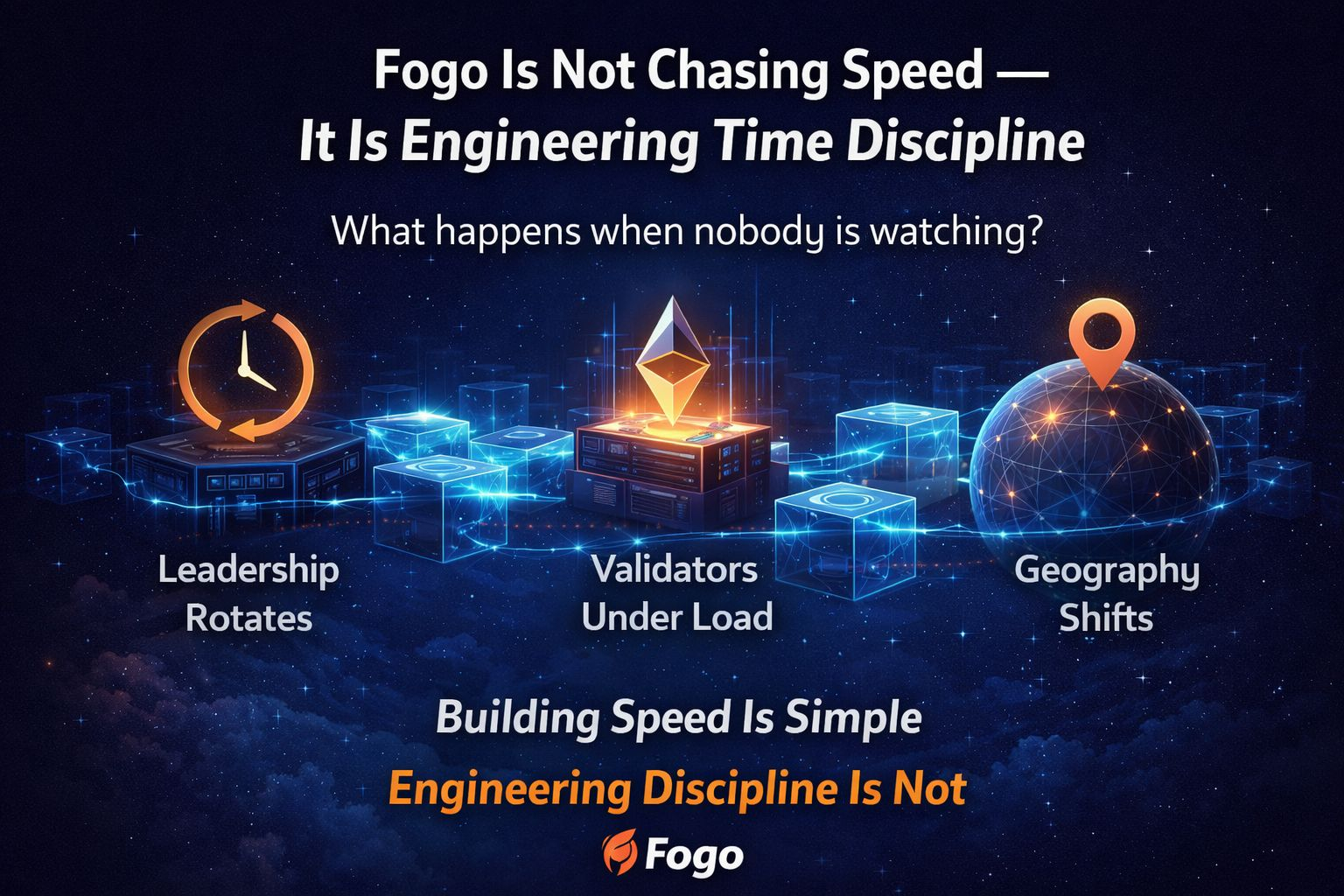
The Real Cost in Trading Is Not Slowness — It Is Unpredictability
In trading infrastructure, a slightly slower system is rarely catastrophic. An unpredictable system is.
The expensive failures are timing inconsistencies, intermittent stalls, degraded behavior under stress, and execution paths that behave differently in production than in test environments. Institutions do not optimize for “maximum theoretical TPS.” They optimize for determinism.
Fogo’s design choices reflect that distinction.
The documentation outlines clear timing parameters: approximately 40-millisecond block targets and structured leader rotations where a block leader produces blocks for a defined window before relinquishing control. This is not merely a throughput boast. It is a scheduling philosophy.
It signals something more serious:
“We want timing that you can plan around.”
That framing matters. Performance without schedule discipline is volatility. Performance with schedule discipline becomes infrastructure.
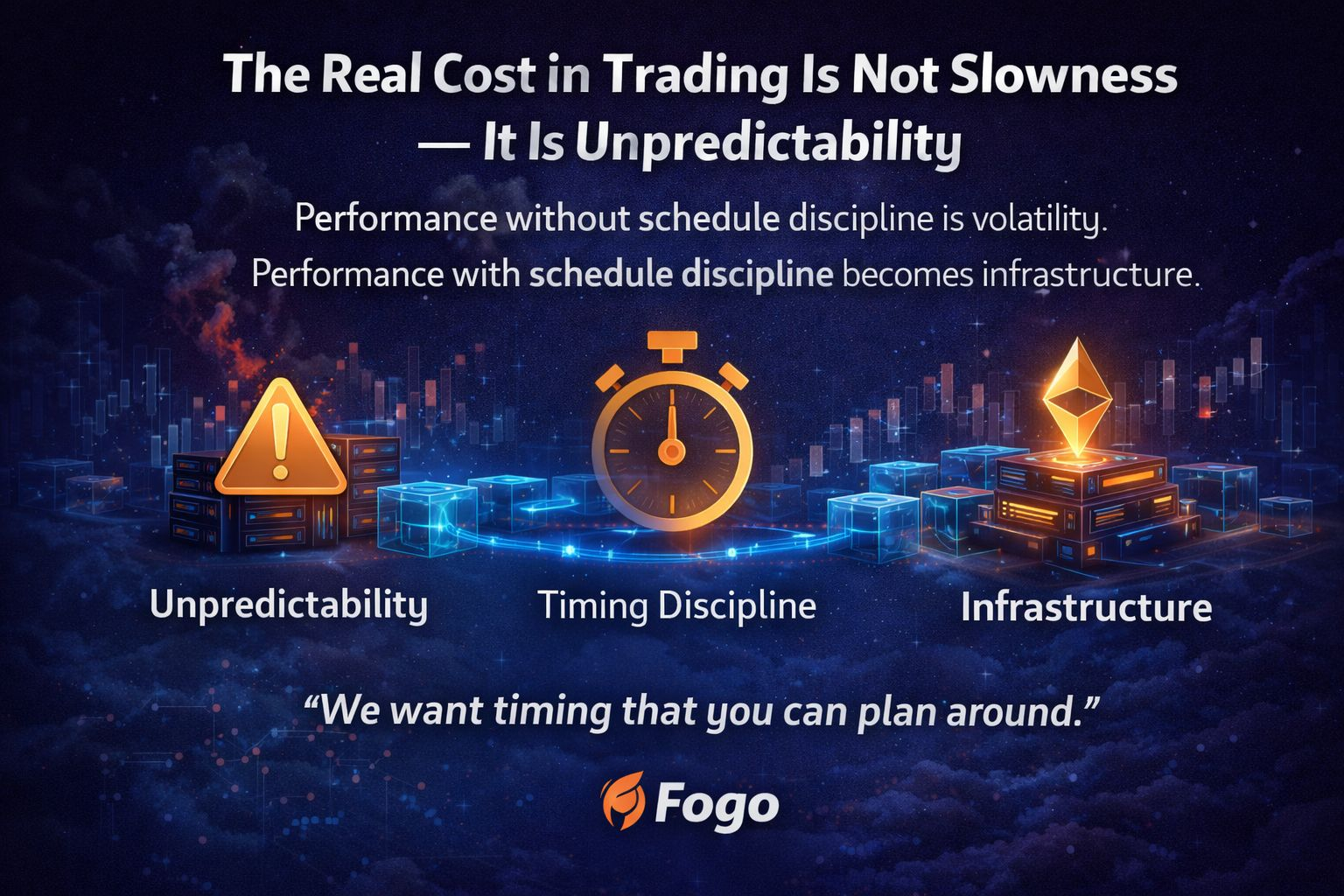
Zones: Accepting the Co-Location Reality
Traditional finance has an unspoken rule: co-location wins. The closer your infrastructure is to the matching engine, the tighter your latency envelope. That reality has shaped exchange architecture for decades.
Most blockchains, by contrast, begin with an ideological commitment to global dispersion and later attempt to patch performance gaps.
Fogo takes a different route. It openly embraces a zone-based architecture — validators clustered within defined geographic spans to minimize consensus latency. These zones are not theoretical abstractions; they are operational groupings designed for predictable performance.
Even more interesting is the rotation mechanism. Consensus does not permanently reside in one geography. Epochs shift the active zone across regions such as APAC, Europe, and North America.
This is not centralization by accident. It is trade-off management by design.
Fogo appears to be saying: performance-sensitive markets require proximity. We will engineer that proximity — and then rotate it.
That is a very different philosophical starting point.
Epoch Rotation as Operational Rhythm
In test configurations, epochs span roughly 90,000 blocks — around one hour. Each epoch transition relocates the consensus zone.
An hour is not arbitrary. It is long enough to observe stability metrics, monitor performance characteristics, and stress test behavior under live conditions. Yet it is short enough to prevent geographic entrenchment.
This creates what I would call an operational rhythm.
The network is effectively rehearsing geographic shifts on schedule. It is training itself to move consensus, re-stabilize, and continue execution without chaos. That behavior mirrors disaster recovery drills in institutional infrastructure.
Crypto networks often treat uptime as an aspiration. Fogo appears to treat geographic transition as a routine.
That difference may not trend on social feeds. But institutions notice it.
RPC Reliability: The Unromantic Foundation
Consensus speed is visible. RPC reliability is not. Yet developers experience the network primarily through endpoints, not validator gossip protocols.
A chain can be theoretically fast and practically unusable if its RPC layer is unreliable.
One of the more understated signals in the ecosystem has been multi-region RPC deployment during testnet phases. Independent infrastructure contributors have operated redundant RPC nodes across regions, explicitly separated from validator consensus roles.
That separation matters.
It reflects production thinking: redundancy, accessibility, and developer experience are first-class concerns, not afterthoughts. Real systems are measured by request success rates and response consistency, not only by block times.
Operational maturity reveals itself in boring places.
Validator Discipline and Staking as Enforcement Mechanism
Zone-based consensus and deterministic leader rotation only function if validator behavior is professional.
This is where staking design intersects with operations. Validators must stake to participate and are incentivized to maintain uptime and performance standards. Delegation mechanics align broader token holders with validator reliability.
In a tightly scheduled network, misbehavior is not abstract. It disrupts a defined time window. Penalty mechanisms therefore become enforcement tools for discipline, not merely token economics features.
The token’s framing as a utility asset for gas and network interaction — rather than speculative narrative — reinforces that the primary design lens is functional access to a system.
Whether or not one focuses on regulatory classifications, the structural takeaway is clear: Fogo is positioning itself as infrastructure first, narrative second.
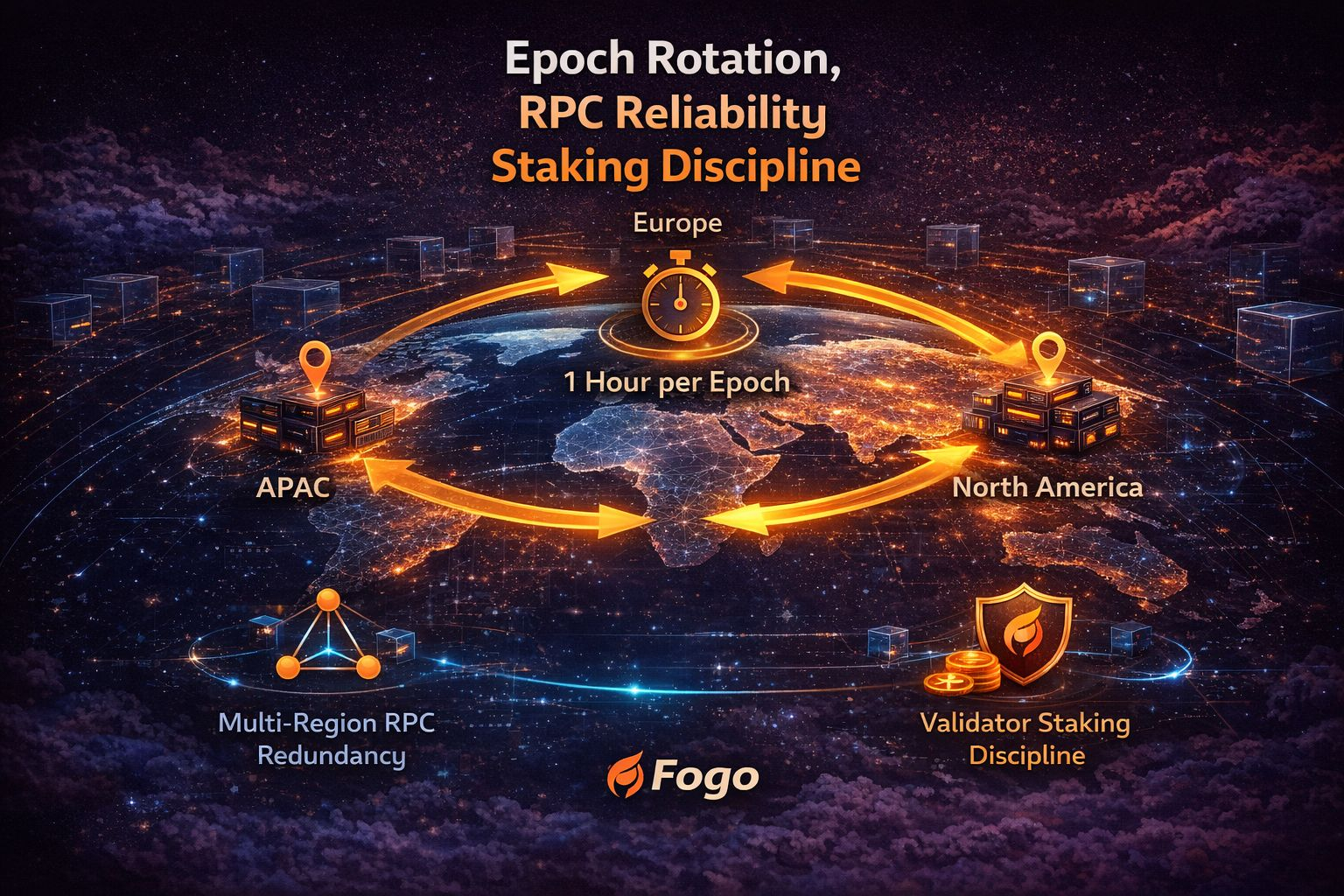
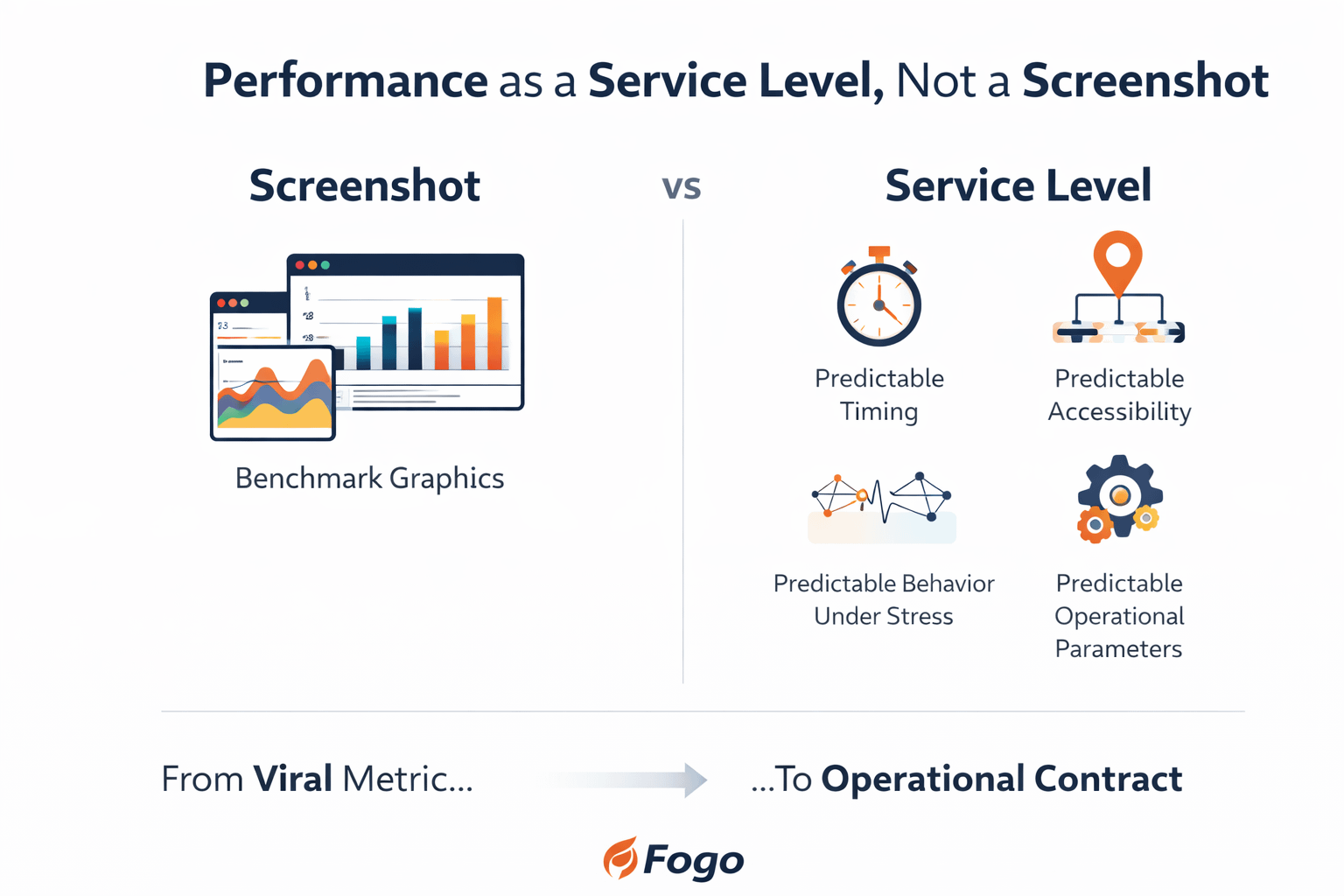
Performance as a Service Level, Not a Screenshot
Most chains market performance through benchmark graphics. Real infrastructure markets performance through service levels.
Service levels imply:
Predictable timing
Predictable accessibility
Predictable behavior under stress
Predictable operational parameters
Fogo’s documentation reads less like advertising and more like an engineering checklist. It exposes timing targets, leadership windows, and structural trade-offs. That transparency is itself a signal. Systems meant to be measured tend to publish measurable parameters.
The deeper ambition seems to be converting blockchain performance from “viral metric” to “operational contract.”
If a network can maintain consistent execution across zone transitions, validator rotations, and developer load, it graduates from being fast to being reliable. If it cannot, then speed becomes cosmetic.
The Shift From Narrative to System
The most interesting aspect of Fogo is not its latency target. It is the mindset shift.
Instead of asking, “How fast can we appear?”
It appears to be asking, “How predictably can we operate?”
Zone clustering acknowledges physical constraints.
Epoch rotation acknowledges geopolitical fairness.
Staking acknowledges behavioral enforcement.
Multi-region RPC acknowledges developer dependency.
Individually, none of these components are revolutionary. Together, they form a coherent thesis: performance markets require discipline, not spectacle.
My Assessment
Fogo’s bet is not that traders want another fast chain. It is that real-time markets demand operational honesty.
If the network succeeds, it will not be remembered merely for low latency. It will be recognized for treating blockchain performance as something that must be run, rotated, monitored, penalized, and stress-tested — repeatedly.
In other words, as a system.
Speed attracts attention.
Discipline sustains infrastructure.
If Fogo can convert its architectural philosophy into consistent execution under pressure, it will have achieved something rarer than raw throughput: it will have engineered predictability.
And in trading systems, predictability is the ultimate performance metric.